
PART 2
The referee’s hand came down between us, and just like that, twenty-three wins and zero losses became twenty-three wins and one defeat.
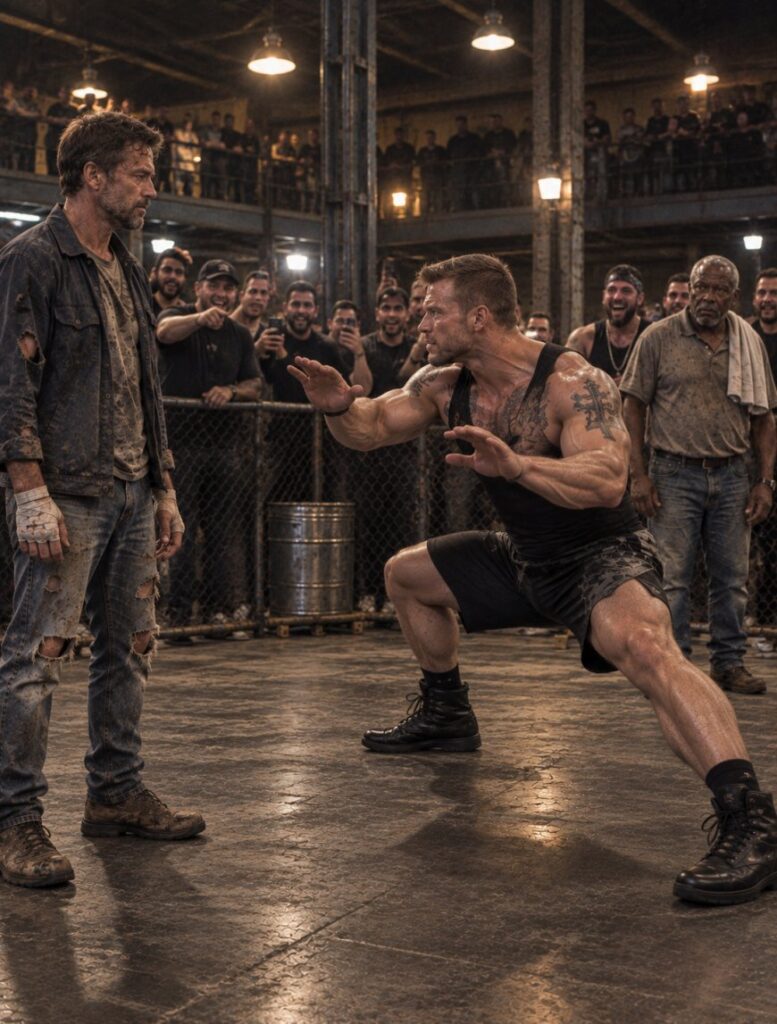
Wade Harlland lay flat on his back, staring up at the rusted rafters of that abandoned railway depot. His chest heaved. His eyes were open but unfocused, still processing what had just happened.
I stood a few steps away. I didn’t raise my fists. Didn’t celebrate. Didn’t acknowledge the crowd that had spent the entire night laughing at me.
I just walked over and extended my hand.
Wade stared at it for a long moment. Longer than most people would have been comfortable with. Then he reached up, took it, and let me pull him back to his feet.
I leaned in close so only he could hear.
“Not bad,” I said, “for your first day fighting.”
He wiped blood from his lip with the back of his hand. And then — unexpectedly — he laughed. A real laugh. The first one all night that didn’t carry any mockery behind it.
Around us, the depot had gone dead silent. Not the tense silence of a crowd waiting for a rematch. The heavy silence of people realizing they’d just watched something far bigger than the fight they’d paid to see.
Brinn Calder was the first to break it.
She pushed through the crowd, already talking before she reached us. The fight didn’t count, she said. Wade had ignored her strategy. I had concealed my identity. The whole thing had been unfair from the start. She wanted it stricken from the record. She wanted people to forget it had ever happened.
Wade didn’t even let her finish.
“Count it,” he said.
Brinn stopped mid-sentence. “What?”
“I lost.” Wade shrugged one shoulder, still breathing hard. “There’s nothing else to talk about.”
For the first time in his career, Wade Harlland acted like a real champion. More than he ever had after any of his twenty-three wins.
Everett Sloan appeared beside me then, hand extended. I shook it. His grip was firm, familiar.
“Twelve years is a long time to stay away from something,” he said.
“Felt longer,” I admitted.
He studied my face for a moment. “You still got it.”
I glanced toward Wade, who was now sitting on a folding chair while Vaughn checked his pupils.
“He made me work for it,” I said.
Wade heard me. I saw it in his expression — a flicker of something between surprise and pride. That one small piece of recognition from me meant more to him than all twenty-three of his previous wins combined. I could see it on his face.
I didn’t stick around much longer after that. I checked on Dustin — the kid Wade had shoved into the beam. His shoulder was sore but nothing was broken. He looked at me differently now. Everyone did. The whispers followed me out the door.
I drove home that night with the radio off. When I got there, my daughter was already asleep. I stood in her doorway for a long time, watching her breathe. Then I went to bed.
The next few weeks were strange.
Footage of the fight spread through the fighting community like wildfire. Not because I’d beaten Wade — but because a former UFC champion who had vanished for over a decade had resurfaced in an underground venue and dismantled the sport’s rising unbeaten star. I got calls from people I hadn’t spoken to in years. Interview requests. Podcast invitations. Offers to return to competition.
I turned them all down.
When one reporter finally tracked me down at my shop and asked point-blank whether I intended to fight professionally again, I told him the truth: that chapter of my life closed a long time ago.
The prize money — the $40,000 Brinn had put on the line — went straight to Colton. It wasn’t enough to solve all of Northline’s problems, but it eased the pressure. Kept the lights on. Kept the doors open.
Colton tried to give me a share. I refused.
“The gym earned it,” I told him. “Long before either of us had anything worth fighting for.”
He argued. I didn’t budge. Eventually he stopped trying.
I thought that was the end of it. I went back to work. Back to oil changes and school pickup and falling asleep on the couch before ten. Back to the life I’d chosen twelve years ago.
Then one afternoon, about six weeks later, a pickup truck pulled into my shop’s parking lot.
I was underneath a sedan, replacing a fuel pump, when I heard the engine cut. Boots crunched on gravel. I slid out from under the car and looked up.
Wade Harlland stood there. Alone. No entourage. No championship gear. No cameras. Just a training bag slung over one shoulder and an expression I hadn’t seen on him before — something close to uncertain.
He looked different. Not physically — he was still the same tall, broad-shouldered fighter who’d tried to knock my head off. But the arrogance was gone. The sneer. The need to dominate every room he walked into.
“You’re lost,” I said.
“Probably,” he admitted.
Neither of us said anything for a moment. A car passed on the road behind him. Somewhere inside the shop, a radio played softly.
Then Wade shifted his weight.
“You still train anyone these days?” he asked.
“Sometimes.”
He nodded slowly. Looked down at his bag. Then back at me.
“Would you train me?”
I wiped my hands on a rag. Took my time answering.
“I’m not really in that line of work anymore.”
Wade didn’t argue. Didn’t push. Didn’t try to convince me. He just set his bag down on the ground and looked me in the eye.
“Start,” he said.
One word. No demand behind it. No entitlement. Just a request from a man who had finally understood something he’d spent his whole career missing.