The room had been making a low, murmuring noise before the round started. The moment I settled into my stance, it went entirely quiet.
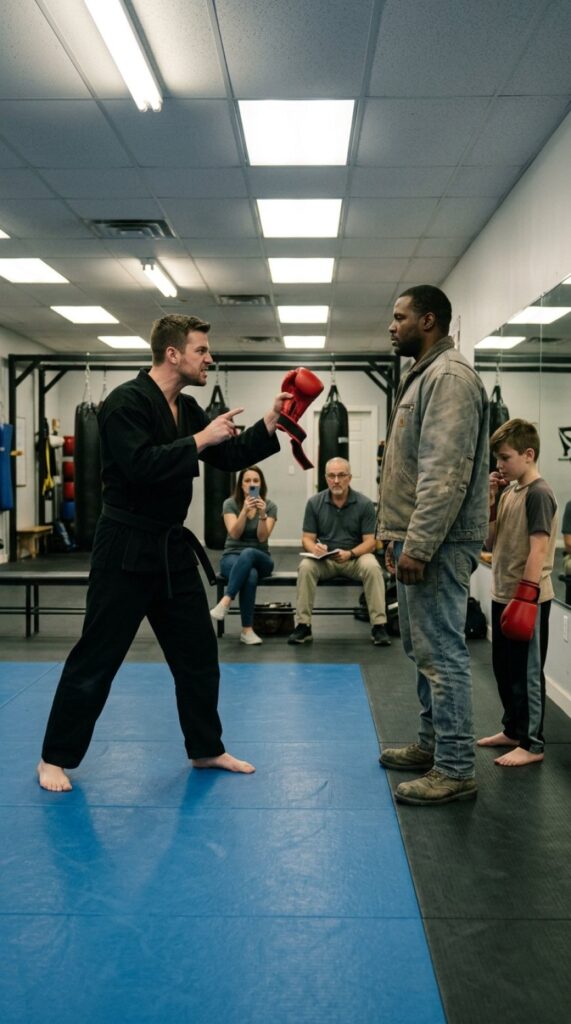
I didn’t raise my hands into a rigid guard. I left them loose, my weight perfectly balanced, my center of gravity entirely under my own control. In the corner of my eye, I saw Raymond Sto—a 57-year-old former competitive referee who had come as a guest of the gym owner—lower his notebook. He was staring at my stance. He was staring at my ears. He knew exactly what he was looking at.
Raymond stepped to the edge of the mat, raised his hand, and brought it down to start the ten seconds.
Travis came in fast. It was exactly what I expected. His first combination was a textbook jab, cross, low kick sequence. He had used it to open every sparring round I had watched him run over the past six months. It was a sound sequence, properly timed, well disguised. Against 99 percent of the fathers who walked into this suburban gym, it would have been enough to establish complete dominance in the first three seconds.
He threw it with the aggressive confidence of a man who had never faced anything he couldn’t bully.
I just moved offline.
It wasn’t a dramatic dive. I didn’t backpedal or scramble. I simply took a half-step to the right. The jab sailed over my shoulder. The cross and the kick violently swept through the empty space where I had just been standing. Because he threw with full power, Travis’s momentum carried him slightly past center.
He recovered quickly—he was genuinely skilled—and spun around, expecting to find me retreating. Instead, I was standing a few feet away, in a new position, entirely relaxed.
The silence in the room deepened.
Travis came again. This time he launched a body attack—a feint high, followed by a vicious right hook aimed directly at my midsection. I read the weight shift off his left hip before his shoulder even twitched. I stepped inside the hook’s arc, crowding him, getting so close that his strike completely lost its leverage.
I placed my open hand against his forearm. I didn’t grab him. I didn’t strike him. I just used the contact point to gently redirect his movement, guiding his own violent momentum past my hip. He stumbled forward, ending up facing slightly the wrong direction for his next attack.
From the outside, it looked like nothing. It looked like I had barely moved. But to Raymond, watching from the edge, it was a glaring, undeniable display of absolute control.
Eight seconds had passed. Then nine.
At ten seconds, Raymond raised his hand and called time loudly.
Travis had not landed a single clean strike. I had not thrown one. My breathing had not changed in any way anyone could detect.
Travis looked at Raymond, then at the clock, then at the watching parents. I could see the frantic calculation running behind his eyes—the rapid reframing of a man whose authority had just been publicly dismantled without a single punch being thrown, desperately searching for a way to restore it.
“That doesn’t count,” Travis snapped. “He was supposed to stand and take it.”
Raymond spoke precisely, without raising his voice. “The stated condition was that he would remain standing for ten seconds. He has done so. The condition has been met.”
“Any real fighter knows ten seconds means actual engagement,” Travis argued, his voice rising, grabbing for a slur because better words were failing him.
“The agreement stands,” I said softly to the room.
Something snapped in Travis. The performative confidence vanished, replaced by the raw, uncontrolled panic of a bully who had run out of tools. He stepped forward to within arm’s reach, his face red, and violently shoved me in the chest with both hands. It was hard enough to push me back a half-step, sending a sharp, cracking pain through my ribcage.
Raymond was on the mat immediately, placing himself between us. “Contact after the signal is a strict violation,” Raymond announced, projecting his voice with the authority of twenty years in the cage. “The round is concluded. The terms are binding.”
Travis turned his rage on Raymond, shouting that a guest referee had no authority in his building. Raymond simply opened his notebook, wrote something down, and ignored him.
The next ten minutes were chaotic. Travis began working the room, speaking in low voices to parents, trying to convert the reality they had just witnessed into his preferred version of events. I walked over to the bench. Micah was sitting there holding the red gloves I had taken out of my bag before the round started. He looked at me with an expression I recognized from the mirror in the months after his mother died—a kid trying to figure out if he was angry or sad, and realizing they were the same thing.
“Did you know you could do that?” Micah asked quietly.
“Yes,” I said.
“Why didn’t you do it when he was yelling at me before?”
I sat down next to him. “Because the goal wasn’t to beat Travis. It was to make Travis stop.”
Before we left, Travis called the room to attention. He announced that the “unauthorized exhibition” had no bearing on anything, and that Micah’s membership was being placed under administrative review pending an assessment of his “skill level” and his father’s behavior.
I didn’t argue. I just drove my son home.
The pain in my chest didn’t subside. After Micah went to sleep, I drove myself to urgent care. X-rays confirmed a hairline fracture in one rib from Travis’s post-bell shove. The doctor’s orders were absolute: no lifting over twenty pounds, no activity placing stress on the torso.
My entire job as an elevator mechanic consisted of placing stress on my torso.