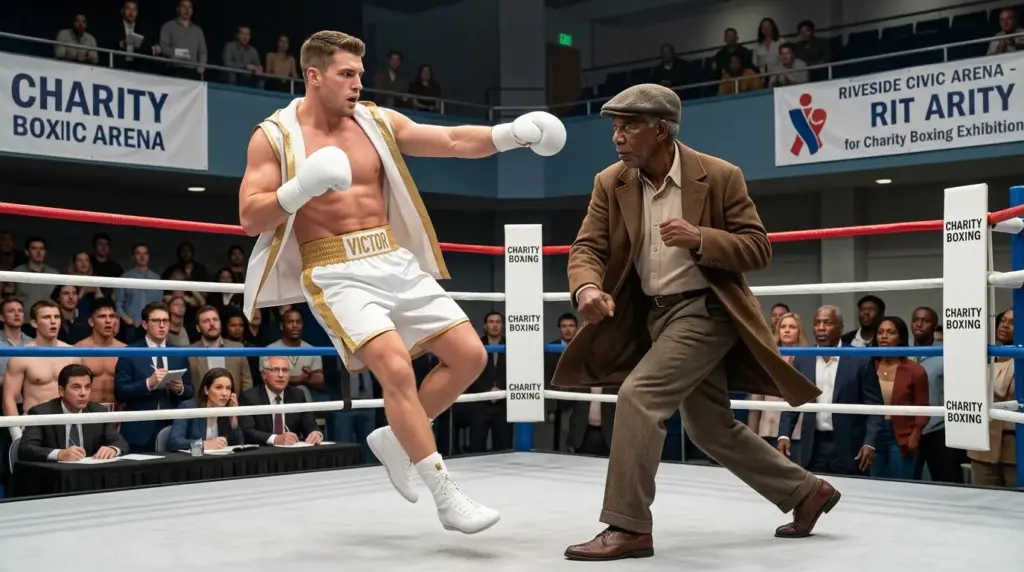
Nine seconds to survive.
Nine seconds to prove he was not wasting everyone’s time.
Nine seconds before the crowd would laugh him out of the ring and the cameras would turn him into a joke that would live forever online.
That was what Victor Kane promised with a grin as he bounced on his toes beneath the white lights of the Riverside Civic Arena.
Nine seconds.
The old man needed only three.
But no one knew that yet.
Not the thousands of people packed into the arena seats.
Not the sports reporters leaning over press tables.
Not the young fighters standing near the ropes, already laughing into their gloves.
Not even Victor Kane himself, undefeated heavyweight champion, Olympic gold medalist, and the most feared knockout artist in American boxing.
Victor had built his name on speed and cruelty.
He was six foot three, two hundred and twenty pounds of polished muscle and perfect timing, with a jawline made for posters and eyes that seemed to enjoy watching men realize they were beaten before they hit the floor.
His fans called him “The Hammer.”
His critics called him arrogant.
Victor called himself honest.
“I don’t disrespect weak men,” he once said in an interview. “I just tell them the truth before physics does.”
That line went viral.
So did the knockouts.
Thirty-one professional fights.
Thirty-one wins.
Twenty-eight by knockout.
The kind of record that made promoters rich and opponents quiet.
That night at Riverside, Victor was not scheduled for a real fight. The event was supposed to be a charity exhibition for a youth boxing foundation. A little entertainment. A little fundraising. A little public relations after Victor had been caught on video shoving a sparring partner who could no longer defend himself.
His manager called the charity event “image repair.”
Victor called it “babysitting.”
He had arrived late, wearing sunglasses indoors, a diamond watch, and a bored expression.
The first part of the evening went smoothly.
Children from local gyms demonstrated footwork drills.
Former fighters told stories about discipline and second chances.
A middle school choir sang the national anthem slightly off-key but with enough heart to make the adults smile.
Then Victor stepped into the ring for what was supposed to be a light exhibition with volunteers from the audience.
Nobody expected anything serious.
The plan was simple.
Victor would let a few donors throw soft punches at him.
He would laugh.
Slip.
Tap their gloves.
Let a kid land a harmless body shot.
Smile for photos.
Raise money.
Go home.
But Victor Kane had never understood the difference between being watched and being needed.
The first volunteer was a school principal, forty-eight years old, nervous and smiling. Victor slipped his punches, made faces at the crowd, and tapped him once in the stomach hard enough to make the man fold while everyone laughed.
The second was a young firefighter, strong but untrained. Victor let him swing twice, then touched his forehead with a jab so fast the firefighter stumbled backward.
“Come on,” Victor said into the microphone clipped near the ring. “I thought Riverside had tough people.”
The crowd laughed, but some of the laughter had gone uneasy.
The third volunteer was a teenage amateur from a local gym.
Seventeen years old.
Nervous.
Thin.
Proud because his little brother was watching from the front row.
Victor was supposed to encourage him.
Instead, he embarrassed him.
He slipped the boy’s jab, tapped him on the ear, spun away, then dropped his hands and smiled.
“Too slow,” he said.
The boy flushed.
He tried again.
Victor caught him with a light left hook.
Light by Victor’s standards.
Hard enough to knock the teenager down.
The arena gasped.
The boy sat on the canvas, blinking in humiliation and pain.
His little brother began crying.
Victor raised both hands.
“He’s fine,” he said. “This is boxing, not piano class.”
That was when the old man stood.
He had been sitting in the third row beside the aisle, wearing a brown wool coat, a flat cap, and shoes polished so carefully they seemed out of place beneath the tired cuffs of his trousers.
His name was Samuel Boone.
Seventy-two years old.
Five foot nine.
Thin, but not fragile.
Quiet, but not weak.
Most people in Riverside knew him only as Mr. Boone, the man who swept the floors at the Eastside Boxing Club and sat in the corner during training sessions with a thermos of black coffee.
The children loved him because he kept peppermint candy in his coat pocket.
The trainers appreciated him because he fixed loose speed bags, tightened ropes, replaced torn tape, and remembered everyone’s names.
The young fighters mostly ignored him.
To them, he was an old janitor with a limp, a raspy voice, and a habit of watching footwork like it was a language only he understood.
Samuel stepped into the aisle as the teenage boy was helped from the ring.
His face was calm.
His eyes were not.
He looked at Victor Kane and said, loud enough for the first few rows to hear, “You didn’t need to do that.”
Victor turned slowly.
The arena quieted.
At first, he thought the voice belonged to a trainer.
Then he saw the old man in the brown coat.
Victor smiled.
That smile had ruined many men before punches ever did.
“Excuse me?”
Samuel moved closer to the ring.
“I said you didn’t need to do that. That boy came here to learn, not to be humiliated.”
Victor leaned on the top rope.
“What’s your name, old-timer?”
“Samuel Boone.”
Victor looked toward the crowd.
“Anybody know Samuel Boone?”
A few scattered voices murmured.
One young fighter shouted, “He cleans Eastside Gym.”
Victor’s grin widened.
“He cleans the gym.”
Laughter moved through the arena.
Samuel did not look away.
Victor tapped the microphone.
“All right, Mr. Boone. You got advice for me?”
“I do.”
The crowd hushed again.
Victor raised an eyebrow.





