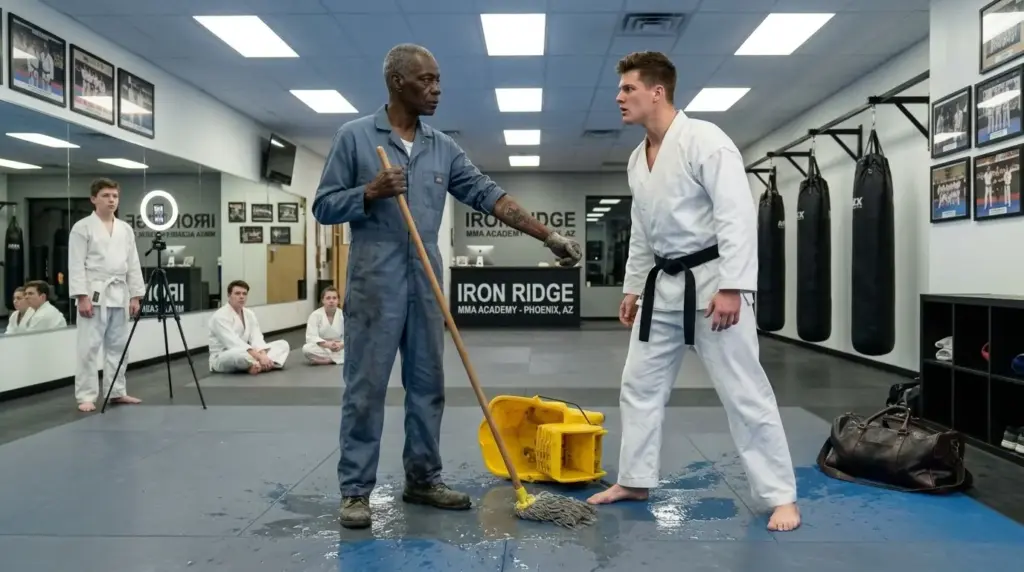
There is a specific sound a mop makes when the water is dirty.
A wet, heavy slop against cheap linoleum.
Most people tune it out.
They ignore the tired man pushing the handle across the floor. They ignore the stiff knees, the faded coveralls, the calloused hands, and the old eyes that have already seen more than anyone in the room could imagine.
That is a mistake.
Because sometimes the man cleaning up the blood is the exact person who knows how to spill it.
The air inside Apex Martial Arts smelled of old sweat, aerosol deodorant, and unearned confidence.
It was a successful dojo, the kind that catered to suburban families on weekdays and aggressive young men on weekends. Ceiling-to-floor mirrors lined the walls, ensuring that no one could throw a punch without admiring his own reflection.
In the center of the tatami mats stood Trent.
Trent was twenty-two years old, built like a Greek statue, and carried a first-degree black belt around his waist with the gravity of a medieval king wearing a crown. He was the gym’s prized fighter, a local point-karate champion who had never been in a real fight in his life, though he would loudly tell anyone who listened that his hands were registered weapons.
“Again,” Trent barked.
His voice echoed off the high corrugated metal ceiling.
Across from him, a nervous teenager named Liam was picking himself up off the mat. Liam’s chest heaved. A red welt was blooming along his jaw where Trent had caught him with a spinning hook kick.
It was supposed to be light sparring.
Trent did not do light sparring.
For Trent, every round was another opportunity to remind the room that he was the apex predator.
“You’re dropping your left hand, Liam,” Trent said, barely breathing hard. He rolled his shoulders, the crisp white cotton of his gi snapping with the movement. “In a real street encounter, if you drop that hand, you’re dead. I’m doing you a favor by punishing you for it.”
Liam nodded quickly, blinking back tears.
“Right. Sorry, Trent.”
“Don’t apologize to me,” Trent said, delivering the line like he had invented it, though he had stolen it from a movie the night before. “Apologize to yourself.”
He glanced toward the front desk.
Sensei Reed, the head instructor, was sitting there counting the register. Reed looked up and gave Trent a thumbs-up.
Trent brought in new memberships.
Trent brought in tournament trophies that looked good in the glass case by the door.
So Reed tolerated the bullying, because the bullying was profitable.
At the edge of the mats, far from the mirrors and praise, stood Arthur.
Arthur was the janitor.
He was sixty-eight years old, wore faded blue Dickies coveralls, and moved with a grinding limp in his left knee. His hair was harsh steel gray, cropped close to the scalp in a way that suggested a lifetime of habit rather than style. His hands were heavily calloused, the knuckles thick and knobby with arthritis.
Arthur watched the sparring match with the blank, uninterested expression of a man watching a microwave countdown.
He did not gasp when Trent landed a hard blow.
He did not nod at the technique.
He simply leaned against his broom, waiting for the boys to finish so he could sweep up the clumps of athletic tape, loose threads, dust, and stray hair they always left behind.
Trent dismissed Liam with a wave of his hand, then untied his black belt and draped it over his neck like a towel.
He walked toward the water fountain, peeling the white athletic tape from his wrists in sweaty, wrinkled strips. Instead of walking the extra four feet to the trash can, he dropped the tape directly onto the hardwood floor, right on a section Arthur had just swept into a neat pile.
Arthur looked at the tape.
Then he looked at Trent.
“Oops,” Trent said, flashing a brilliant, empty smile. “Missed the can. You got that, right, Arty?”
Arthur said nothing.
He did not glare.
He did not sigh.
He simply stepped forward, his heavy work boots squeaking softly, and swept the tape into his dustpan.
His silence irritated Trent.
Trent was used to deference. He was used to people shrinking away or snapping back so he could assert dominance. The old man did neither. He treated Trent like weather, a minor inconvenience that could not be reasoned with and would eventually pass.
“You’re welcome for the job security,” Trent muttered, loud enough for his friends near the bags to hear.
A few of them chuckled.
Arthur dumped the dustpan into a black garbage bag. He tied the bag with a knot that was tight, efficient, and complex, pulling it taut with a sharp jerk of his wrists.
Then he hoisted the heavy bag over one shoulder without a grunt.
His face remained an unreadable map of deep lines.
He had been cleaning the gym for two years.
He knew the names of the fighters.
He knew how they moved.
He knew Trent had a habit of telegraphing his right cross by flaring his elbow.
He knew Trent’s balance during high kicks was fundamentally compromised.
He knew half the young men in the room mistook volume for confidence and speed for skill.
But Arthur was not paid to teach.
He was paid fourteen dollars an hour to make sure the place smelled more like bleach than body odor.
So he walked toward the back exit to toss the trash, his bad knee clicking faintly every second step.
Behind him, Trent was already loudly explaining to his friends how he would easily handle a multiple-attacker scenario.
Arthur pushed the heavy metal door open and stepped into the cool, damp night air of the alley. He tossed the bag into the dumpster. The heavy thud echoed in the quiet.
For a moment, he leaned against the brick wall and pulled a small tin from his pocket.





