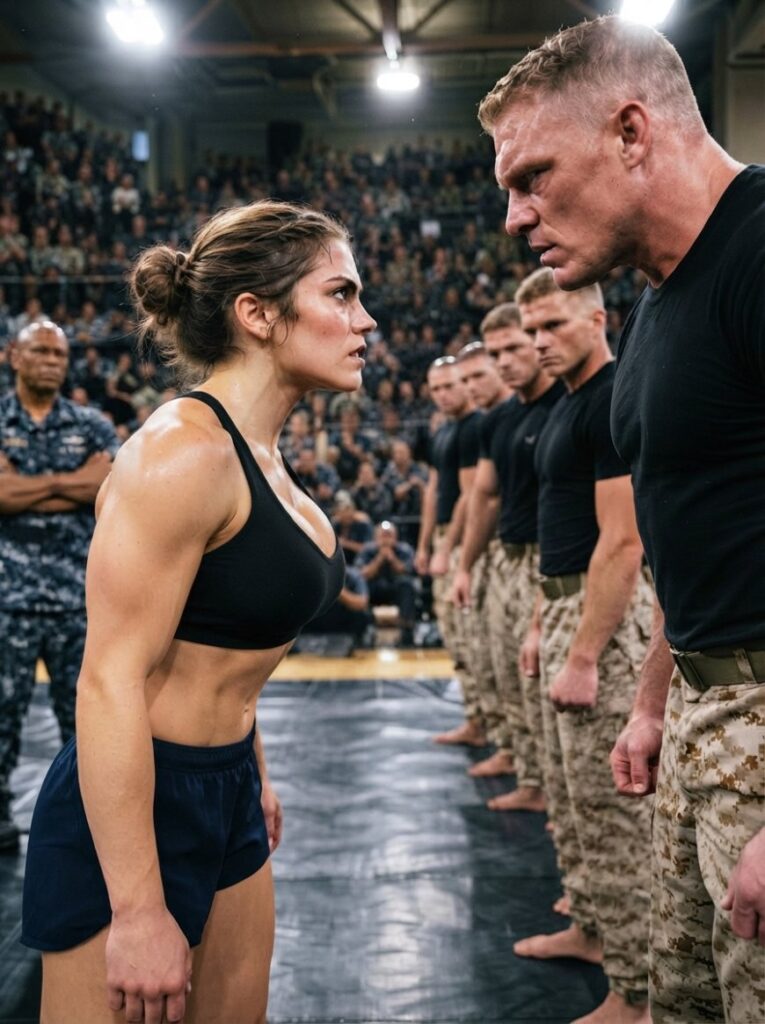
The word hung in the air like a live grenade. “No.” Admiral Vance’s expression didn’t change, but something flickered behind his eyes. Surprise. Maybe respect. Maybe something older and harder to name. “Lieutenant Mitchell, I understand your—” “You don’t understand anything, sir.” The words came out sharp enough to cut glass. Four hundred people inhaled at once. Master Chief Turner took a step toward me. “Abby—” “Don’t.” He stopped. I turned to face the admiral fully, ignoring the fire in my ribs, ignoring the blood still drying on my knuckles, ignoring the way my legs threatened to buckle beneath me. “You show up here with a folder and a story about my father. You dangle classified information in front of four hundred witnesses like it’s a party trick. And then you order me to walk away from the only thing I’ve ever been able to control?” Vance’s jaw tightened. “Lieutenant, there are protocols—” “I know protocols, sir. I’ve spent my entire career following them.” I pointed at Bennett. “That man challenged me. Publicly. In front of my command. He wagered my Trident against an apology because he was certain I couldn’t win.” Bennett’s eyes met mine. Something shifted in his expression. Not quite guilt. Not quite respect. Something caught between the two. “The agreement was made,” I continued. “The terms were accepted. Four of his men have already stepped onto this mat. Two remain.” Vance looked toward Turner. The Master Chief stood frozen, his face unreadable. “Admiral,” Turner said quietly, “the Lieutenant has a point.” The gym erupted. Not cheers. Arguments. Marines shouting at sailors. Officers trying to restore order. Somebody near the back screamed something about wasting everyone’s time. Vance raised one hand. Silence fell like a hammer. “Lieutenant Mitchell.” “Sir.” “You are injured.” “Yes, sir.” “You have fought four consecutive matches against opponents significantly larger than yourself.” “Yes, sir.” “Your judgment may be compromised.” I almost laughed. “Sir, with respect, my judgment has never been clearer.” I touched the frayed black belt around my waist. “My father wore this on every deployment until the day he supposedly died. Master Chief Turner kept it for fifteen years. He gave it to me tonight because he believed I needed to remember something.” I looked at Turner. “Didn’t you, Chief?” His eyes glistened. “Yes.” “What was I supposed to remember?” Turner’s voice cracked. “That you’re his daughter.” The words hit me like a physical blow. I turned back to Vance. “Six men challenged me. I’ve beaten four. I’m not walking away because you showed up with secrets.” I looked at Bennett. “Unless you’re calling it off.” Bennett stared at me for a long moment. Then he did something I didn’t expect. He laughed. Not mockingly. Genuinely. “You’re insane,” he said. “Probably.” He looked at Vance. “Sir, the Lieutenant and I made an agreement. I stand by it.” Vance’s expression hardened. “Staff Sergeant—” “With respect, Admiral, this isn’t about you.” The gym went silent again. Bennett continued. “This is between the Lieutenant and me. And I owe her a chance to finish what I started.” Vance studied him. “You understand what’s at stake?” “I understand that I’ve been wrong about a lot of things.” Bennett looked at me. “And I’d like to stop being wrong.” Something passed between us. Not friendship. Not forgiveness. Just recognition. Vance stepped back. “Very well.” He held up the folder. “But when this is over, Lieutenant, you and I are going to have a conversation. A long one.” “Yes, sir.” He walked to the edge of the mat. Turner followed. The referee looked at me. “Lieutenant, are you able to continue?” I looked at the two remaining Marines. Gunnery Sergeant Knox stood waiting, arms folded. He was 6-foot-3, 220 pounds of quiet violence. Beyond him, Bennett was stripping off his blouse. “Ready when you are,” I said. The bell rang. Knox moved first. He didn’t rush. That was smart. He circled left, cutting off the mat, forcing me toward the edge. I knew his strategy. He’d seen my previous fights. He knew I relied on speed and leverage. He knew I was injured. He was going to use every inch of his size advantage. I feinted right. He didn’t bite. I feinted low. Nothing. He kept coming, slow and steady, a predator who knew his prey was already wounded. Then he struck. His left hand shot out, grabbing my wrist. His right locked behind my shoulder. I tried to rotate, but he changed levels and drove forward. The world flipped. My back hit the mat. Knox’s weight came down on my chest. Two hundred and twenty pounds compressed the air from my lungs. I couldn’t breathe. Couldn’t move. Couldn’t think. He began isolating my right arm, setting up an Americana. If he secured it, I was done. My father’s belt dug into my waist. And suddenly I was thirteen again. Standing in our garage. My father kneeling in front of me. Daniel Mitchell had been a massive man. Six feet, two hundred pounds, hands like shovels. But when he taught me to grapple, he never relied on strength. He would put one finger against my forehead and push until I wanted to scream. Then he’d laugh. “You’re trying to beat my strength,” he’d say. “You’ll lose every time.” “So what do I do?” He tapped my forehead. “Make strength irrelevant.” Knox pulled my arm farther. The memory shattered. I stopped fighting him. Completely. Knox hesitated. Only for half a second. But half a second was enough. I turned toward the pressure instead of away from it. Slid my elbow beneath my body. Trapped his wrist against my chest. Knox reacted instantly, shifting his weight. Exactly what I needed. I bridged hard. Not to throw him. Just to create three inches. Three inches became my entire world. I pulled one knee through. Recovered half guard. Turned sideways. Breathed. Knox tried to flatten me again. I framed against his neck, slipped underneath his arm, and crawled toward his back.





