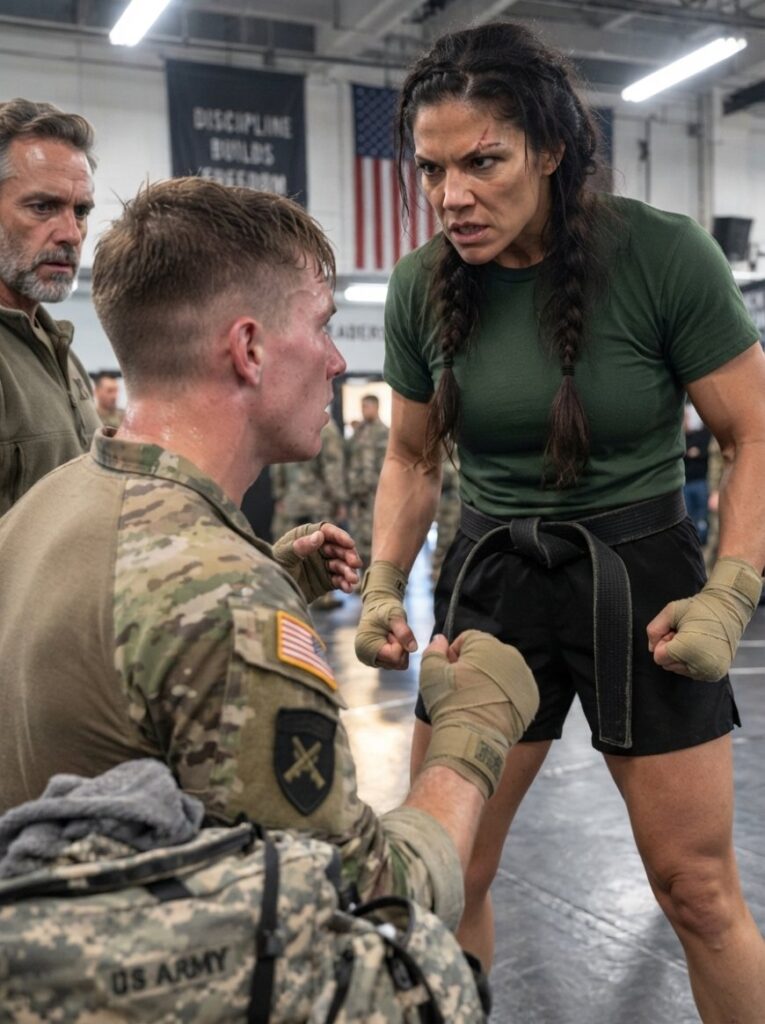
The wrap bit into my knuckles as I pulled it tight. The room stayed silent. I could hear the hum of the overhead lights and the distant thud of boots in the hallway.
No one moved.
Blake—the soldier who had thrown the punch—still had his gloves half raised. His arms looked heavy, like they didn’t belong to him anymore. He stared at me, then at the observer, then back at me.
The observer said nothing. He just waited.
I let the silence stretch. I wanted him to feel it. I wanted all of them to feel it.
The younger soldiers were still standing near the edge of the mat. They looked like they wanted to disappear. One of them took a small step toward the door, then stopped when the observer didn’t move.
“Everybody out,” the observer said again. This time his voice was softer. That made it worse.
They filed out. No jokes. No whispers. Just the sound of boots on concrete and the squeak of the door hinge.
The door clicked shut.
Then it was just the three of us.
Blake didn’t lower his gloves. He didn’t step back. He just stood there, breathing through his mouth.
“You heard him,” I said. “You can go.”
He shook his head. “No.”
“No?”
“I need to know.”
I looked at the observer. He gave me a small nod. Permission. Or maybe warning.
I unwrapped one hand, then the other. The cloth fell away. My knuckles were pale and scarred. I flexed my fingers. They still worked. Mostly.
“You really don’t remember me,” I said.
Blake’s jaw tightened. “I remember a name. From a report. But the face…” He trailed off.
“The face doesn’t match the story,” I said.
“No.”
“That’s because the story was a lie.”
The observer stepped forward. He was older, maybe fifty, with close-cropped gray hair and eyes that had seen too much. He had been watching from the beginning.
He hadn’t laughed. He hadn’t joined the jokes. He had just stood there like a man waiting for a train he knew would be late.
“Sergeant Blake,” he said. “Do you know who I am?”
Blake straightened. “Colonel Hayes, sir.”
“Good. Then you know I don’t waste time.” Hayes looked at me. “Tell him.”
“Tell him what?”
“Everything.”
I didn’t want to. I had spent three years not telling anyone. But Hayes had asked me to come here. He had said it was time.
I had said it was never time. He had said that was the problem.
I walked to the edge of the mat and picked up my water bottle. I took a long drink. The water was warm. I didn’t care.
“Three years ago,” I said, “you were a private. Third Platoon. You were on a convoy outside Kandahar. Do you remember that?”
Blake’s face went white. “How do you know about that?”
“Because I was there.”
He shook his head. “No. That convoy was hit. I was the only survivor from my truck.”
“You weren’t the only survivor.”
“I was told—”
“You were told a lot of things.” I set the bottle down. “Some of them were lies.”
Hayes moved to the wall and leaned against it. He crossed his arms. He didn’t interrupt.
Blake took a step toward me. “Who are you?”
“My name is Carter. Staff Sergeant Carter. Or it was. Before I was medically discharged.”
He stared at me. “Carter. The Carter? The one from the reports?”
“The reports said I died.”
“Yes.”
“I didn’t.”
He looked at Hayes. “Sir, is this a joke?”
Hayes didn’t smile. “Does she look like she’s joking?”
Blake looked back at me. He studied my face. I knew what he was seeing. A woman in her thirties, tired, with a scar along her jaw and eyes that didn’t blink enough.
Not the hero from the stories. Not the ghost from the reports.
“I don’t understand,” he said.
“You were unconscious when I pulled you out of the truck. You had shrapnel in your leg and a head wound. I carried you to the medevac. Then I went back for the others.”
His mouth opened. “You went back?”
“I went back three times. The first two, I got two men out. The third time, the truck blew.”
He flinched.
“I woke up in a hospital in Germany. I had a broken back, a collapsed lung, and a discharge paper with my name on it. The official report said I was KIA. It said Master Sergeant Cole made the call to leave me because I was already dead.”
Blake’s hands dropped to his sides. “Cole? He’s my mentor.”
“I know.”
“He told me he went back for you. He told me he tried.”
“He lied.”
The silence that followed was heavier than the one before. Blake looked at the floor. He looked at his gloves. He looked at the door.
“Why didn’t anyone tell me?” he asked.
“Because you didn’t ask.”
“I didn’t know.”
“That’s the problem.”
He took a shaky breath. “I’m sorry.”
“I know.”
“I didn’t mean to—”
“You called me a joke. You told me to get off your mat. You threw a punch at my face. You didn’t ask who I was. You assumed.”
He nodded slowly. “I did.”
“Yes.”
“I was wrong.”
“Yes.”
He waited for me to say something else. I didn’t. He looked at Hayes. “Sir, why is she here?”
Hayes pushed off the wall. “Because I asked her to be.”
“Why?”
“Because we have a new class of recruits coming in next month. They think like you. They assume. They laugh. They challenge without respect. I wanted them to meet someone who could teach them otherwise.”
Blake’s face tightened. “I’m not a recruit.”
“No. You’re worse. You’re a sergeant who should know better.”
The words hit him like a slap. He didn’t argue.





