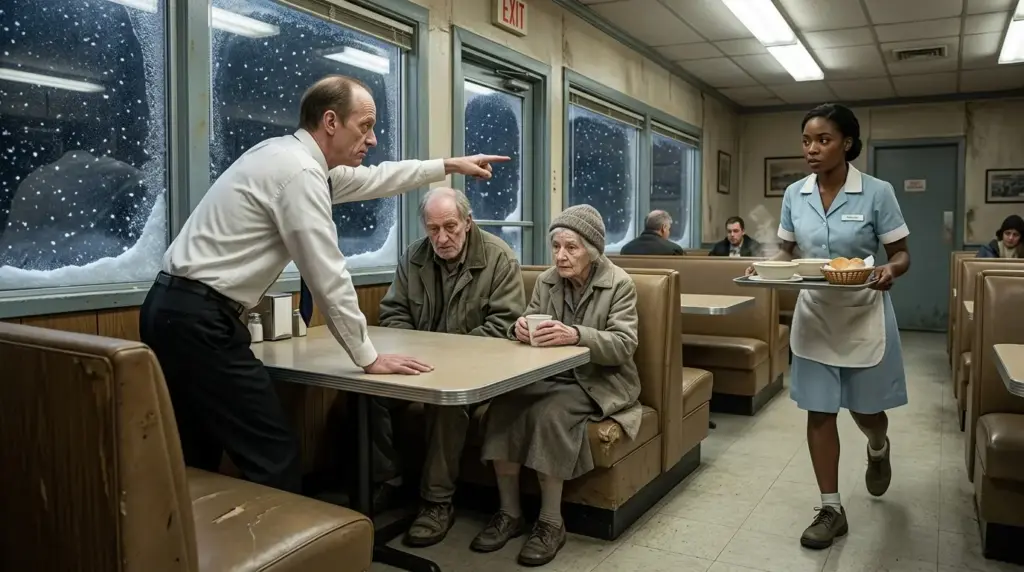
And her one moment of courage was about to become a revolution. The snow had been falling since midafternoon, soft and relentless, blanketing the highway in a silence that felt almost sacred. By 8:00 on Christmas Eve, the world outside the Crossroads Diner looked like a postcard someone had crumpled and smoothed out again. Beautiful, but worn at the edges. Inside, the warmth was modest.
A string of colored lights blinked lazily above the counter, half of them dead. Paper snowflakes cut by someone’s careful hands weeks ago, hung from the ceiling tiles, spinning slowly in the draft from the door. A small plastic tree sat on the hostess stand, decorated with ornaments that had seen better decades. It wasn’t cheerful exactly, but it tried. That counted for something.
Nia Carter moved between tables with the practiced efficiency of someone who had worked too many double shifts to count. At 28, she carried herself with a quiet grace that made people feel seen without demanding anything in return. Her dark eyes were warm but tired, the kind of tired that sleep couldn’t fix. Her uniform, a pale blue dress with a white apron, was clean and pressed, even though she’d been on her feet since 6:00 that morning. She refilled coffee cups and cleared plates, her movements automatic.
In her mind, she was calculating. Rent was due in three days. Her mother’s prescription refill would cost another $140. The electric bills sat unopened in her purse because opening it wouldn’t change the number inside. After her mother’s surgery 6 months ago, the medical bills had swallowed everything Nia had saved.
Every shift now was a battle against mathematics that never worked in her favor. Nia, the voice cut through her thoughts like a blade. Raymond Mitchell, the diner manager, stood behind the counter with his arms crossed. He was a thin man in his 50s with a permanently sour expression. The kind of person who seemed to resent joy on principle.
Business is slow tonight. Real slow. Nia nodded, wiping down a table that didn’t need wiping. Yes, sir. The snow’s keeping people home.
“Snow or not, margins are tight. ” Raymond’s eyes narrowed. Any mistakes tonight come out of your pay. Understood. No freebies, no extras, no feeling generous with company property. The words landed exactly as he intended.
A threat wrapped in policy. Nia kept her face neutral. Understood. Raymond disappeared into the back office, leaving Nia alone with three other customers. A trucker nursing his third cup of coffee, a young couple arguing quietly over their phones, and an older woman reading a paperback novel with the cover torn off.
None of them looked up. None of them needed anything. Nia returned to the counter and began refilling sugar dispensers, a task that didn’t need doing, but gave her hand something to hold. Through the window, she watched the snow fall harder. Each flake catching the glow of the street light before vanishing into the growing drifts.
Somewhere out there, people were warm. Somewhere out there, families were gathering around tables that didn’t wobble, sharing meals that didn’t come from a kitchen that smelled like old grease and broken promises. She thought about her mother asleep in her small apartment across town. The surgery had saved her life, but it had also stolen something. Her strength, her independence, the light in her eyes that used to make even bad days feel bearable.
Now, she spent most days in bed apologizing for being sick, for costing money, for existing in a way that required care. Nia told her every day that none of it was her fault. But guilt doesn’t listen to logic. The bell above the door chimed, pulling Nia from her thoughts. An elderly couple stepped inside, bringing a gust of cold air and snow with them.
The woman was small and frail, her silver hair tucked beneath a knit hat that had seen too many winters. Her coat was thin, the kind you’d find at a thrift store clearance rack, and her gloved hands trembled as she clutched her husband’s arm. The man was tall but stooped, his face weathered in kind. His jacket was too big, hanging loose on his frame, and his shoes were worn smooth at the heels. They stood just inside the doorway, blinking against the warmth, looking uncertain about whether they belonged.
The trucker glanced up, then looked away quickly. The young couple stopped arguing long enough to stare. The older woman with a paperback lowered her book, her expression hardening into something between suspicion and disdain. Looks like we got some vagrants, ” the trucker muttered. Not quite quietly enough.
Nia felt the shift in the room, the way kindness could curdle into judgment in a single breath. She moved toward the couple before anyone else could speak, her smile genuine and warm. “Welcome to Crossroads, ” she said softly. “Just the two of you tonight. ” The elderly woman looked up at her, and Nia saw something flicker in her eyes. Surprise, maybe.
Or relief. Yes, just us. If that’s all right. Of course, it’s all right. Nia gestured toward a booth near the window away from the other customers.





