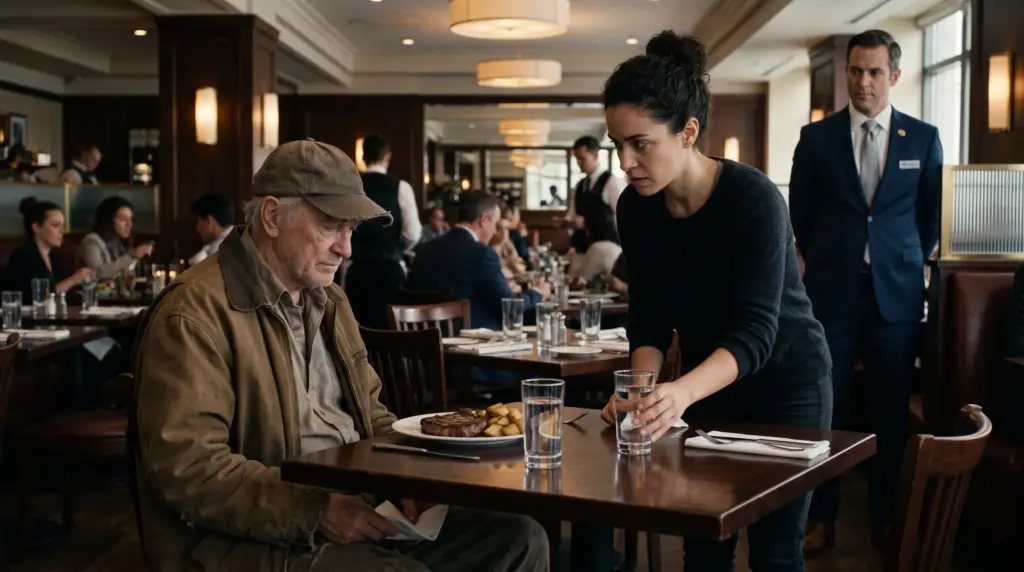
DON’T EAT THE STEAK.
Adrian read the three words once, then again, without changing his expression. Around him, the dining room of Bellamy House moved with the polished rhythm of wealth: crystal glasses, low piano music, waiters carrying plates that cost more than some families spent on groceries in a week, and conversations softened by money. Nothing in the room looked dangerous, which was exactly why Adrian had learned not to trust appearances.
He left his fork where it was and glanced toward the young waitress who had delivered the plate. Her name tag said NORA. She was already helping another table, her face calm, but one hand trembled slightly as she poured water. Across the room, regional director Preston Vale stood near the private dining room and watched Adrian’s table with the kind of casual attention that was never casual at all.
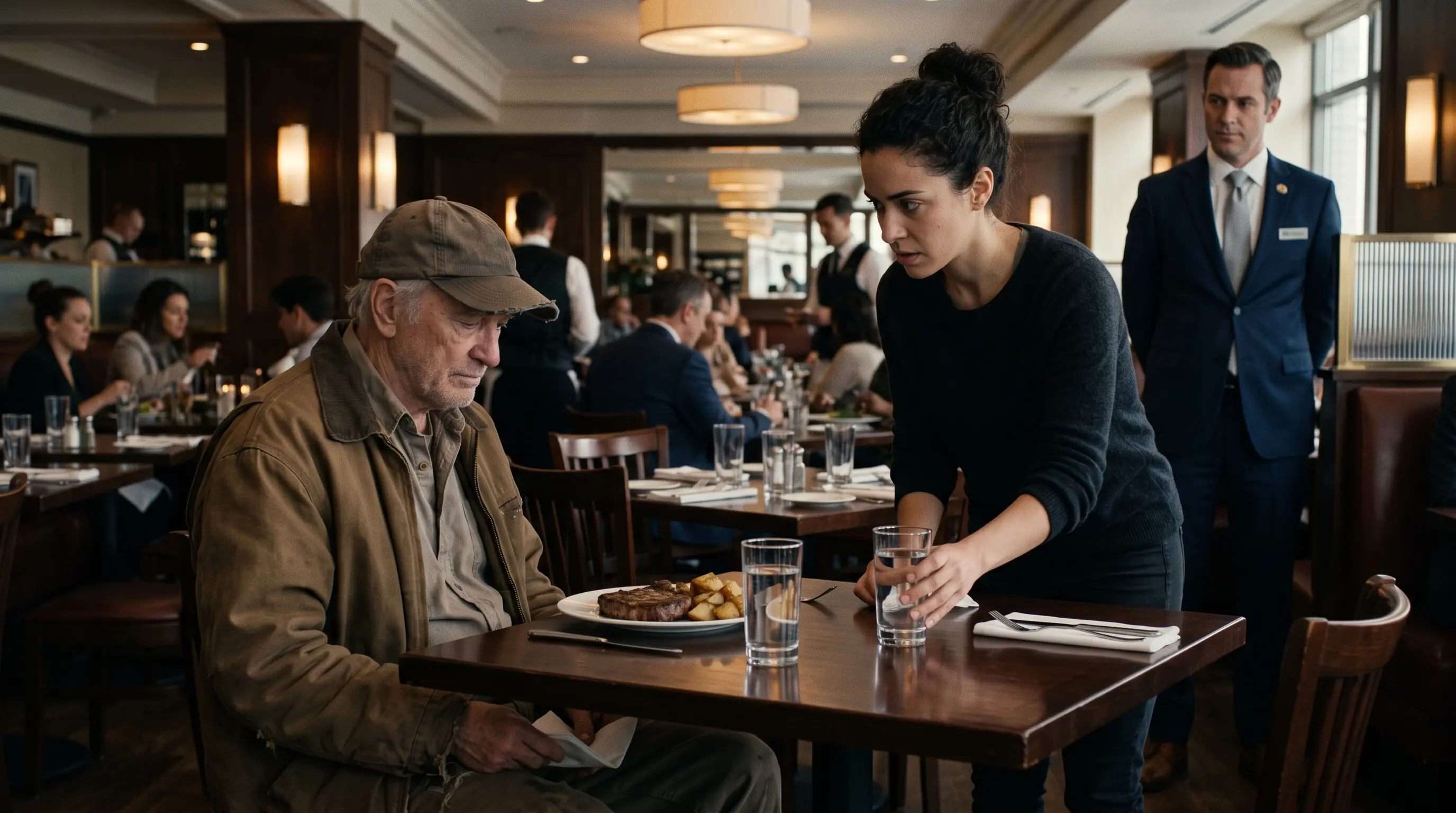 Adrian had entered Bellamy House under the name Andrew Cole. No driver had brought him, no bodyguards sat in the lobby, and the charcoal suit he wore had come from an ordinary department store instead of the tailor who usually dressed him. To almost everyone in Manhattan, Adrian Ross was the thirty-nine-year-old founder and controlling shareholder of Ross Meridian Group, a multibillion-dollar company with interests in logistics, hotels, software, commercial property, and, as of six months earlier, a newly acquired group of luxury restaurants.
The restaurants looked healthy on paper. Reservations were strong, customer reviews were excellent, and the flagship location produced numbers that should have made any investor comfortable. Yet Adrian’s internal finance team had found something that did not make sense: food costs rose when customer volume fell, maintenance invoices appeared in duplicate under different vendor names, and several supposedly independent suppliers shared mailing addresses with shell companies nobody could explain.
His chief financial officer, Malcolm Voss, had called the irregularities normal integration noise. Preston Vale had blamed inflation, labor shortages, and a vendor software migration. Even Adrian’s head of security, Grant Hale, had told him an undercover visit was unnecessary and risky. That was precisely why Adrian decided to come.
Only four people were supposed to know he would be at Bellamy House that evening. His executive assistant, Claire Mendoza, Malcolm Voss, Grant Hale, and Adrian himself. The reservation had been booked under a false name less than six hours earlier. Yet Preston Vale had looked at him the moment he walked through the door as though he had been waiting.
Adrian slowly lifted his water glass, but before drinking he noticed Nora looking toward him again. Her eyes dropped to the glass, then moved away sharply. He set it down untouched.
Preston crossed the dining room twenty seconds later. He wore a navy suit, silver tie, and the small enamel Bellamy House pin issued only to senior management. “Everything satisfactory, sir?” he asked.
“Looks excellent,” Adrian said.
Preston’s gaze flicked toward the untouched steak. “Our dry-aged ribeye is one of the reasons people come across the city to eat here.”
“I’m sure it is.”
“You should try it while it’s hot.”
Adrian smiled faintly. “You seem personally invested in my dinner.”
For the first time, Preston’s expression slipped. It lasted less than a second, but Adrian saw it.
“We pride ourselves on the guest experience,” Preston said, recovering. “Please let me know if you need anything.”
As he walked away, Adrian touched two fingers to the inside of his jacket, pressing the silent alert built into a device clipped behind his belt. Grant Hale had insisted he carry it even during undercover visits. The signal was supposed to notify a private response team positioned two blocks away.
Nothing happened.
No discreet vibration confirming receipt. No message on his phone. No sign from the street-facing windows that anyone was moving toward the entrance.
Adrian waited fifteen seconds, then pressed it again.
Still nothing.
That disturbed him more than the note.
Nora passed his table carrying an empty tray. Without looking directly at him, she whispered, “Hallway by the restrooms. Two minutes.”
Adrian remained seated long enough not to make the movement obvious. Then he stood, left the plate untouched, and walked toward the hallway at an unhurried pace. He passed the restrooms, continued toward a service corridor, and found Nora waiting beside a locked linen closet.
The moment they were out of sight of the dining room, her composure disappeared.
“Mr. Ross,” she whispered.
Adrian stopped cold.
“Say that again.”
Nora’s eyes darted toward the corner. “Not here.”
“You know who I am.”
“Yes.”
“How?”
“Because my father knew you.”
Adrian studied her face. She was about twenty-nine, with dark curls pulled into a practical bun and an expression that mixed fear with stubbornness. Nothing about her looked familiar, but the fear did.
“Your father’s name?”
“Elias Bennett.”
The name landed harder than Adrian expected.
Elias Bennett had been a forensic systems analyst inside Ross Meridian’s internal audit division. Three years earlier, he accused senior executives of manipulating vendor payments through the hospitality and logistics divisions. A formal review concluded that Elias had accessed files beyond his authority, violated confidentiality rules, and fabricated links between unrelated transactions. He was fired.
Four months later, Elias died in a highway accident outside Newark.
Adrian had signed the final termination approval.
“You’re his daughter,” he said quietly.
Nora’s jaw tightened. “Yes.”
“Why are you working here?”
“Because this is where the money comes through.”
Adrian’s eyes narrowed.
“What money?”
“The money my father tried to tell you about.”
Before Adrian could respond, footsteps sounded from the dining room. Nora grabbed his sleeve and pulled him deeper into the corridor.
“They know you’re here,” she said. “Not because you made a mistake. Someone told them.”
“Who?”
“I don’t know yet. But they knew your fake name before your reservation hit the host system.”
Adrian felt a cold pressure settle behind his ribs.
“How do you know that?”





