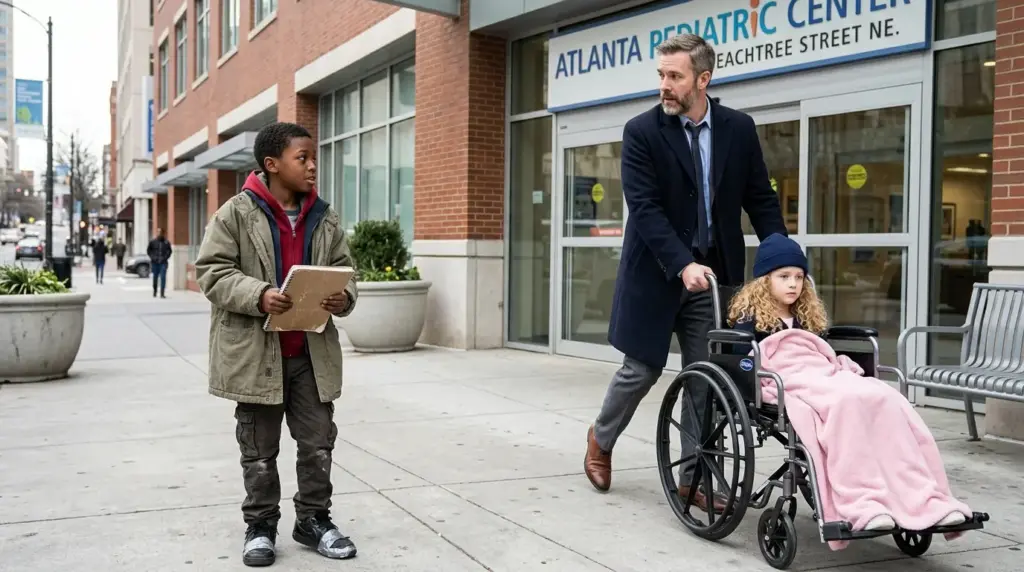
Some clutched crumpled appointment papers. Most of them had that same tight drawn expression on their faces, the one that says, “Don’t look, just move. ” Just to the left of the entrance, a boy sat alone on a flattened cardboard box. His jacket swallowed him whole. Two sizes too big sleeves rolled up so far they touched his elbows. His sneakers were torn, the left one held together at the toe by a strip of silver duct tape.
A red hoodie peaked out from underneath his coat. The hood pulled tight over his head, almost hiding the deep brown of his skin and the wide, alert eyes that didn’t miss a thing. He wasn’t begging. He wasn’t crying. He wasn’t even asking for food.
He was just drawing slow, detailed sketches inside a worn notebook, the kind with a frayed spine and smudges from years of use. Every few minutes, he’d glance up, watch someone rush by, then go back to his pencil. He looked like he’d been there forever. His name was Malik Darnell Jones. Some of the staff had tried to move him when he first started showing up a few months ago.
A security guard even threatened to call child services once, but Malik never argued, never made trouble. He just returned the next Saturday, quieter than before, more invisible, and slowly people stopped noticing. That morning, like every other people, walked past him, like he was part of the sidewalk, part of the cold. But Malik noticed everything. He saw the nurses who always left early eyes rimmed red.
He watched the exhausted fathers chain smoking by the curb, the worried mothers juggling two kids in a clipboard. He didn’t stare. He just watched, quiet, patient, invisible, until Charles Whitmore showed up. The sleek black SUV pulled up across the street, rolling to a gentle stop beside a red curb that read, “No parking anytime. ” Nobody cared. Not when the driver was someone like Charles, powerful, polished, important.
He stepped out slowly, stiff from the drive, tall white, mid-40s. His black wool coat was open, flapping in the wind, and his tie was loose around his neck. His salt and pepper beard was neatly trimmed. But his eyes, his eyes looked like they hadn’t seen sleep in weeks. He walked around to the passenger side and opened the rear door.
He gently lifted out a child, a girl no older than seven. She was pale, thin, her curly blonde hair tucked behind one ear. A soft pink blanket wrapped around her legs, but it was clear she couldn’t feel them. Her hands were folded in her lap. Her eyes were open, but she wasn’t really looking.
This was Ellie. The wheelchair sat ready on the sidewalk. Charles settled her in carefully, his hands moving with a kind of mechanical tenderness like he’d done this too many times to still let himself feel it. He didn’t see Malik. Most people didn’t.
Her legs didn’t move. She just stared straight ahead, her hands in her lap, face blank. Malik watched them. He hadn’t looked up much that morning, but something about the man, the way he held her, the way he looked at the building like it was the last place on earth he wanted to walk into, made Mollik sit up straighter. And then before he could stop himself, he spoke.
“Sir,” he said softly. Charles didn’t stop. “I can help your daughter walk again. ” The man stopped midstep, not because he was angry, not because he felt threatened, but because of how the words were said, soft, clear, like a truth already known. Charles turned his head slowly. “What did you just say? ” he asked.
His voice was flat, but not angry. Confused, Mollik stood up. He closed his sketchbook, tucked it under his arm. His fingers were red from the cold, but he didn’t shiver. I said, Malik repeated.
I can help her walk again. Charles looked the boy up and down, oversized coat, shoes taped together, skin dark and dry from the wind. A quiet voice that sounded too groan for a 10-year-old’s body. Charles blinked. This supposed to be a joke.
His voice wasn’t angry, just tired. Bone deep tired. No, sir. Then what is it? You hustling looking for cash?
I didn’t ask for money. Charles’s fingers tightened on the wheelchair handles. Ellie shifted slightly, looking at Malik for the first time. Her expression didn’t change. “You don’t even know her,” Charles said.
“You don’t know what she’s been through. ” “I don’t have to,” Malik said simply. “I can still help. ” Charles took a step forward, narrowing his eyes. “You’re what, 10? You’re just a kid sitting outside a hospital. ” Malik nodded. Almost 11, and you think you know more than the doctors inside.
“I don’t know more,” Malik said. But I watched my mama help people walk again. She was a healer. She taught me things. Charles didn’t say anything for a moment.
You learned physical therapy from your mom, not just therapy, touch, timing, faith, she said. The body remembers. Charles’s lips pressed into a flat line. He looked down at Ellie. She was still looking at Mollik.
Not with fear, not with pity, just curiosity. Charles shook his head. This is insane, he muttered and turned toward the doors. But even as he pushed the wheelchair forward, the boy’s words clung to him. I can help her walk again.