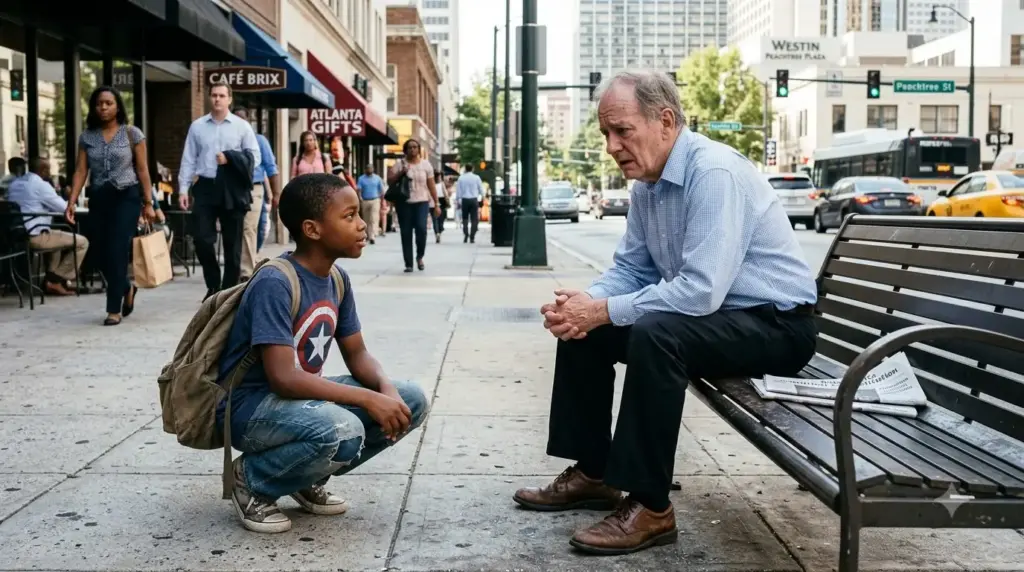
Robert Miller had always loved spring weather back when he could remember why. At 76 years old, he sat on a bench outside a cafe on Peach Tree Street, watching people rush past with their coffee cups and briefcases, and he felt something he couldn’t quite name. Not fear exactly, but close to it. His son had been sitting right there beside him just a moment ago, or maybe it was longer than a moment. Time had gotten slippery lately, like trying to hold water in his hands. “
James, ” Robert called out his voice thin. Nobody answered. The bench beside him was empty except for a newspaper someone had left behind. Robert picked it up, looked at the date, April 21st, 2015, then set it down again. The numbers didn’t mean anything to him anymore.
He tried to remember why he was here. There had been something about breakfast, about meeting someone important. James had told him to sit still and wait, hadn’t he? Or had James gone to get the car? Robert’s mind circled the question like a dog chasing its tail, never quite catching it.
A woman walked by pushing a stroller, and Robert smiled at the baby. The woman didn’t smile back. She quickened her pace as if Robert might be dangerous. He looked down at his hands, confused. When had they started shaking like that?
The truth was that Robert Miller had spent 40 years as a machinist at the Delta Steel plant outside Atlanta. He’d raised James on his own after Robert’s wife, Ellen, died in a car accident when the boy was only eight. Those had been hard years, lean years, working double shifts, and sleeping 4 hours a night. But they’d been proud years, too. Robert had made sure James had everything he needed, had pushed him to study, to dream bigger than a factory floor and a time clock.
And James had dreamed big. Full scholarship to Georgia Tech, MBA from Emory. Now, he ran some kind of investment company downtown, something with hedge funds and private equity, terms that slid right out of Robert’s head the moment James explained them. Robert had been careful with money his whole life. He’d bought a modest house in East Atlanta in 1972 for $18,000.
It was worth nearly $400,000 now. He’d put every spare dollar into his retirement account and a few solid stocks that James had recommended. His pension from 40 years at Delta Steel was small but steady. And when Ellen died, her life insurance had paid off the mortgage and left a nest egg he’d never touched, saving it for emergencies. He wasn’t wealthy by any means.
Not like the people James worked with in their Buckhead mansions. But Robert had enough. Enough to be comfortable. Enough to leave James something when he was gone. Enough to help someone if they needed it.
If only he could remember things clearly enough to actually help. What Robert could remember on his good days was the distance between him and his son. When James visited, which wasn’t often, he moved through conversations like he was checking items off a list. Call dad, check. Ask about medications, check.
Make sure the new caretaker is working out, check. Promise to visit again soon, check. The worst part was that Robert knew he was forgetting. He could feel his mind slipping away like sand through an hourglass, and there wasn’t a damn thing he could do about it. Now, sitting on this bench, Robert felt that familiar fog creeping in.
Where was he supposed to be? Where had James gone? The question swirled but wouldn’t settle. Robert stood up because sitting still suddenly felt wrong. His legs were stiff, but they carried him down the sidewalk.
He didn’t know where he was going. He just went. The city moved around him in a blur of noise and motion. Car horns blared. People shouted into their phones.
Somewhere nearby, a jackhammer pounded concrete. Robert walked faster, trying to outpace the confusion, but it followed him like a shadow. He turned down a side street he didn’t recognize. Then another. The buildings got taller, blocking out the sun, and Robert realized with a cold jolt that he had no idea where he was.
Excuse me, he said to a man in a suit rushing past. I’m looking for, but the man was already gone. Robert tried again with a young woman. Can you help me? I’m trying to find.
She glanced at him, then away, speeding up her walk. Panic bloomed in Robert’s chest. He spun in a slow circle, searching for something familiar, finding nothing. His heart hammered, his hands shook harder. He couldn’t remember his address.
He couldn’t remember James’s phone number. He couldn’t remember anything except that he was lost and no one would help him. Robert found another bench and collapsed onto it. His breath came in short gasps. He thought about standing up, about trying again, but his legs felt too heavy.





