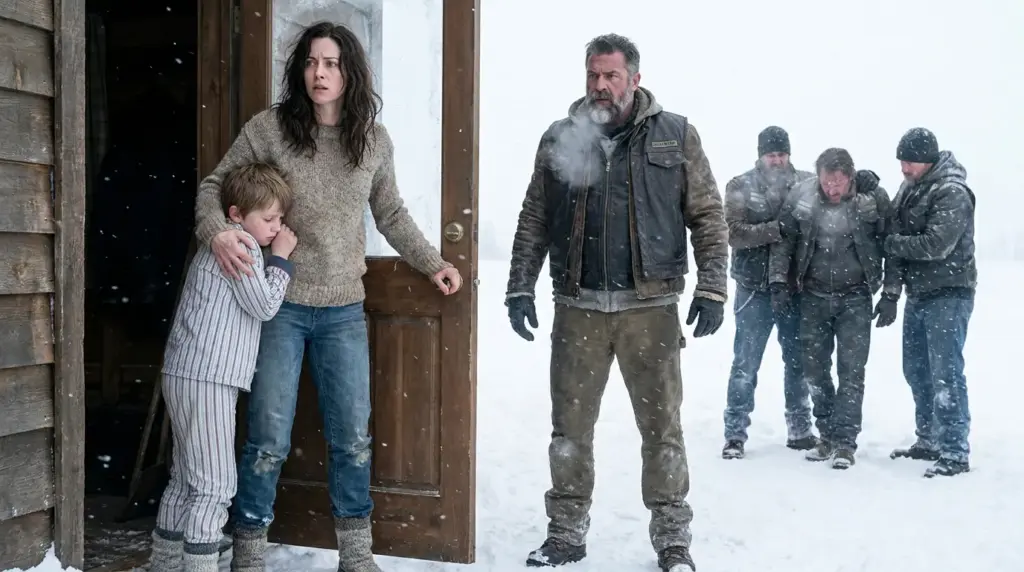
The storm slammed into the cabin so hard it nearly pushed her back. The lead biker stood on the porch, tall and broad, probably in his early fifties, with silver threaded through his black beard and pale green eyes that seemed painfully alert despite the cold. His leather cut was iced over, but she could see the patch across the front: ROURKE. PRESIDENT.

His eyes flicked once to the revolver in her hand. He did not flinch.

“Fair enough,” he said quietly. “I’d do the same.”

“Bring the injured one in first,” Mara said.

The cabin changed in less than a minute. The quiet, poor, fragile little space became crowded with leather, snow, steam, pain, and urgency. Seven men filled the room, but they moved with surprising care, as if they understood that one wrong step might break the dignity of the woman who had opened her door. The injured biker was the youngest of them, maybe twenty-four, with red hair and blood soaking through a torn sleeve near his upper arm. Another man, older and heavyset, shook so violently his teeth clicked.

“Lay him on the couch,” Mara ordered, slipping into the tone she used when Ben was sick and panic had no permission to enter.

Rourke looked at her sharply. “You know first aid?”

“My mother was a nurse,” Mara said. “I learned enough to keep people alive until help came.”

“Help isn’t coming tonight.”

“Then I’ll do better than enough.”

She boiled water, tore clean pillowcases into strips, and cleaned the wound while the young biker gritted his teeth and tried not to cry out. His name was Luke. He had gone down when his bike slid on hidden ice, and a jagged piece of broken metal had sliced his arm deep. It needed stitches. Mara had no stitches. She had butterfly bandages, alcohol, an old sewing kit, and hands steadier than she felt.

Ben crept from the bedroom while she worked. One of the bikers, a huge bald man with a gray mustache and a patch that read MOOSE, saw him and slowly lowered himself into a kitchen chair so he looked less frightening.

“You the artist?” Moose asked, nodding toward the motorcycle drawings on the table.

Ben blinked. “Maybe.”

“Those yours?”

The question was quiet, but every biker in the cabin seemed to hear it. Moose looked up from the chair. Preacher stopped mid-sip of coffee.

Mara folded the dish towel. “His name was Eli.”

Rourke closed his eyes.

For one second, he looked older than he had all night.

“Eli Mercer,” he said.

Mara’s throat tightened. She had not heard his full name spoken in years.

“You knew him?”

Rourke opened his eyes. “He was my brother.”

The words landed so heavily that even the storm seemed to pause.

Mara gripped the edge of the sink. “Your brother?”

“My little brother.” Rourke turned back to the photograph. “We called him Saint. Stupid nickname from when he was nineteen and thought that medal made him bulletproof.” His voice roughened. “He died twelve years ago.”

Mara swallowed hard. “I know.”

Rourke looked at her then, really looked. His gaze moved from her face to Ben sleeping against Moose, then back again. There was no accusation in it, but there was a question so large it filled the room.

Mara had spent nine years preparing for that question from someone, anyone, though she had always imagined it coming in daylight, not during a blizzard, not from a stranger wearing the same winged skull Eli had once worn on his shoulder.

She whispered, “Ben is his son.”

Moose’s hand tightened protectively around the sleeping boy’s shoulder. Preacher muttered something under his breath that sounded like a prayer. Rourke stood absolutely still.

“Eli had a son?”

Mara nodded, and the shame she had buried under years of survival rose like smoke. “He never knew.”

Rourke’s jaw worked, but he said nothing.

“I found out after he was gone,” Mara said quickly, because silence felt dangerous. “I tried to contact someone, but I didn’t know how. I didn’t know the club. I didn’t know his family. He told me he had a brother named Sam, but he never gave me a number, and after the crash…” She wiped at her face angrily. “I was twenty-two, broke, pregnant, and scared. Then my mother got sick. Then life just became one emergency after another.”

Rourke stared at the photograph. “He talked about you.”

Mara’s breath caught.

“All the time,” he said. “Girl at the fair with brave eyes. Girl who laughed at his terrible jokes. Girl who made him think maybe he could be more than road miles and trouble.”

Mara pressed both hands over her mouth.

“He was coming back to find you,” Rourke said. “That was the last thing he told me before the run to Montana. Said he had something real and didn’t want to mess it up.” His voice broke slightly. “Then he never made it home.”

The room blurred.

For years Mara had carried the story alone, not because she wanted to hide Ben, but because poverty made every day small. When you were choosing between rent and antibiotics, grief became a luxury. Questions became dangerous. Hope became another bill you could not pay.

Rourke turned toward Ben. The boy slept with his mouth slightly open, one hand still resting on the motorcycle drawing. In the soft lamp light, Mara saw it happen: recognition, grief, wonder. Eli’s smile lived in Ben’s face. Eli’s stubborn chin. Eli’s left eyebrow that lifted higher than the right.

“He looks like him,” Rourke whispered.

“Yes.”

Rourke crossed the room slowly and knelt beside the chair where Ben slept. He did not touch him. He only looked, as if afraid the child might vanish if he moved too fast.

“Eli had a boy,” he said, barely audible.

Mara expected anger. She expected blame. Instead, Rourke bowed his head, and one tear slipped into his beard.

The next morning, the storm broke clean and sudden. Sunlight poured over the snowfields, turning the whole world white and gold. The motorcycles were still half-buried, but Ghost—whose real name was Abel and who apparently could repair anything made of metal—had them running before noon.

Mara thought the men would leave quickly after what had been revealed. Instead, they moved around the cabin with a reverence that unsettled her. Moose fixed the loose hinge on the back door. Preacher patched the worst gap around the kitchen window. Abel cleaned the heater, replaced a cracked line with a part from one of the bikes, and made the flame burn steady and strong.

Ben woke to find the Iron Saints sitting at the table eating oatmeal like it was the finest breakfast in Wyoming. He looked shyly at Rourke, who seemed unable to stop staring at him.

“Mom said you knew my dad,” Ben said.

The cabin went quiet.

Rourke set down his spoon. “I did.”

“Was he nice?”

Rourke’s face changed. “He was wild. Loud. Brave. Sometimes foolish. But yes, kid. He was nice where it counted.”

Ben nodded as if filing that away somewhere sacred. “Did he ride fast?”

Moose snorted. “Too fast.”

Rourke smiled through the grief. “He rode like the devil owed him money.”

Ben laughed, and the sound cracked something open in all of them.

Before they left, Rourke stood on the porch with Mara while the others loaded gear. The world smelled of snow, pine, and gasoline.

“I don’t know what you want from us,” Mara said quietly.

Rourke looked toward Ben, who was showing Luke a drawing of a blue motorcycle. “I want nothing you don’t want to give.”

“I don’t want him swallowed by a club.”

“He won’t be.”

“I don’t want trouble around him.”

“You won’t have it.”

“I don’t know you.”

“No,” Rourke said. “But Eli did. And if he knew he had a son, every brother wearing that patch would already know that boy’s name.”

Mara looked away, her eyes burning.

She Opened Her Cabin to 7 Freezing Bikers — Then Their Leader Whispered, “He Was My Brother”

She Opened Her Cabin to 7 Freezing Bikers — Then Their Leader Whispered, “He Was My Brother”

Chapter 4

Theme:

Font Size:

24px




