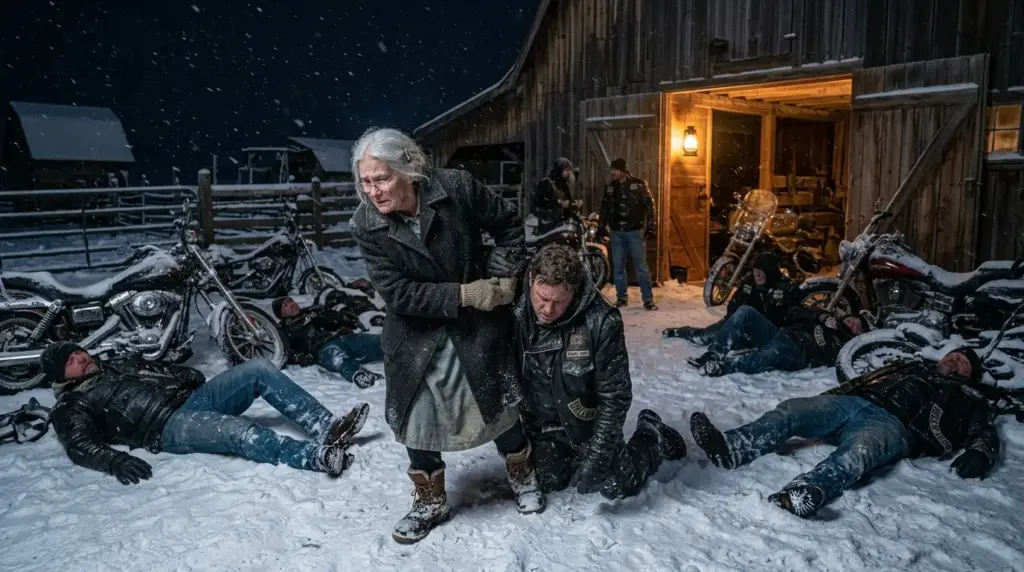
She had the generator running. She had fed the animals before dark, knowing she would not be going back to the barn until morning. She made herself tea and sat with it at the kitchen table, listening to the storm work itself up to its full height. And she thought about Frank the way she thought about him most evenings, not with acute grief anymore, but with the low continuous ache of absence, the way a healed break still registers cold weather. She heard the engines at 9:40.
At first, she thought she was mistaken. The wind had a way of producing sounds that were not there, assembling them from its own noise into approximations of familiar things. But the sound persisted and grew, and it had a mechanical regularity that wind could not replicate multiple engines. She realized not one working hard against conditions that had no business containing them. Motorcycles.
The thought was so improbable that she sat with it for a moment before moving. Then she went to the window that faced the driveway and pressed her face close to the glass, shielding her eyes from the light behind her. Through the white chaos, she could see headlights, a dozen, maybe more, weaving down the long drive that led from the county road to the farmyard. Even as she watched, the lights began going out, not switching off, but toppling one after another like candles being snuffed. She heard the crashes, even through the walls, metal on frozen earth, and then faintly voices men shouting, then the voices cutting off, swallowed by the wind.
Eleanor stood at the window for the span of three full breaths. She knew what rode in groups like that. Everyone in Redemption County knew about Hell’s Iron. They had been a presence in this part of Montana for 15 years, visible at the truck stop off the highway, talked about in the particular low voice that people use for things they are afraid of and not entirely sure they understand. Outlaws, dangerous men, the kind of people that decent folk were advised to give a wide birth.
Whatever they were, they were dying in her driveway. She thought of Frank. She thought of the thing he had said more times than she could count. Said it in the same even tone whether it applied to a neighbor’s broken down truck or a stranger at the side of the road or the injured hawk they had nursed back to health. One spring in a cardboard box in the kitchen.
You don’t get to choose who deserves help, Ellie. You just choose whether to help. She put on her coat, the heavy one, the one with the worn cuffs. She laced her boots. She took the emergency lantern from the hook by the back door and checked that it was charged.
She wrapped a scarf twice around her neck and pulled her wool hat down over her ears. Then she opened the back door and the storm came in to meet her like something that had been waiting. The cold was beyond anything the word cold was meant to describe. It was not a temperature. It was a presence physical and aggressive, finding every seam of her clothing in the first second and pressing through it.
Her lungs seized on the first breath. The air so cold it felt solid. And she stood in the doorway for one moment, one moment only, and let her body register what it was walking into. Then she walked into it. She found the guide rope her father-in-law had strung between the house and the barn back in 1961.
A simple precaution that had saved lives in bad winters, and that Frank had maintained every year without being asked. She wrapped her fingers around it and moved hand overhand into the white. She nearly stepped on the first man before the lantern found him. He was enormous, easily the largest human being she had seen outside of a hospital, and he lay face down in the snow with his motorcycle half on top of him. She knelt beside him, pressed two fingers to the side of his neck.
His pulse was there, slow and thready, but present. His skin was the color of old wax. Eleanor assessed him the way she had assessed a thousand patients in 30 years of nursing quickly without sentiment cataloging what was known and what was needed. Hypothermia advanced, possible head injury, structural damage indeterminate. He needed warmth.
He needed it in the next 15 minutes in a serious way and the barn was 80 yards away across terrain that the storm had turned into something close to impassible. She grabbed him under the arms and pulled. He did not move. He was, she would later learn, 260 pounds of a man named Thomas Mahoney, who rode under the name Brick for reasons that had to do with both his dimensions and his temperament. She had pulled unconscious patients before in emergencies when no one else was available.
She had never pulled one like this. She reset her grip, dug her heels into the frozen earth, leaned back with everything she had, and pulled again. He moved 2 in, then another, then a foot. The wind pushed against her as if it understood what she was doing and objected. The snow found the gap between her scarf and her collar.
Her fingers, even through her heaviest gloves, registered the cold as a kind of pain that moved past sensation into something that felt like it was being done to the bone rather than the skin. She pulled. She counted steps because counting gave the mind something to do while the body did the impossible. She told herself 10 more pulls and then 10 more after that. And she did not allow herself to look up and see how far the barn still was.





