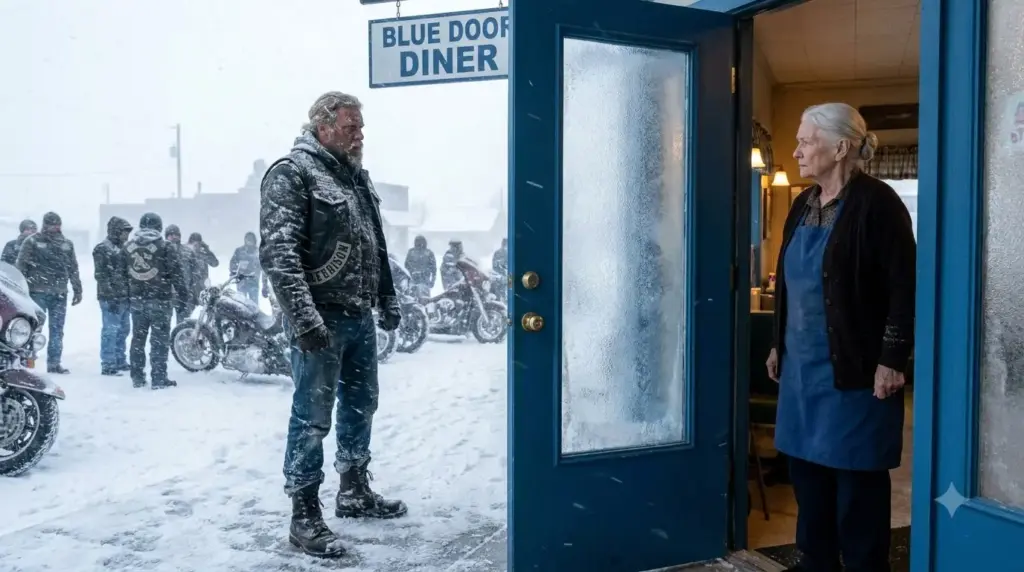
He said. ” So have I. ” He let go of her hand and walked out the blue door. The engines started one by one, a sequence of sound that built from a single point into something that moved through the whole street of Cooper’s Crossing like a physical force. Jack led the formation out of the lot and onto 212. And as he made the turn, he saw in the mirror on his left handlebar the diner behind them, the blue door still open.
Evelyn standing in it with her dish towel over her shoulder watching them go. He watched her until the road curved and she disappeared. He rode for 6 miles before he said anything on the comm. Then Devereaux. ” Here. ” “
How long do you need to build something that holds up 2 weeks, maybe 10 days if the public records are accessible? ” ” 10 Days. ” Jack said. ” What are we building? ” Asked Mitch Carver’s voice younger and tighter, still learning the register of these conversations. “
Evidence. ” Jack said. ” The kind that goes to a state financial crimes unit and doesn’t get lost. ” Silence for a moment. Then Sal’s voice steady, “We’re going back. ” “
Yes. ” Jack said. ” We’re going back. ” He didn’t elaborate. He didn’t need to.
The comm went quiet and stayed quiet and the formation moved east on 212 engines loud and clean in the cold morning air. 44 Men who had arrived at a diner as strangers and were leaving as something else, something that didn’t have a clean name but that every one of them understood that lived in the body before it lived in the mind, that felt like purpose finding its shape. Meanwhile in Cooper’s Crossing, the conversations Jack had expected were happening. Dale Pruitt was in the back room of the hardware store with two other council members and a woman named Sandra Hess who ran the town’s Facebook group, and had already posted three times before 7:00 in the morning. The first post had been cautious, noting that a large group of motorcyclists had taken shelter at the Blue Door during the storm.
The second had been less cautious, asking whether anyone else was concerned about what this might mean for the town’s safety. The third had not been cautious at all. Sandra Hess had a gift for language in the specific way that small-town gossip had always had a gift for language. The ability to imply everything while technically stating nothing to frame a concern in a way that sounded reasonable while landing in the gut as alarm. She had 1,400 followers on the town group.
By 8:00 in the morning, the post had 63 comments. The bikers are controlling her. That one had 37 likes. This is how gang territory starts. 29 Likes.
Someone should do a welfare check. Make sure she’s okay. That last one had come from a woman named Carol, who meant it genuinely, who was actually worried about Evelyn, and not about the optics. And it got 11 likes, which was less than a quarter of the likes that gang territory got. And that ratio said something about what the thread was actually for.
Evelyn knew about none of it. Or rather, she knew the way small towns moved, which meant she knew that people were talking, which meant she knew that by mid-morning there would be a layer of commentary sitting over everything that had happened, and that the layer would be thicker than the truth, and would take longer to clear than the storm. She’d been through it before. Not this, not this specifically, but the particular experience of doing something that didn’t fit what people expected, and then living through the recalibration. She’d hired a black cook in 1987, and lived through 3 months of comments before people got over themselves.
She’d extended credit to a family that was struggling in 2008, and been told by two different people that she was making herself a target. She’d been the person in this town who did the unexpected thing and bore the weight of it for longer than was comfortable and then kept going. She was tired though. She was tired in a way that had nothing to do with the night she just spent and everything to do with 14 months of banker’s letterhead and forged signatures and the growing low-grade terror of watching something she’d built with her hands and her marriage and 41 yearss of her life being quietly dismantled by people she’d never met who saw it as nothing more than an asset in a portfolio. At 12:30 Preston Vance walked through the blue door.
She knew who he was. Cooper’s Crossing was not a large town and Preston Vance had been buying property in it for 3 years and was not subtle about it. He was 54, tall, carried himself like a man who’d been told he was impressive often enough that he’d taken it as fact. He wore the suit she’d heard about from Marge at the post office, the good one, the charcoal one, and he walked into her diner like he was walking into a room he already owned. ” Evelyn, ” he said, like they were old friends.
They had spoken exactly twice in her life, both times briefly, both times in public. ” Mr. Vance, ” she said, “kitchen’s closed for the afternoon. ” ” That’s fine. I just came to talk. ” He sat down at the counter without being invited. “
Wanted to check in, make sure last night didn’t cause you any trouble. ” She looked at him. ” Last night was fine. ” ” I’m glad to hear it. You know, some people in town are concerned. ” “