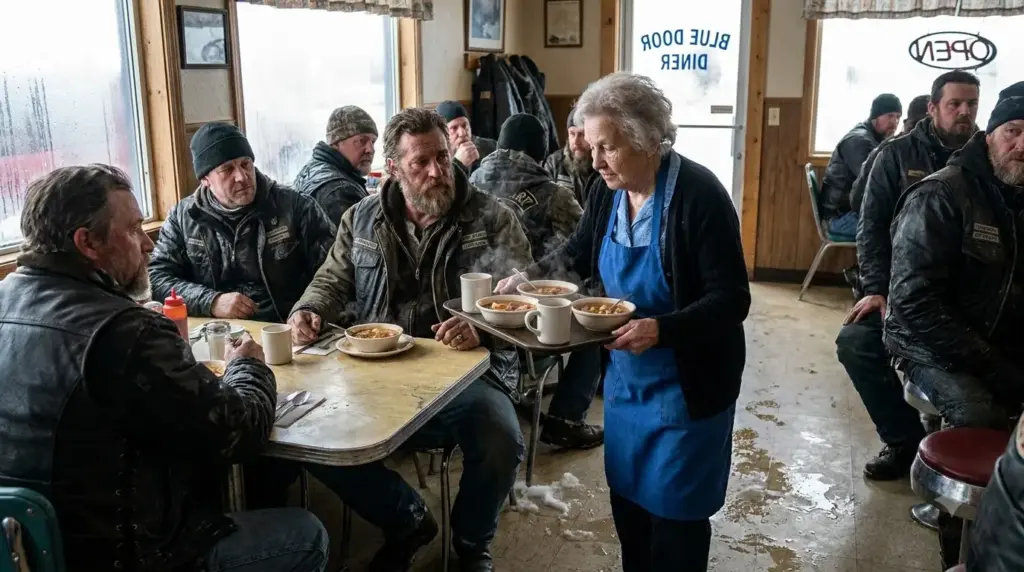
Brody Simmons was pale in a way that made Jack keep glancing at him. Curtis Webb had been walked inside by Sal and lowered into a booth and was now sitting with both hands wrapped around a coffee mug that had appeared in front of him with the speed and efficiency of a woman who’d been feeding people her entire adult life. Evelyn moved through them like she did this every day. That was the thing that struck Jack first and hardest and stayed with him. The absence of hesitation.
She didn’t pause at the kitchen door and reconsider. She didn’t look at the patches on their vests and recalculate. She looked at 44 human beings who were cold and she did what she would have done for 44 anyone else as she cooked. ” What do you have? ” Jack asked her following her to the kitchen because it felt wrong to just sit while she worked. “
Eggs, a lot of eggs, two full flats. Bacon, I’ve got maybe 8 lb of it. Potatoes, bread. I made chili this morning before the power went so there’s a pot of that. Coffee if you can wait 15 minutes for the big urn to run through. ” “
That’s enough for That’s enough. ” She said in a way that made it clear the calculation was finished. She pulled out a cast iron pan the size of a hubcap and set it on the burner. ” Can any of you cook? ” Jack blinked. “
Some of us. ” ” Then send me two who won’t get in my way and won’t argue with how I do things in my kitchen. ” Jack sent her Danny Reyes who’d worked a diner line in San Antonio for 3 years before joining the club and still talked about it and Marcus Webb, no relation to Curtis, who’d grown up in a restaurant family in New Orleans and could scramble eggs for 50 people without blinking. The three of them disappeared into the kitchen and what came out of it over the next 90 minutes was by any fair accounting a miracle of logistics performed by an 83-year-old woman who hadn’t been asked and hadn’t hesitated. Plates of eggs, mountains of bacon, potatoes fried in a cast iron pan with onion and pepper, chili served in deep bowls with bread to soak it up, coffee, real coffee, dark and strong in mugs that kept getting refilled without anyone having to ask.
Jack sat at the counter and watched his men eat. He’d been riding with some of these men for 15 years. He’d seen them in situations that would make most people’s hair go white. He’d seen them angry and drunk and grieving and terrified and violent and generous and everything in between. He thought he knew what they looked like in every condition a human being could find themselves in.
He’d never seen them look like this, grateful. Not just in the surface way, the polite way, grateful the way you got when something happened to you that reminded you what it felt like to be treated like a person and you realized how long it had been since that happened last and the realization hit you somewhere tender that you thought you’d walled off years ago. Kowalski was crying. Not loud, he’d turned his face toward the wall and was doing it quietly and Jack was the only one who noticed and he let it go because sometimes a man needed to let something out and the only kindness you could offer was to not make it a thing. Across the diner at a corner booth, Tillman was talking to the kid next to him.
Kyle, 28, relatively new and Jack couldn’t hear the words, but he could see Tillman’s expression, which was the expression of a man telling a true story, not a performed one. At the counter, Sal Guzman had somehow struck up a conversation with Evelyn Harper while she was refilling his coffee and from the fragments Jack caught, they were talking about the road conditions on 212 and whether the county would send plows by morning. Sal was treating her like a colleague. She was responding in kind. Jack watched all of it and felt something he hadn’t expected to feel when the day started.
He felt ashamed. Not of his men, of the assumptions he’d made. Not about Evelyn because he hadn’t had time to make assumptions about Evelyn before she proved them irrelevant, but about what he’d expected to find in this town. He’d expected what they always found. Curtains drawn, doors locked, the particular way a community could close itself against you without ever saying a word, communicating everything with the absence of welcome.
He’d expected Cooper’s Crossing to give them nothing. Instead, one person in Cooper’s Crossing had given them everything she had. Outside through the diner’s front window, Jack could see lights coming on in buildings across the street. People waking up, or people who hadn’t slept peering out into the storm at the 44 motorcycles lined up in front of the diner. He could imagine what they were saying to each other.
He’d heard versions of it his entire adult life. What are they doing there? Why is she letting them in? Somebody should call somebody. He’d spent 20 years being the thing other people called somebody about.





