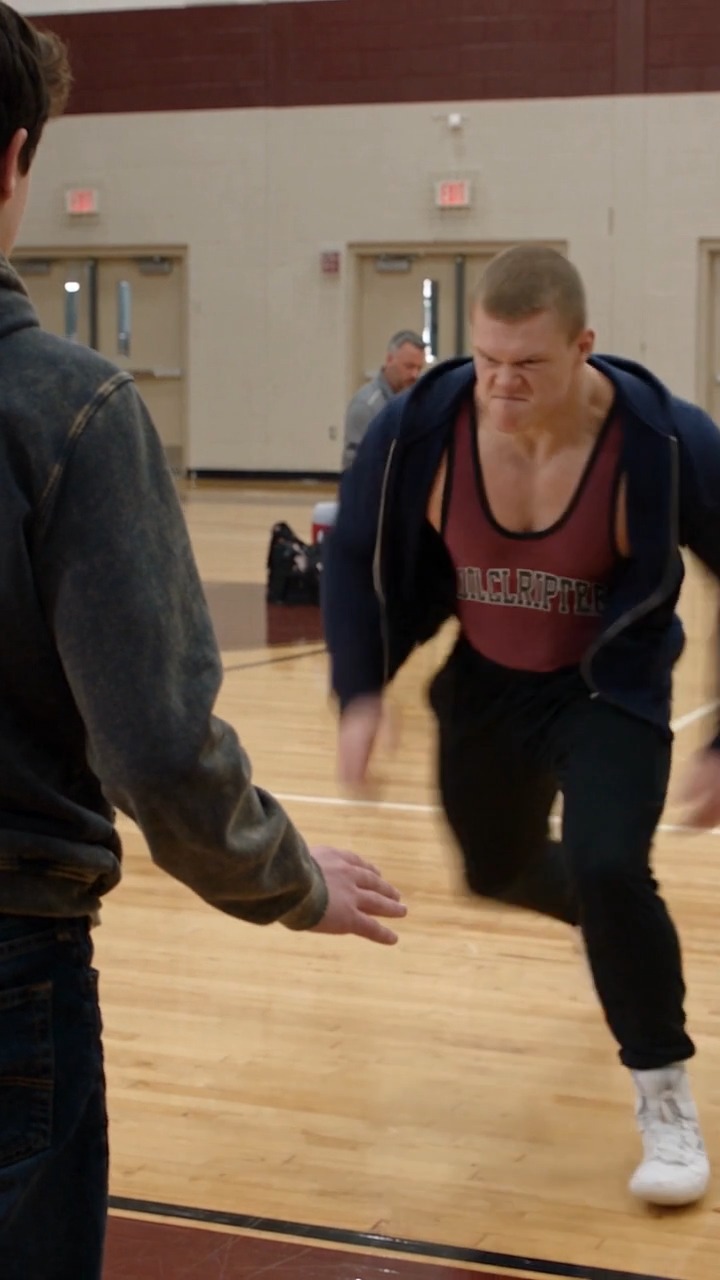
Thorne Denton snapped a fast, vicious jab directly at the gray-haired man’s face, laughing as he said the words he assumed would end the confrontation: “You’re too old to fight.”
Abby Kelly didn’t blink. He didn’t raise his hands. He simply tilted his head backward perhaps one inch, letting the heavy leather glove brush past his ear.
The air in Iron and Dust Martial Arts was thick with sweat and cheap floor cleaner. Just minutes earlier, Abby had been sitting quietly on a wooden bench, drinking terrible, cold coffee and watching Thorne spar. Thorne was twenty-four, a cocky black belt with fast hands and a desperate need for an audience. After intentionally injuring a tired nineteen-year-old warehouse worker with a brutal leg kick, Thorne had noticed Abby quietly shaking his head in disappointment.
Thorne had demanded the old man step onto the mat to prove himself.
So Abby had calmly unlaced his work boots, folded his canvas jacket, and stepped barefoot onto the blue canvas in his faded jeans and gray thermal shirt.
Now, missing his first punch, Thorne frowned. Abby just adjusted his weight on his bad left knee, his face entirely blank. “School is in session,” Abby said quietly.
Enraged, Thorne lunged forward, crossing the distance with explosive speed. “I’ll break your jaw!” he shouted, throwing a massive, full-power right hook aimed straight for Abby’s temple.
But hands can deceive; shoulders reveal intention. Abby watched the younger man’s shoulders.
Instead of blocking, Abby dropped his weight by bending his knees, letting the heavy hook pass harmlessly over his gray hair. Pain exploded through his fused lower spine and damaged left meniscus, but Abby ignored it. Pain was just information.
In one fluid motion, Abby stepped inside the strike. He wrapped his right arm behind Thorne’s neck, locking the grip. He drove his forehead sharply into the bridge of Thorne’s nose—a cracking impact that sent blood pouring down the young fighter’s face.
Before Thorne could even scream, Abby gripped the fabric at Thorne’s hip, positioned his leg, and threw him.
It wasn’t a clean, elegant judo toss meant to impress judges. It was an ugly, brutally efficient sweep built to put a body onto concrete.
Thorne’s feet left the mat. For an instant, he was weightless. Then his back hit the canvas with a booming impact that shook the entire floor. The air exploded from his lungs.
Before Thorne could recover a single breath, Abby was over him. His right knee dropped heavily onto Thorne’s upper abdomen, trapping his breathing. Abby pinned Thorne’s right wrist to the mat, his free hand resting gently beside the elbow joint.
Abby didn’t crank the arm. The positioning alone explained everything to the young fighter: one small increase in pressure, and the joint would snap.
The entire gym went dead silent. Thorne’s three friends, who had been laughing by the cage seconds earlier, stood completely frozen.
Thorne looked up into Abby’s eyes, expecting to see triumph, anger, or the same desperate ego he carried himself. Instead, he found absolutely nothing. The older man looked bored.
Abby held his gaze for several seconds, ensuring the young man understood he was entirely at his mercy. Then, without a word, Abby released the wrist, stood up, and limped toward the edge of the mat.
Gregory Shaw, the exhausted gym owner, stepped forward, holding a rag. He looked down at his prized young fighter lying paralyzed on the blood-spotted canvas.
“He went easy on you,” Gregory said quietly.
Thorne clutched his bleeding nose, his arrogance completely shattered. “Who is he?” he managed to wheeze.
Gregory looked toward the exit door as Abby walked out. “We served together,” Gregory said, his voice dropping. “First Recon. Later he moved into Marine Special Operations. He spent twenty-five years doing things in places you will never see, so people like us can stand under fluorescent lights and play at fighting. You’re lucky he’s trying to be a civilized man.”
Three days later, the air carried the crisp chill of early autumn. Abby sat on the front porch of his small, quiet house, drinking black tea. The swelling in his knee had settled into a deep, familiar ache.
A worn black Toyota Tacoma pulled up to the curb. Thorne climbed out. Both of his eyes were bruised a deep purple, and a hard white splint covered the bridge of his fractured nose. He wore gray sweatpants. No entourage. No swagger.
Thorne walked slowly up the concrete path and stopped at the bottom of the porch steps.
“Greg gave me your address,” Thorne said.
Abby took a sip of tea. He didn’t tense. “I assumed.”
“I came to apologize. I was out of line. I was disrespectful.” Thorne swallowed hard, looking at the older man. “I just don’t understand. I train four hours a day. I have a black belt. I’m faster than you. You didn’t even put your hands up. You just walked through me.”
Abby set his tea down. “You’re a sports car, Thorne. You were built for a track. You have rules, referees, weight classes, and an opponent who agrees to fight according to the same structure you trained for.”
Abby leaned forward slightly. “I’m not a sports car. I’m a bulldozer. I was trained to clear rubble. When you stepped toward me, you were calculating combinations, timing, what would look good for your friends. I was calculating the shortest path to making you incapable of continuing.”
Thorne looked at the wooden porch boards, the reality of the words sinking in.
“You fight angry because your ego needs proof that you’re dangerous,” Abby continued quietly. “That means you need an audience. When somebody is fighting because survival requires it, the violence isn’t entertainment. It’s a necessary chore. Like hauling garbage to the curb. You don’t get angry at the garbage. You remove it.”
Thorne nodded slowly. He had built his entire identity around being the toughest guy in the room. In ten seconds, an old man in jeans had completely dismantled it, simply by refusing to play his game.