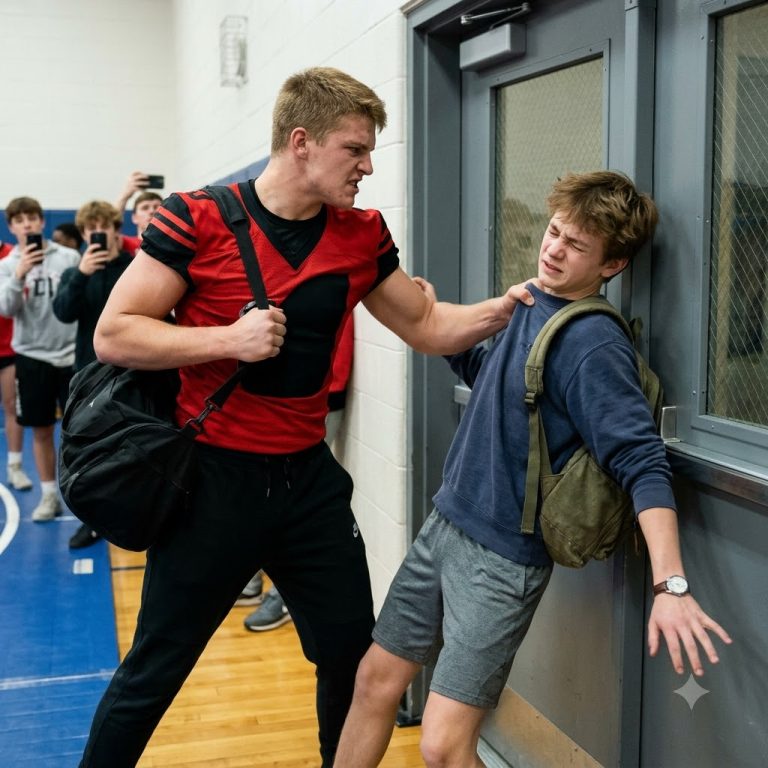
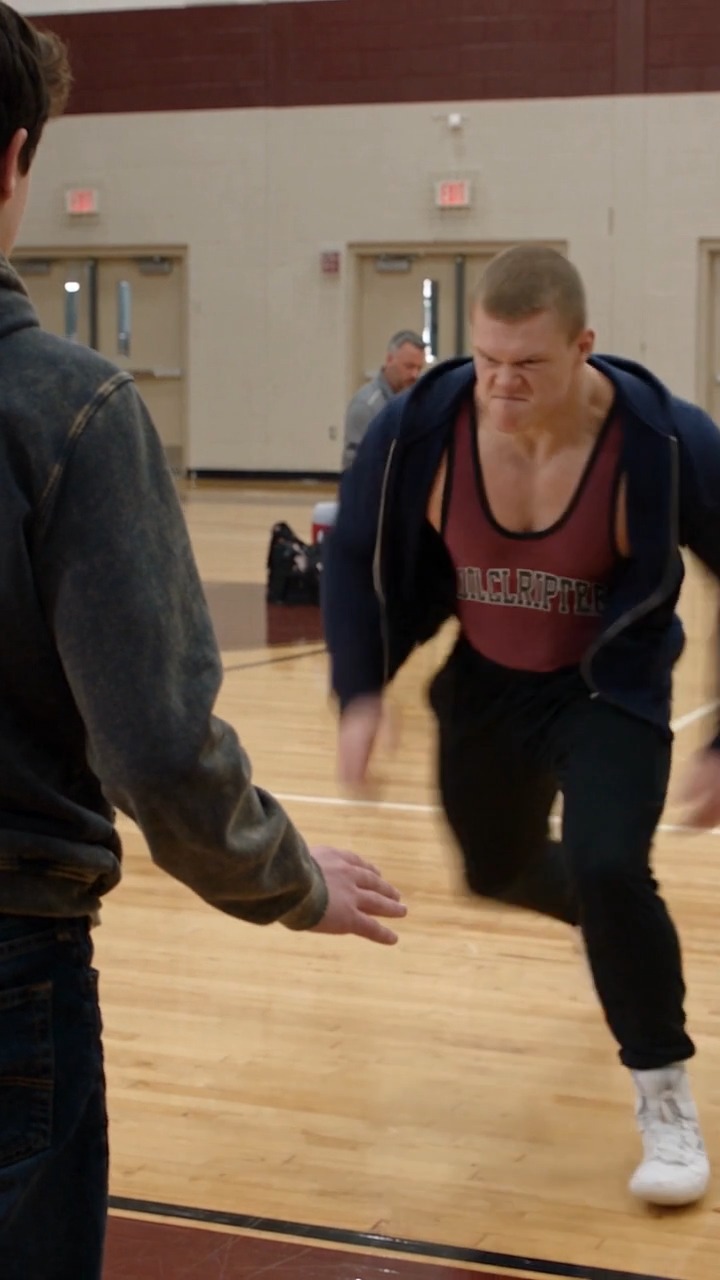
Cole locked his hands around the older man’s waist. “Nowhere to go.”
He stepped deep behind David’s leg. He planned a simple outside trip. Controlled. Enough to put the fifty-three-year-old man down. Enough to make the room laugh again. He shifted his heavily muscled weight forward, expecting the older man to resist, stumble, and fall.
David moved. Once. That was all.
One step. One turn. One small change of angle. His right foot slipped outside Cole’s lead leg. His left hand captured the champion’s elbow. His hips moved slightly off line. Cole’s own forward pressure continued, but David was no longer there to receive it.
For a fraction of a second, the champion’s face changed. He knew. Too late.
His balance disappeared completely. His feet left the canvas. David guided rather than threw. Cole rotated through the air and landed flat on his back with a heavy slap. The ring ropes shook.
Silence. Absolute silence in the gym.
David remained standing. He did not follow Cole down. He did not jump on him. He did not pose or smile. The entire movement had taken less than two seconds.
Cole stared at the ceiling. The celebration was gone from the room. He sat up, his face flushed with confusion. “What was that?”
David looked down calmly. “A mistake.”
Cole frowned, standing up quickly to save face. “Mine?”
“Yes.”
The answer irritated Cole more than any technical explanation could. He looked toward Frank Harris, his coach and the owner of Riverside Fight Club. “You knew he could do that.”
Frank exhaled. “Yes.”
“Who is he?”
David stepped toward his boots, quietly pulling on a sock over the surgical scar on his ankle. “Here we go. You need the biography.”
“I want to know who I just got dumped by,” Cole demanded.
David stood. “You want a résumé that makes the floor feel less embarrassing. That’s the habit you should worry about. Deciding how much respect someone deserves after you find out what they can do to you.”
The room stayed completely quiet. Everyone knew exactly how they had gotten to this moment. Ten minutes earlier, Cole had been holding court, a newly crowned thirty-year-old boxing champion showing off for sponsors and amateurs. He had loudly demonstrated a knockout combination, claiming he knew exactly when his opponent was broken.
From the back of the room, David—a man in a faded polo and jeans who had walked in quietly to visit Frank—had chuckled. Just once.
Cole’s ego couldn’t handle it. He demanded to know what was funny. David politely explained that Cole had committed to the combination before his opponent’s feet had actually stopped responding. It worked, but it was a technical risk. Cole, furious at being corrected by an “ordinary” older man, had challenged him into the ring for a “technical clinch” to prove a point.
Now, Cole was the one dusting off his back.
Frank finally spoke, his voice carrying through the quiet gym. “David Brooks fought professionally for nine years. Seventeen wins. Five losses.”
Cole frowned. That was good, but it didn’t explain the effortless way he had just been handled by a man twenty pounds lighter and twenty years older.
Frank walked toward an old, faded photo wall near the entrance. He pointed to a picture from decades ago. David wearing a plain corner jacket beside a young fighter with both hands raised.
Cole stared at the photograph. The fighter’s name was unmistakable. Raymond “The Surgeon” Lewis. A former world middleweight champion, a Hall of Fame inductee, and one of the most technically respected fighters of his era. Known for impossible balance and a famous ability to make aggressive opponents fall into positions they believed they had created.
“David was one of Ray Lewis’s main sparring partners,” Frank said quietly. “For six years. And later his assistant coach.”
Now the pieces arranged themselves. Cole remembered an old interview with Raymond Lewis. The world champion had talked about an unnamed wrestler in his camp who taught him how to recognize the exact instant an opponent’s weight committed beyond recovery. Most guys think balance is where their feet are. Dave taught me balance is where your next foot has permission to go.
Cole turned slowly. “Dave. That was you.”
David said nothing.
Cole felt relief wash over him. He hadn’t been embarrassed by a random old man; he had been thrown by a high-level veteran. He almost started smiling again.
David saw the shift immediately. “There. The smile. Biography worked.”
Cole’s face reddened.
“Ten minutes ago I was just an older man sitting in a chair,” David continued, his voice calm but firm. “You hit your sparring partners harder because people laugh. You invited me in because you heard one chuckle. You’re not protecting skill. You’re protecting an image. And that image is going to make you stupid against someone who knows how to wait.”
Frank didn’t defend his champion. In fact, Frank looked relieved that someone was finally saying it. “You’re not a bad man, Cole,” Frank added. “But lately, you’re becoming a bad room. When you walk in, everyone starts adjusting around your ego.”
That sentence landed deeper than the physical throw. Cole looked around. The young amateurs he trained with avoided his eyes. He realized instantly that Frank was right.
Cole stepped out of the ring. He walked over to a young amateur he had hit unnecessarily hard earlier in the night. Cole didn’t make a speech. He just looked the kid in the eye and said, “I shouldn’t have done that. I’m sorry.”
It was the first real step.
Over the next few months, everything about Cole changed. When a teenager caught him cleanly in sparring, Cole smiled instead of punishing him. He stopped trying to win every single second of practice. When David eventually agreed to train with him at 6:00 a.m. on Saturdays, they didn’t work on throws. They worked on weight, patience, and recognizing when pride was forcing a bad decision.