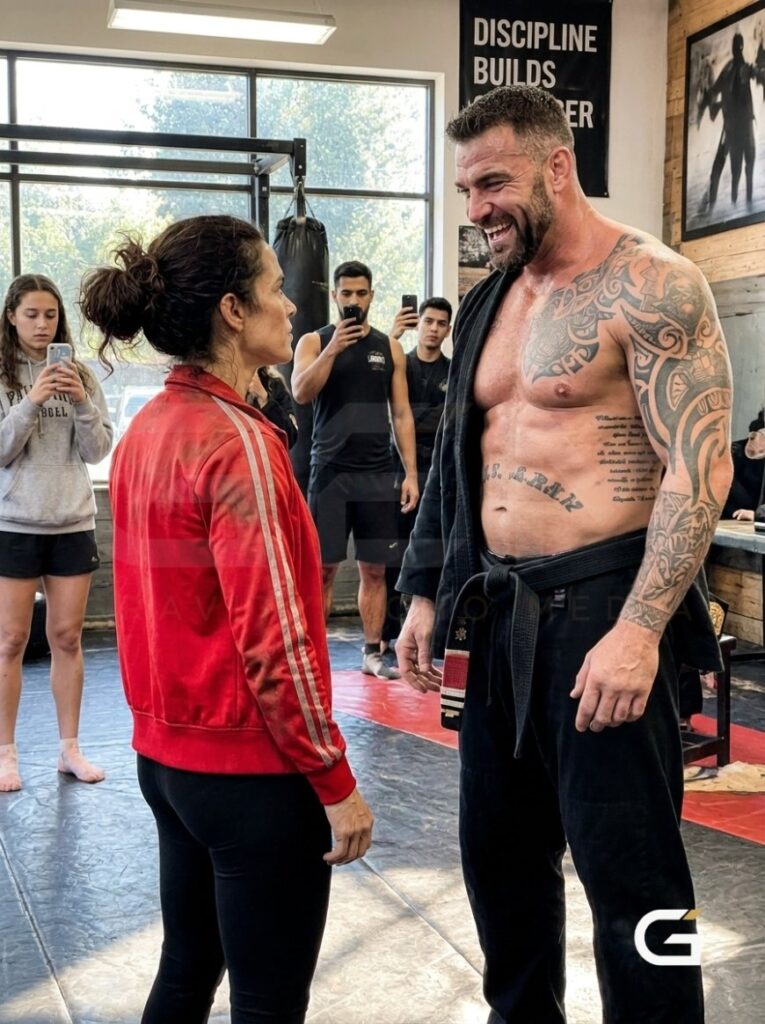
The fist stopped an inch from my face.
Not because he pulled it. Because I made it stop.
My left hand had caught his wrist mid-flight, fingers wrapping around bone and tendon with the casual certainty of someone who had done this ten thousand times before. The impact of his momentum died against my palm like a wave hitting a seawall.
Jake’s eyes went wide.
I held his wrist for one heartbeat. Two. Long enough for him to feel the impossible strength in a hand that looked like it should be holding a coffee mug, not a trained fighter’s arm.
Then I let go.
He stumbled back three steps, cradling his wrist like I’d burned him. The dojo had gone so quiet I could hear the fluorescent lights humming overhead.
“What the—” he started.
“You led with your right,” I said calmly.
“You always lead with your right. It’s in every drill you’ve run tonight. Predictable.”
His mouth opened. Closed. Opened again.
“I told you,” I continued, my voice carrying to every corner of that stunned room.
“You wanted to teach a lesson. So let’s teach one.”
Jake’s face cycled through shock, then confusion, then something uglier—humiliation curdling into rage.
“Lucky catch,” he spat.
“You got one hand on me. Big deal.”
“Then come try again.”
I said it without heat. Without bravado. Just a simple statement of fact. Water is wet. Fire is hot. Come try again.
He did.
This time he came in low, feinting left before snapping a roundhouse kick toward my ribs. It was his best technique—I’d watched him drill it on the heavy bag earlier. Crisp. Fast. The kind of kick that had probably won him trophies and intimidated a hundred students.
I stepped inside it.
His shin whispered past my hip as I closed the distance. One hand found his collar. The other pressed flat against his chest.
And then I simply… redirected him.
Jake flew sideways. Not thrown with force—guided, like a leaf caught in a current. He hit the mats shoulder-first and rolled, scrambling to his feet with a grunt of fury.
“WHAT ARE YOU?” he shouted.
The question echoed off the walls. I saw parents frozen mid-whisper. Students clutching each other’s sleeves. And Sarah—my Sarah—standing at the edge of the mat with her hands pressed to her mouth and tears streaming down her face.
Not tears of fear. Tears of recognition.
She’d seen the videos. Years ago, when she was twelve and found an old laptop I’d forgotten to wipe. She’d watched every fight. Every interview. Every slow-motion replay of the Silent Storm dismantling opponents twice her size.
She’d never told me. But she knew.
“Answer me,” Jake demanded, circling now, keeping distance. His chest heaved. Sweat darkened his collar.
“Who are you?”
I straightened slowly from my stance. Let my hands fall to my sides.
“My name,” I said, “is Lily Chen.”
The name landed like a grenade.
I watched it roll through the room—saw it detonate behind the eyes of the older students first. The ones who followed MMA before it was mainstream. The ones who remembered the late-night fights on obscure channels, the grainy footage of a woman with quiet eyes and devastating precision.
“Oh my God,” whispered a teenage boy near the front. He was already pulling out his phone. “Oh my God, that’s actually her.”
“Lily Chen,” another student repeated, voice cracking. “The Silent Storm. She was—she was undefeated for like four years.”
Jake’s face drained of color. He knew the name. Of course he knew the name. Every serious martial artist did. Lily Chen was a legend—the kind of fighter whose matches got dissected in training videos, whose techniques got taught in seminars, whose retirement had been mourned by an entire sport.
“You’re lying,” he said, but his voice had lost its edge. “Lily Chen retired fifteen years ago. She disappeared. Nobody knows where she went.”
“Thirteen,” I corrected quietly. “Thirteen years ago. I moved here. Changed my name back to my mother’s maiden name. Stopped competing.”
“Why?”
The question came from somewhere in the crowd. A woman’s voice, soft and genuinely curious.
I turned to face her—a mother I recognized vaguely from drop-offs and pickups. Kind eyes. Worried expression.
“Because I lost someone,” I said.
“Someone I loved more than fighting. More than winning. More than anything except breathing.”
The words hung in the air like smoke.
“My brother, Michael. He was a fighter too. Not as good as me—he’d be the first to admit it. But he loved it. Loved watching. Loved learning. He drove three hours to watch me defend my title for the third time.”
I paused. The next part never got easier to say. It never would.
“He never made it. Semi truck blew a tire on the interstate. Crossed three lanes of traffic. Michael’s car went under the trailer at sixty-five miles an hour.”
A woman in the back gasped. Someone else began crying quietly.
“He was twenty-two,” I continued.
“Twenty-two years old. And the last thing he ever texted me was ‘Can’t wait to see you break another record, sis.'”
My voice didn’t waver. It couldn’t. I’d spent thirteen years learning how to carry this weight without breaking.
“I retired two weeks after the funeral. I couldn’t look at a ring without seeing his face in the crowd. Couldn’t throw a punch without wondering if I was still doing it because I loved it, or because I was trying to prove something to a ghost.”
Sarah had walked onto the mat now, standing just behind me. I felt her hand slip into mine. Small fingers. Callused from months of practice. The hand of the girl who’d brought me back to this world without even knowing it.
“I never told her,” I said, looking at my daughter.
“I never told anyone. I thought if I let Lily Chen die, I could finally live with myself.”
“You built a new life,” Jake said. Not a question.





