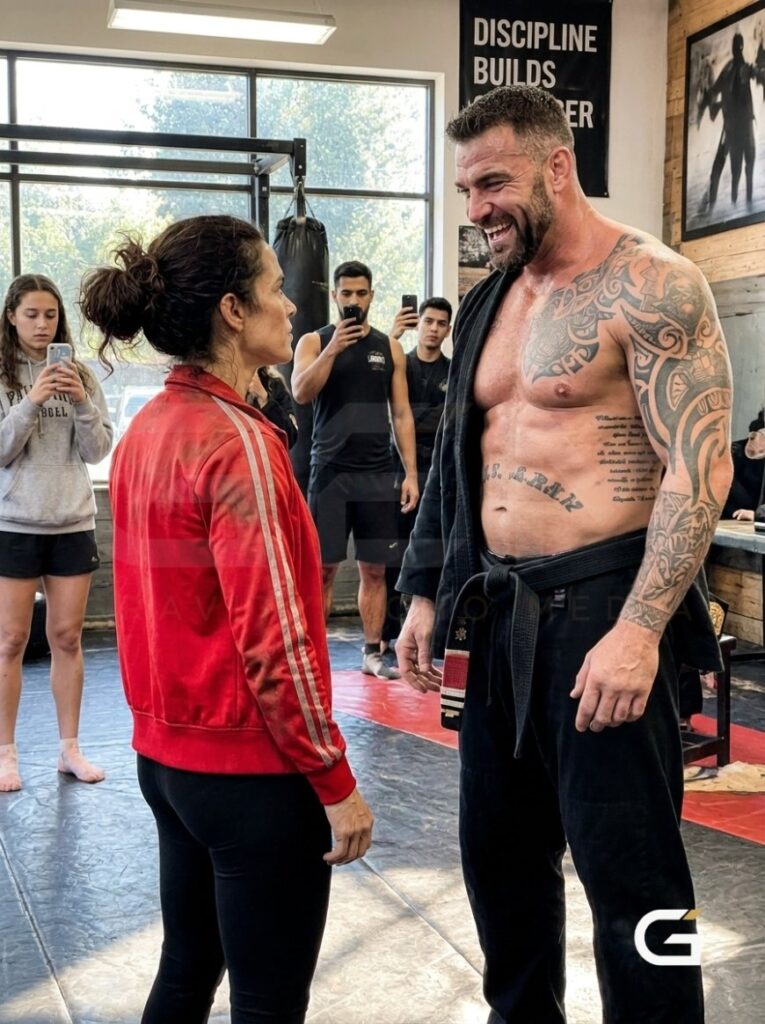
I looked up at the ceiling of the studio—at the cheap fluorescent lights and the exposed pipes and the worn-out mats. And I smiled.
“I’m done running from who I am.”
The room erupted. And this time, when the applause echoed, I didn’t fight the tears.
I let them fall.
Because I was home.
—
**The exhibition, spring**
The arena was small—a high school gymnasium with fold-out bleachers and a concession stand selling stale popcorn. Nothing like the stadiums I used to pack. But that felt right, somehow. Felt like a beginning, not an ending.
Sarah sat in the front row, wearing the SILENT STORM sweatshirt. Her father was beside her. Jake Reynolds was two seats over, looking anxious.
Opposite me on the mat was my opponent—a woman twenty years younger, entirely unafraid. She had heard the stories. She knew who she was facing. She also knew I had no intentions of breaking her.
“Ready?” I asked.
“Ready.”
We touched gloves.
And for eleven minutes—three rounds of controlled, respectful sparring—I was Lily Chen again. Not the champion. Not the legend. Just a woman moving the way she was born to move. The way Michael always said she looked when she was happy.
When it was over, we hugged. The crowd cheered. I looked up toward the bleachers and found Sarah standing, tears streaming down her face, clapping harder than anyone.
I bowed to her.
She bowed back.
And I knew, finally, that I had built something that would outlast me. Not a title. Not a highlight reel. A daughter who knew what strength was. A community that wanted to learn it. A past I could finally own without flinching.
The Silent Storm had returned.
And she wasn’t silent anymore.
The applause dissolved into the shuffle of feet and the creak of folding chairs. I stayed on the mat, my toes curling against the canvas. Sarah climbed over the bleacher railing and dropped down beside me.
“You bowed to me,” she said, her voice cracking.
“You bowed back.”
She wrapped her arms around my waist and pressed her face into my shoulder. I felt the dampness of her tears through the fabric of my uniform. Over her head, I saw her father watching us. He didn’t wave. He just nodded, slow and deliberate, like he was sealing something.
Jake appeared at the edge of the mat, clipboard in hand. “Foundation just hit twelve thousand dollars.”
“From one exhibition?”
“From one exhibition and a silent auction your daughter organized behind your back.”
I looked down at Sarah. She shrugged, sniffling. “I told you. Fifteen percent.”
“You’re not taking a cut of a nonprofit.”
“Fine. Ten. And I get to name the scholarship fund.”
I laughed. The sound bounced off the metal rafters and came back to me, unfamiliar and warm. For years, laughter had been a thing I rationed like water in a drought. Now it spilled out without permission.
Later, in the locker room—a cramped closet with dented gray lockers and a single flickering tube light—I sat on a splintered bench and unwound the tape from my knuckles. The skin was pink but unbroken. Controlled sparring. No injuries. No grudges. Just two women who understood the difference between fighting and hurting.
The door groaned open. Jake leaned against the frame, arms crossed.
“You okay?”
“Tired. Hungry. Both.”
“That’s not what I asked.”
I looked at him. The cocky edge was gone from his jaw. Something quieter had taken its place. Not exactly humility—more like the awareness that strength wasn’t a performance.
“I’m okay,” I said. “Really.”
He nodded. “Good. Because a promoter approached me after the match. West Coast. Wants you for a televised exhibition. Real money. I told him no, but you should know the offer exists.”
I stood, slung my bag over my shoulder, and walked past him into the hallway. The gym was nearly empty. A janitor folded chairs with mechanical patience. The popcorn smell had gone stale and sour.
“No,” I said.
“That’s it?”
“That’s it. I did what I came here to do. I honored Michael. I showed my daughter I’m not afraid of my own shadow. But I’m not a circus act. I’m a teacher.”
Jake smiled. “Good answer.”
We walked out together. Sarah and her father waited by the car. The night air smelled like rain and cut grass. Sarah ran up and took my hand.
“Mom, I’ve been thinking.”
“Dangerous.”
“Ha. I want to keep training. Not just self-defense. Everything. The forms. The philosophy. The boring breathing stuff.”
“It’s not boring.”
“It’s a little boring.”
“It’s the most important part.”
She rolled her eyes. “Fine. Will you teach me?”
I stopped walking. The streetlight buzzed overhead. This was the moment I’d been dodging for fourteen years—the collision of Lily Chen and Lily Carter, the two women who shared my skin but never my peace.
“I’ll teach you,” I said. “But you have to promise me something.”
“Anything.”
“You never use what I teach you to hurt someone who doesn’t deserve it. And you never use it to prove you’re tough. You use it to protect. To stand tall. To know when to walk away.”
She held my gaze. Her father’s eyes. My stubborn chin. “I promise.”
We drove home in silence, but it was the good kind. The kind that doesn’t need filling. Sarah fell asleep against the window, her breath fogging the glass. I watched the streetlights slide across her face and thought about how much she looked like him when she slept.
At home, I didn’t go inside right away. I stood on the porch and looked up. The city glow washed out most of the stars, but a few stubborn ones pierced through.
“Still with me?” I whispered.
The wind moved through the maple tree in the front yard. Leaves rustled. I felt it again—that presence. Not a ghost. Not a memory. Just the certainty that Michael’s love had never left. It had only changed shape.





