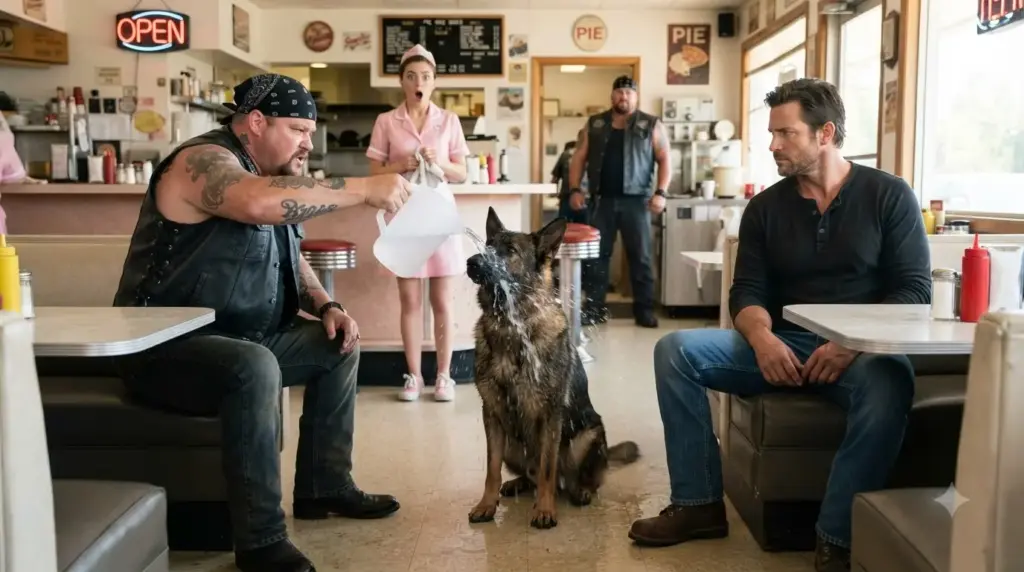
“Not so tough now, is he?” the man said, loud enough for half the Rusty Spit Diner to hear.
Rex stood beside Butch Calder’s booth with his square head lowered and his old tan service vest hanging over a chest that had gone gray around the muzzle long before the rest of him. He did not bark. He did not growl. He simply watched the man in the patched leather vest the way he had once watched doorways, alleys, and broken windows overseas, with the patient stillness of an animal that had learned the difference between noise and danger. Butch kept one hand around his coffee mug and the other resting on the edge of the table.
“Please,” the biker said, grinning at the two men behind him. “You and what army?”
Butch looked at Rex, then back at the biker. “I don’t need one.”
The laughter grew. The biker’s name was Clay Mercer, and he had been riding with the Red Mile Riders for less than a year, though he wore the club colors with the swagger of someone who thought cloth could make him older, tougher, and wiser all at once. He had spent the last ten minutes poking at Rex from across the aisle, first with jokes, then with a french fry tossed too close to the dog’s paws, then by calling him an oversized house pet in a vest. Nobody had stopped him because the Rusty Spit was crowded, everyone was tired, and cruelty delivered as humor often survived longer than it should.
Butch had ignored him until Clay leaned over and snapped his fingers beside Rex’s face.
“Stay,” Butch said quietly.
Rex did not move.
Clay straightened, amused. “See? Not so tough.”
The diner owner, Mara Keene, looked up from the register. “That’s enough, Clay.”
“You taking his side?” Clay asked.
A voice from the counter answered before Mara could. “That’s a war dog. Show some respect.”
The speaker was Luis Ortega, a retired diesel mechanic with hands like knotted rope and a habit of occupying the same stool every Tuesday morning. He was seventy-one and moved slowly until something annoyed him. Then he became suddenly younger in the face. Clay glanced at Rex again, his grin thinning.
“Didn’t know,” he muttered.
“Now you do,” Luis said.
Clay should have stopped there. Instead, embarrassed by the fact that the room had shifted against him, he stepped closer to Butch’s booth and reached down as if he meant to tug the edge of Rex’s vest. Rex rose in one smooth motion and moved between Clay and Butch, not lunging, not snapping, simply becoming a wall of muscle and attention. Butch’s voice stayed level.
“Rex. Block.”
The dog held position.
Clay swore, stumbled backward into a chair, and when Rex took one silent step after him, he turned and hurried toward the door. One of his friends laughed as Clay nearly clipped the coat rack on his way out. Rex stopped exactly where Butch had told him to stop.
“He ran,” someone said.
Butch scratched the dog’s shoulder. “So? Good boy.”
The diner relaxed by degrees. Conversation returned in pieces, then in waves. Mara brought Butch a fresh coffee he had not asked for and set a plate of bacon near Rex’s water bowl without looking at either of them too directly. Butch pushed the bacon back toward the counter.
“He doesn’t get paid in breakfast.”
“Then you eat it,” Mara said. “You look worse than he does.”
Butch almost smiled. Almost.
The truth was that people had been laughing at him longer than they had been laughing at Rex. Not openly, not usually, but in the quiet way small towns could hold a story against someone after they had forgotten most of the facts. Butch Calder had once been louder than anyone in the Rusty Spit. He had ridden hard, fought easy, and spoken about weakness as if it were a disease other men caught by standing too close to sadness. He had worn a patch for nineteen years, buried friends, broken bones, lost jobs, repaired motorcycles in three states, and believed strength meant needing nobody long before he realized how much damage a man could do with that belief.
Aaron had been his younger brother.
Aaron had been quieter.
That difference had been a problem between them almost from childhood. Butch came into every room like it owed him space. Aaron entered as if he were checking whether someone else needed the chair first. Butch collected stories about fights and long rides. Aaron remembered who took coffee black, who needed a ride after chemo, whose kid had a school play, and who had stopped answering texts after a bad week.
For years, Butch thought that made Aaron soft.
Aaron rode too. He could handle a bike through rain, gravel, or mountain wind with the same steady patience he brought to everything else. But he did not care about being seen arriving. He would show up at a man’s trailer with coffee and sit on the steps without asking questions. He would ride beside someone for fifty miles in silence because the person had said he could not stand being alone but did not want to talk. He once spent an entire night in a hospital parking lot because a club brother’s wife was in surgery and the man said he did not want company.
Butch told him he was wasting time.
Aaron laughed. “Maybe I’m saving it.”
Butch remembered those words because he had mocked them.
He remembered almost everything he wished he could forget.





