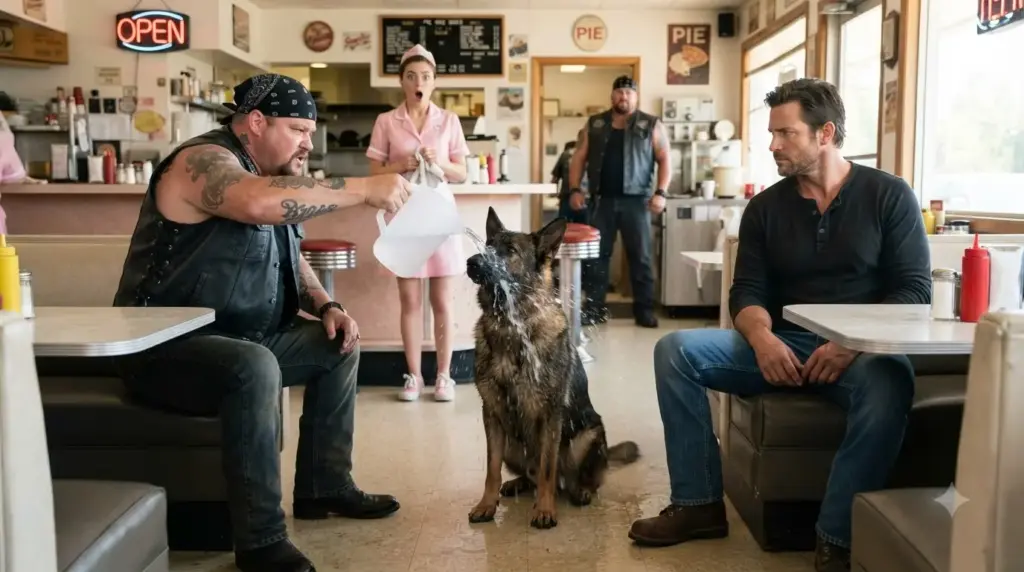
Mara opened the envelope in the diner with Butch, Luis, Sienna, and Rex nearby. The development company’s height and marina-access variances were denied because the plan failed several public-access and shoreline requirements unrelated to the emotional testimony. That did not automatically save the Rusty Spit, but it reduced the value of the developer’s offer enough that the property owner agreed to consider a longer-term lease with an option to purchase.
Mara sat down hard.
“The Rusty Spit will remain open,” she read from the county summary. “The small meeting room may continue serving the Open Table subject to occupancy and safety approval.”
Luis slapped the counter.
Sienna cried.
Butch looked down at Rex.
The dog yawned.
“He thought someone would continue this,” Mara said.
Butch looked toward the old wooden sign from Aaron’s locker.
“He made it easier for them too.”
Before the new room could officially open, the county required one final weekend of work. The second exit needed a push bar, the drywall around the electrical panel had to be replaced, and an old water stain in the ceiling had to be cut open to prove there was no active leak above it. Mara posted a handwritten list on the counter, not as a fundraiser and not as a public appeal, just a record of what still had to be done. By Saturday morning, six people were standing in the back room with tool belts, paint rollers, coffee, and no coordinated plan beyond the fact that the work was there.
Clay arrived last.
He came without his vest again, carrying a box of door hardware and a cordless drill. Butch watched him stop in the doorway, clearly uncertain whether walking into the room counted as asking forgiveness twice. Rex raised his head from the floor but did not stand.
“What are you doing here?” Butch asked.
Clay held up the box. “Mara said the exit needs hardware. I install commercial doors.”
Mara, standing on a ladder with a paintbrush, did not look down. “I said nothing. Luis told him.”
Luis kept tightening a ceiling fixture. “And I regret nothing.”
Clay shifted his weight. “I can leave.”
Butch looked at the drill, then at the unfinished door. Years earlier he would have made Clay earn the right to stay with a humiliation of his own. That instinct still existed. It simply no longer got the first vote.
“Door sticks at the bottom,” Butch said. “Frame’s out about an eighth.”
Clay nodded once. “I can fix that.”
He worked for three hours. No speech. No second apology. No jokes about Rex. When he finished, the door closed cleanly and opened with one push. Clay tested it four times, then handed Mara the spare key and started packing his tools.
Butch stopped him. “Coffee?”
Clay looked toward the Open Table. “You asking me to sit?”
“I’m asking if you want coffee. Don’t make it complicated.”
Clay almost smiled. “Black.”
They drank without talking about the day Clay had laughed at Rex. Butch understood, finally, that forgiveness did not have to erase the record. It could simply stop the record from becoming the only page anyone was allowed to live on.
That evening, after everyone left, Butch stayed behind to sweep the new meeting room. The county inspector was due Monday. Fresh paint had brightened the walls, but the room was still small enough that Butch could cross it in six steps. A narrow window faced the marina, and Mara had placed Aaron’s old wooden OPEN TABLE sign on the wall opposite the door.
Rex walked to the far corner and lay down.
Butch stopped sweeping.
The room was not the exact storage room where Aaron had once asked him to stay. That one had been remodeled years earlier when the diner changed ownership. But the dimensions were close, and the hum of the old refrigerator in the kitchen beyond the wall struck the same low note as the broken freezer from that night. For a moment Butch was no longer fifty-seven, gray in the beard, shoulders slower than they used to be. He was standing with one hand on a door while his younger brother sat in a folding chair trying to explain something Butch was too afraid to hear.
“What did you ask me to do?” Butch said aloud.
Rex lifted his head.
“Stay in the room.”
Butch leaned the broom against the wall and sat in one of the chairs. There was nobody across from him. No Aaron. No second chance disguised as a conversation. Just an empty chair, an old dog, and enough silence for the memory to exist without being fought.
He stayed anyway.
Ten minutes passed. Then twenty. Mara returned through the kitchen because she had forgotten her keys and found him sitting there in the dark except for the lamp beside the resource board. She did not ask if he was all right. She simply switched on the coffee warmer, poured two cups, and sat in the chair across from him.
After a while Butch said, “I thought if I admitted I was scared for him, that would make me weak too.”
Mara waited.
“He was asking me to sit there while he was hurting, and all I could think was that if I couldn’t fix it, I had no business being in the room.”
“A lot of people confuse usefulness with presence,” Mara said.
Butch stared at the empty cup between his hands. “He knew the difference.”
“Maybe that’s why he left you the key.”
Butch looked toward Aaron’s sign. For years he had treated the key like a message from a dead man telling him what he should have done. Sitting there, he understood something different. Aaron had not left an accusation. He had left instructions for the future.
The next morning, Butch added one sentence beneath the resource board in plain black letters.





