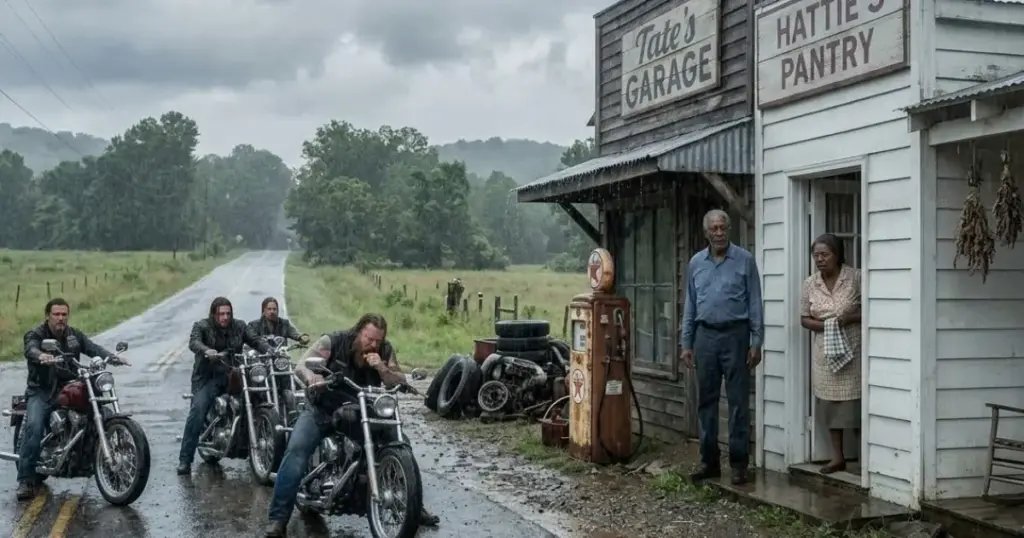
Booker Tate, 68, $43 in his cash box, a bank notice that said Tuesday. Sir, we got turned away everywhere. Cops told us move along. My brother’s sick. How sick? Heart. He needs to sit down now.
Booker glanced back. Hattie was already in the doorway, dish towel in hand. Come in, Booker there. I see what they are. Bring them in. The biker’s voice cracked. Ma’am, five doors said no. Booker just nodded. This one says yes, boy. Come on.
Five days later, 60 Harleys would roll up that same driveway, and the Tate name would be carried across four states.
48 hours before those four men knocked on his door, Booker Tate was doing what he’d done every morning for 43 years. He flipped the open sign at 5:00 a.m., touched the corner of his father’s photo above the workbench, whispered, “Morning, Daddy.” Then he went next door to kiss his wife.
Hattie was already at the griddle, apron tied, coffee on, the smell of biscuits and bacon drifting out into the gray Ohio morning. “Morning, sugar.” “Morning, baby.” “Sleep all right?” “Mhm, roof leaked again.” “I know, heard the bucket.” She handed him a mug without looking up. They’d done this for 43 years. They didn’t need to look anymore.
The Tate property sat on Route 9, 4 miles outside Blainboro. Two old buildings and a tired little house behind them. Tate’s Garage on one side, built by Booker’s father Ezekiel in 1954. Hattie’s Pantry on the other, added in ’82 when Hattie quit the diner in town to be near her husband. A narrow breezeway connected them. They ate lunch there together every single day at noon. Two mugs, two plates, 43 years. It was a life. A small, quiet, honest life. And it was about to end.
The bank notice had been on Booker’s desk for two months. He kept turning it face down. Hattie kept pretending not to see him turn it face down. Tuesday was the deadline.
Booker counted the cash box that morning. $43, two singles, a five, three 10s, a worn-out 50 he’d been saving in case the truck needed a new battery. He closed the box, looked at his hands. These hands had rebuilt 3,000 engines. These hands had splinted a child’s broken wrist once when a family broke down outside the shop in a thunderstorm. These hands had buried his mother, his father, and his only son. Now these hands were going to hand over the keys.
He didn’t tell Hattie that yet. She knew. She always knew. But neither of them was ready to say it out loud.
The chain auto shop two miles up Route 9 had been bleeding their customers for a decade. Slick signs, coupon books, a loyalty app on the phone. The young folks didn’t know what a master mechanic was anymore. They knew what a 15% off sticker was.
Booker had three regulars left. This is Hollister, whose husband had passed in spring. The Peterson kids, who brought their daddy’s old truck in on Sundays, and Russ from the gas station up the road who came in once a month for an oil change and stayed for biscuits. That was it. That was the whole business.
Hattie’s Pantry did a little better. Truckers stopped for her sweet tea, which was famous all the way to Cleveland, but not enough better. She kept a tin on the counter that read, “Coffee. Pay what you can.” Most days she lost money on that tin. Some days she didn’t. Some days a trucker would drop a twenty in and walk out before she could give change. That was Hattie. She gave the coffee before she counted the coins.
Two truckers came in at 5:15 for biscuits. Friendly fellows, knew Booker’s name, paid, left. After the door swung shut, Booker said quietly, “You notice how that one always waits for the other to pay?” Hattie didn’t look up. “Mhm.” “My daddy used to say, you learn who folks are by how they pay you, or how they don’t.” “He said a lot of things, your daddy.” “He did.” Booker drank his coffee. Hattie wiped the counter. Neither of them said the other thing, the thing Ezekiel used to say back in 1962 about being a black mechanic in a town that wouldn’t let him buy a sandwich at the diner across the street. They didn’t need to say it. Some things sit in the quiet between two people who’ve been married 43 years.
The hardest part of the morning came at 7:00. Their granddaughter Naomi came by before school. Seventeen years old, top of her class, built a working hydraulic engine for the science fair when she was 13. A week ago, the letter had come. Purdue University, College of Engineering. Admitted. She’d run down Route 9 holding that letter like it was a baby bird. Booker had cried right there in the garage, grease still on his hands. The tuition was 41,000 a year. They had $43 in the cash box and a bank notice that said Tuesday.
Naomi didn’t know about the notice. Hattie had made it clear. “She won’t hear it from me, baby. Not till after she signs whatever she needs to sign. She’s going to fight for it. Let her fight for it.” So that morning, Naomi sat at the counter eating a biscuit talking about thermodynamics and Booker sat across from her smiling, hand on his coffee mug. The lie of the morning weighing 40 lb in his chest. Hattie watched him from the griddle. Their eyes met once. She just shook her head slow. “Don’t, baby. Not yet.” He nodded, bit his biscuit, kept smiling.





