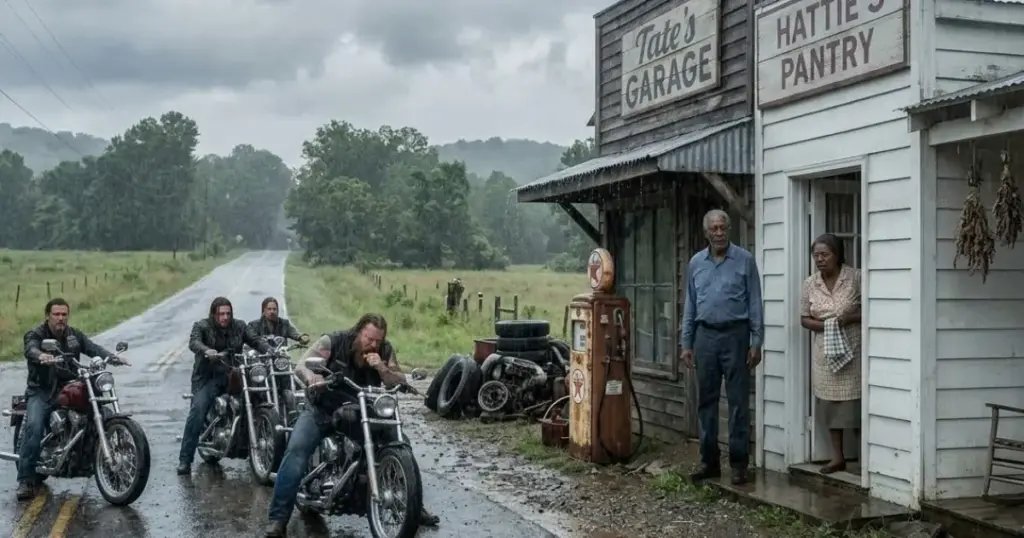
Sunday morning came up gray and cold, but the rain had stopped. Booker was out front by 6:00 surveying the damage. The storm had done what storms do. The gutter on the garage was hanging by two nails, more shingles missing off the pantry roof, the front sign had tilted another inch toward the road. He stood there in his work coat with a cup of coffee and looked at it all and didn’t feel much. He felt something else instead. He kept thinking about Dalton’s eyes when he said, “Lilly, she’s seven.”
Hattie opened the pantry at 6:30 like every other Sunday for 43 years. Two truckers came in for biscuits. One of them, Earl, drove for a feed company out of Akron, leaned an elbow on the counter and said, “Hattie, my buddy was driving past here last night around dark, said he saw bikers at your place. Big fellows, tattoos. You all right?” Hattie wiped a coffee ring. “One of them was sick.” “Sick how?” “Sick enough.” “Hattie, you be careful here. Folks like that…” “Earl, you want another biscuit or no?” Earl raised both hands. “Yes, ma’am.” She refilled his coffee, didn’t say another word about it.
Out in the garage, Booker rolled Dalton’s wrecked Harley further into the bay and pulled the tarp off. A beautiful machine, even ruined. Custom black paint with a hand-painted skull and wings on the tank. The frame was straight. The fork was tweaked, but fixable. The engine was the question. He laid a hand flat on the saddle without meaning to. He’d done that to a thousand bikes in his life. “Listening with his palm,” his daddy used to say.
The pantry phone rang at 7:15. Hattie picked it up. “Tate’s Pantry?” “Mrs. Tate?” “Yes, baby.” “It’s Hammer from last night. I’m calling from the hospital.” She set the rag down. “How is he?” “He’s going to be okay, ma’am. Cardiac team caught everything. Said another 20 minutes without those meds and warmth, it could have gone bad. He’s awake. Asking about y’all.” Hattie’s eyes filled up. She turned her back to the truckers at the counter and walked into the storeroom with the phone. “You tell him we’re glad. You tell him to rest.” “I will, ma’am.” “And Mrs. Tate, something else. Some folks might come by your place over the next few days. Just don’t be scared.” “What folks?” “Brothers, ma’am. Just brothers. Y’all did something last night. The kind of thing that doesn’t stay quiet.” She didn’t know what that meant. She said, “Okay.” She hung up.
She walked out into the pantry. Booker was coming through the door from the garage side. Their eyes met. “Hattie?” “He’s all right, baby.” “Praise God.” She didn’t tell him the rest yet. The part about brothers. She wasn’t sure what it meant, either. She tucked it in her apron pocket along with the plain card Hammer had slipped under the coffee tin the night before. The card had two words on it. Hammer Iron Crows MC and a phone number. She didn’t know what an Iron Crows MC was. She’d never heard of it. Neither had Booker.
What they didn’t know, what they couldn’t know, was that at that same moment in a hospital room 60 miles south, Dalton was on the phone with a man called Bones. A man whose voice was like gravel running through a cement mixer. A man who, when Dalton finished telling the story — five doors, the cops, the old man in the rain, the old woman with the biscuits — said only two things. The first was, “God damn it, Dalton.” The second was, “Don’t move. Don’t argue with the doctors. Let me make some calls.” Then he hung up.
By Sunday evening, 60 phones across four states would ring. By Monday morning, 60 men would start packing tools. But Booker and Hattie didn’t know any of that yet. They thought it was over.
Monday morning, Hattie opened up at 5:00 a.m. like she always did. There was a box on her porch. Plain brown cardboard, no tape, no label. She bent down and lifted the flap. Inside, a roll of high-grade electrical tape, two Napa oil filters in original packaging, a fresh tube of brake cleaner, a bag of clean shop rags, about $50 worth of supplies. No note. No card. She carried it inside and put it on the counter. Stood there a minute looking at it. Then she went and got Booker. “Somebody left this on the porch.” “Who’d leave this?” “I don’t know, baby. Customer, maybe? Somebody dropping off they couldn’t pay for last time?” “Maybe.” He went back to the garage, but she didn’t put the box away. She left it sitting on the counter where she could see it. She looked at it three more times before lunch.
Monday evening, two men she’d never seen pulled into the lot in a pickup. They came inside, polite, no eye contact problems, ordered three sandwiches and two coffees, asked her how long the pantry had been there. One of them said, “Mind if I get a picture of the sign? My wife collects pictures of old roadside signs.” Hattie said, “Sure.” He took two photos. They left a $50 tip on a $12 order. She showed Booker the bills later. He said, “Some folks are just generous.” She said, “Mhm.” But she put the 50 in a separate envelope.