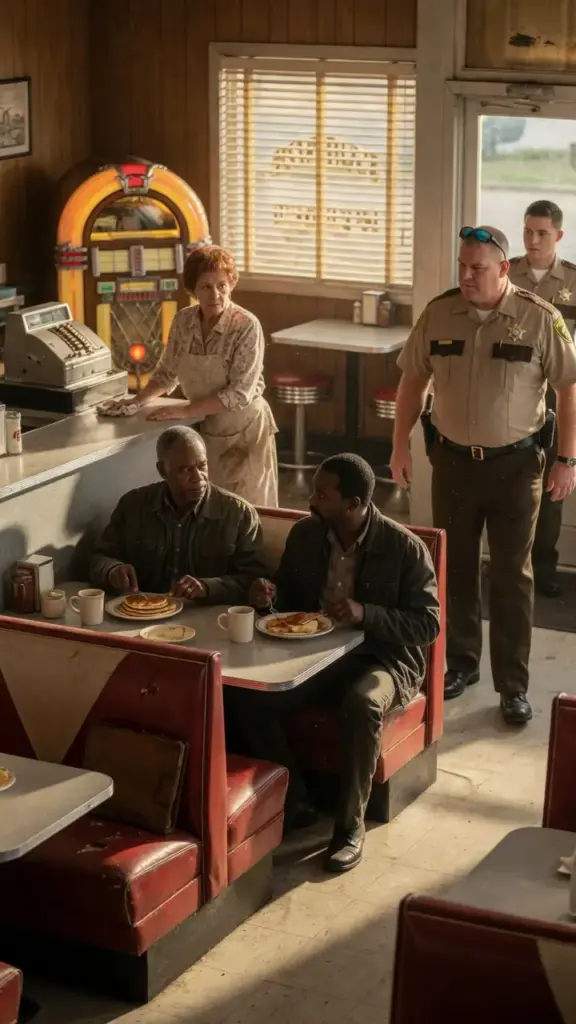
That’s how Dale Hutchins ran his county. Dirty money in his pocket. But today, he stopped dead when he saw two black men sitting in a corner booth. “Can we help you, officer?” “Yeah. Get out. I don’t serve animals at people’s tables.” His partner gripped his fork, jaw locked, knuckles pale. “Sergeant.” “And I said, ‘Move.'” “Before I put you somewhere you belong.” 12 people heard every word. Twelve people stared at their plates.
Nobody moved. But here’s what that sergeant didn’t know. Those two men he just called animals, they had badges, too. And everything he just said was already on tape.
“Hold on.” To understand what happens next, we need to go back 12 hours. Malcolm Owens sat in the passenger seat of a rented sedan watching the highway signs count down the miles to Ridgedale County. No government plates, no markings, just two black men in a Honda Accord that could have belonged to anyone. He had a leather folder open on his lap.
Eight complaint reports. Same name on every single one. Sergeant Dale Hutchins. Racial profiling, illegal stops, falsified reports.
All of them closed by the local department with the same two words, “unfounded allegation”.” Terrence Blake drove, former college linebacker, quiet, the kind of guy who listened more than he talked. He glanced at the folder. “Eight complaints in three years, and nobody did anything?” “Local oversight protects their own,” Malcolm said. His voice was calm, measured, the tone of a man who’d seen this before.
“That’s why we’re here.” Two weeks ago, Captain Elaine Crawford had called them into her office at the State Bureau of Professional Standards. She slid the Ridgedale file across her desk and said one sentence, “I need you to see if this is real.” The assignment was simple. Spend a weekend in Ridgedale County. Eat at restaurants, walk around town, exist as two black men in public spaces.
If Hutchins was dirty, he’d show himself. Body cameras concealed, audio recording, every second documented. Malcolm adjusted the rearview mirror and checked his reflection. Habit.
Years of knowing that before he opened his mouth, people would see his skin first. He wore a polo shirt, jeans, a nice watch his wife bought him for their anniversary. He looked like a man on vacation. That was the point.
Terrence broke the silence. “You ever get tired of this?” “Of what?” “Being the test, the bait.” Malcolm was quiet for a moment. Then he said, “Yeah,” every time.” They crossed into Ridgedale County just after sunset. One Main Street, a courthouse with a Confederate memorial on the lawn, a gas station flying a Blue Lives Matter flag next to the American one, a hardware store, a church with a sign that read All welcome.
Though Malcolm had learned long ago that all didn’t always mean all. And at the center of it, Brenda’s Griddle House. The kind of place where everyone knew everyone, where deals got made over coffee and gossip traveled faster than the Sunday paper. Saturday morning, 9:15, Malcolm and Terrence walked into the diner.
A bell above the door jingled. Heads turned just for a second, then went back to their plates. Curious glances, not hostile, not yet. Brenda Carlyle, the owner, came over with two menus.
60-something, silver hair pulled back. She smiled, but it didn’t reach her eyes. “Sit anywhere you like.” They took a corner booth, the kind with cracked red vinyl and a window view of Main Street. Malcolm could see the whole room from here.
Another habit. The diner smelled like bacon grease and burnt coffee. The jukebox in the corner hummed low, some old country song Malcolm didn’t recognize. Plates clattered in the kitchen.
A waitress poured coffee at the counter, the ceramic mugs clinking together like church bells. They ordered. Pancakes, eggs, coffee. Normal.
“Easy.” Terrence pulled out his phone, pretended to scroll. Really, he was checking the concealed recorder in his jacket pocket. Green light. Rolling.
Malcolm sipped his coffee, watched the door. Near the register, a waitress leaned toward Brenda and whispered something. Malcolm caught the fragment. “Hutchins usually comes in around 9:30.” Brenda’s whole body tensed.
She wiped the same spot on the counter twice, three times. That told Malcolm everything. This man had weight in this town, the kind of weight that made people wipe counters that were already clean. Terrence saw it, too.
He set down his phone. “He’s coming.” Malcolm nodded, didn’t look up, just stirred his coffee and waited. The bell above the door jingled. Dale Hutchins walked in, full uniform, Ridgedale County Sheriff’s Office patch on his shoulder, gun belt sitting heavy on his hips, mirrored sunglasses pushed up on his buzz-cut head, even though the sun wasn’t in his eyes.
Behind him, a younger deputy, mid-20s, Cody Lassiter, skinny kid with a fresh haircut and a uniform that looked like it still had creases from the package. The diner went half silent. Forks slowed. Conversations dropped to murmurs.
Brenda straightened up behind the register like a student when the principal walks into class. Hutchins didn’t head to the counter, didn’t wave at the regulars. His eyes swept the room in one practiced motion and locked onto the corner booth where Malcolm and Terrence sat. He walked straight toward them.
His boots hit the tile floor with that deliberate cop rhythm. Slow. Heavy. The kind of walk that says, “I have all the time in the world, and you don’t.” He stopped at the edge of their booth, didn’t sit, didn’t lean, just stood there, looking down at them like a man inspecting something he stepped in.





