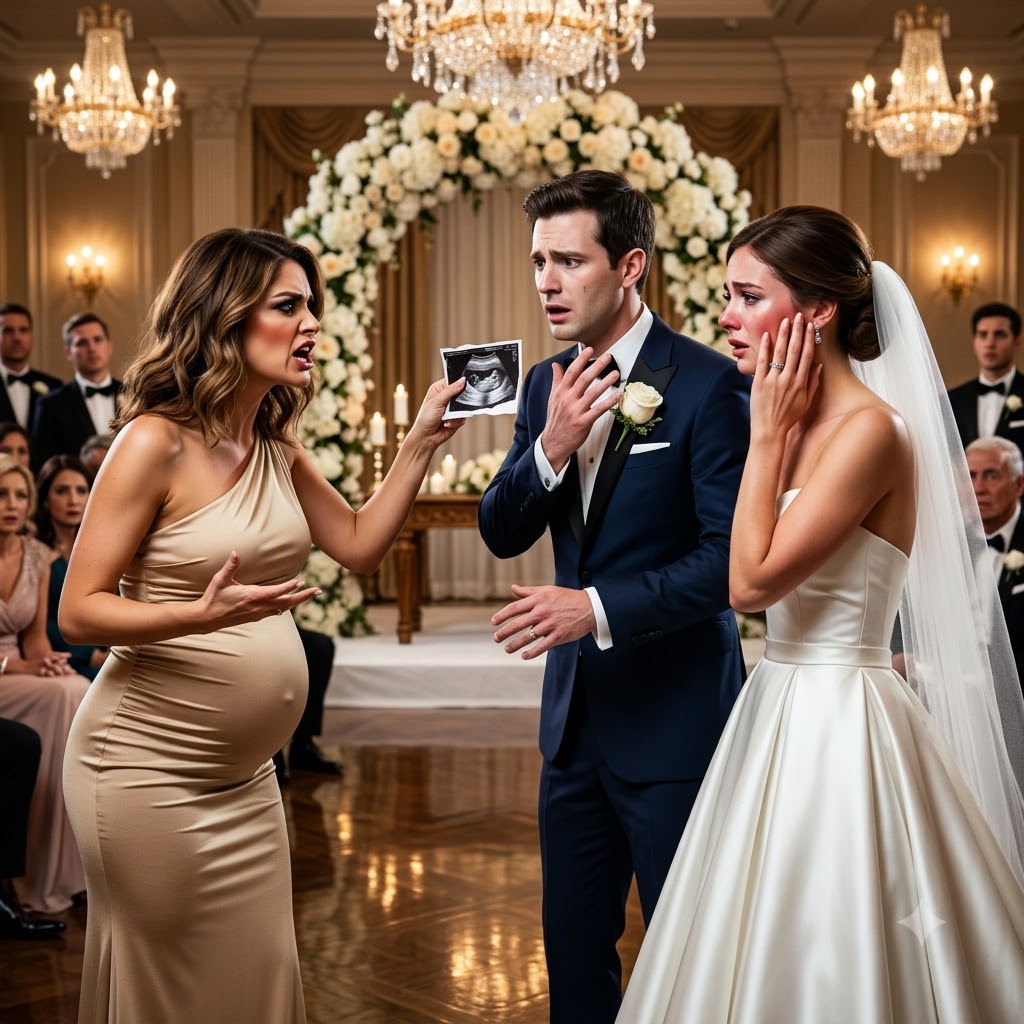
The pregnant woman slapped the bride before the wedding vows could turn a lie into a lifetime.
The sound cracked across the Newport mansion lawn.
White chairs, golden sunlight, and perfect flowers froze around the altar.
The bride staggered one step, her bouquet dipping toward the polished aisle.
One trembling hand rose to her reddening cheek.
Her pearl earring shook against her skin.
The groom turned pale before anyone even asked why.
The pregnant woman stood in front of them with tears in her green eyes and fury locked in her jaw.
She was visibly pregnant, dressed in dark blue, and breathing like a woman who had swallowed silence for too long.
Guests stared, but no one spoke.
The bride looked at her, wounded and confused.
The pregnant woman met her eyes directly.
“You’re marrying the father of my baby.”
The bride’s face changed slowly, painfully.
Not because she understood everything.
Because her heart understood enough.
She turned toward the groom.
Her eyes filled with tears.
She silently asked him to deny it.
He looked away.
That was the first confession.
The crowd stayed frozen beneath the floral arch.
The groom stepped forward fast, panic breaking through his perfect tuxedo smile.
He grabbed the pregnant woman’s wrist and pulled her away from the altar.
His grip was not protective.
It was controlling.
It was the hand of a man trying to drag the truth out of sight.
The pregnant woman planted her feet.
She did not scream.
She did not beg.
She stared at him like fear had finally died inside her.
He looked directly at her, breathing hard.
“I told you not to come here.”
The bride went still.
Those words destroyed the last piece of hope inside her.
He knew this woman.
He knew about the baby.
He knew exactly what he had hidden.
Tears fell down the bride’s face, but she did not collapse.
Her white gown caught the golden light like the day was still pretending to be beautiful.
The pregnant woman yanked her wrist free.
The groom’s hand dropped uselessly to his side.
She stepped back to the altar table.
From her hand, she unfolded an ultrasound photo.
She placed it flat on the table in front of the bride.
The image was small.
The silence around it was enormous.
The bride looked down at it.
Then she looked back at the groom.
His face had gone rigid and colorless.
The pregnant woman turned to the bride, not to him.
Her voice was quiet, controlled, and brutal.
“He chose your money, not you.”
The sentence struck harder than the slap.
The bride’s breath broke.
The guests finally understood what kind of wedding they had been invited to witness.
Not love.
Not commitment.
A transaction dressed in white flowers.
The groom had not chosen a wife.
He had chosen a fortune.
The bride’s father rose from the front row.
His chair scraped against the stone aisle.
His steel-blue eyes locked onto the groom with cold fury.
No one moved.
The groom stood trapped between the woman he used, the woman he abandoned, and the child he tried to erase.
The pregnant woman wiped no tears away.
The bride stood shattered beside the ultrasound photo.
Her father’s stare sharpened like a verdict.
The groom opened his mouth, but no excuse could survive that silence.
The altar had been built for vows.
Instead, it became evidence.
And the man who came to marry money lost his mask in front of everyone.
Salt air always carried two distinct odors up the granite bluffs of Bellevue Avenue in late September: the clean, briny tang of the Atlantic breaking fifty feet below the seawall, and the faint, sweet rot of crushed hydrangeas left behind by caterers’ trucks.
Clara Sterling stood just inside the French doors of the Rosecliff conservatory, holding her breath while two seamstresses on their knees steamed a phantom crease out of five yards of silk mikado. Through the leaded glass, three hundred white Chiavari chairs gleamed in disciplined rows across the manicured emerald lawn, bisecting a runner of ivory travertine that led straight to a cedar arch choked with imported Dutch peonies and white Juliet roses. Beyond the arch, Narragansett Bay burned silver-gold under a four-o’clock sun, dotted with the triangular white sails of forty-foot sloops that belonged to men who were currently sitting in the third and fourth rows checking Bloomberg terminals under their programs.
“Breathe from your ribs, sweetheart, or you’ll faint before the cello finishes the Pachelbel,” her father said.
Richard Sterling stood near the marble mantelpiece, adjusting a pair of platinum cufflinks that had belonged to Clara’s grandfather. At sixty-four, with silver hair cut sharp as steel wire and ice-blue eyes that had gutted three rival shipping conglomerates before Clara finished middle school, Richard did not look like a father giving away a daughter. He looked like a chairman presiding over an acquisition he remained privately skeptical about, even after signing the term sheet.
Clara forced a smile, touching the single teardrop South Sea pearl trembling at her left earlobe—her mother’s earrings, taken out of the Providence vault yesterday afternoon. “I’m breathing, Dad. Just trying not to crush the bodice.”
“You could wear burlap and outshine half of Newport,” Richard said, though his gaze drifted past her shoulder, out through the glass toward the altar where Julian Vance stood waiting beside Bishop Talbot.
From sixty yards away, Julian looked as if he had been cast in bronze specifically for a bridal magazine cover. Tall, broad-shouldered inside a bespoke midnight-navy Tom Ford dinner jacket, his dark blond hair catching the slant of coastal light, he was smiling effortlessly at Senator Aldrich in the front row. Everything about Julian was calibrated to put rich men at ease: the firm, two-second handshake, the self-deprecating stories about rowing bow seat at Dartmouth on financial aid, the earnest, unhurried attentiveness when older executives spoke about municipal bond yields.