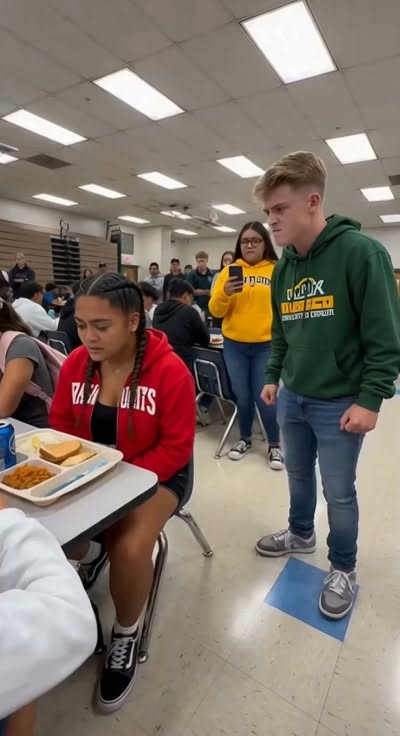
I had grown up under expectations.
The air inside the Makai High School gymnasium was always heavy, a suffocating blend of Honolulu humidity, aerosol hairspray, and the sharp, chemical tang of fresh floor wax. For most of my life, it was a scent I associated with sanctuary. The varnished maple planks were where the noise of the world faded, replaced by the rhythmic, squeaking chorus of rubber soles and the resounding smack of leather meeting palm.
But this season, the gym felt less like a sanctuary and more like a terrarium. And Kenzie Hale was the apex predator tapping on the glass.
I stood at the baseline, a seventeen-year-old Samoan American girl with broad shoulders and thighs built for explosive vertical leaps. I spun the volleyball in my hands, feeling the textured seams against my calloused fingertips. Across the net, Kenzie was stretching, though it looked more like she was posing for a fitness magazine. She wore her custom, navy-blue captain’s jacket unzipped, revealing the pristine white of her uniform. Her blonde ponytail swung in a perfect, calculated arc as she laughed at something our head coach, Coach Davis, had just whispered to her.
Above them, suspended from the steel rafters, hung the glossy new banners. HONOR. TEAMWORK. FAIR PLAY. They were printed in vibrant Makai Blue, paid for entirely by Pacific Heights Development—the real estate conglomerate owned by Kenzie’s stepfather. The same company had paid for the new maple floor beneath my feet, the hydraulic net systems, and the digital scoreboard that loomed over the court like an omniscient, glowing eye.
Kenzie hadn’t just grown up under those banners; she had grown up under the absolute certainty that the world they overlooked belonged to her.
I, on the other hand, had grown up under expectations. Keep your head down, Malia, my father would tell me, his massive hands resting on my shoulders before every tournament. Let your work speak. The loudest one in the room is usually the weakest. Be the mountain, not the wind.
For three years, I had been the mountain. I took the grueling practices. I absorbed the passive-aggressive comments about my size, my thrift-store knee pads, the fact that I had to take the city bus home instead of climbing into a sleek silver Range Rover. I swallowed my pride when Coach Davis inexplicably benched me during crucial sets, despite my hitting percentage being the highest in the district. I kept my head down. I passed the ball.
But the mountain was about to erupt.
The catalyst wasn’t a bad practice or a snide comment. It was a manila folder, currently tucked inside my gym bag on the bleachers, practically burning a hole through the nylon canvas.
Two days prior, I had been in the windowless equipment room, hauling out the heavy ball carts. Kai, our junior equipment manager, was sitting at his cramped desk in the corner. Kai was a quiet, lanky kid whose genius with electronics was only matched by his profound disdain for the school’s social hierarchy. He spent his days repairing the iPad stat-trackers and managing the digital video feeds for the coaches.
“Malia,” he had said, his voice barely a murmur over the hum of the air conditioner. “You need to see this.”
I had dropped the ball cart and walked over to his glowing monitors. Kai pulled up the athletic department’s secure server, bypassing the coach’s firewall with a few casual keystrokes.
“UCLA and Stanford scouts are coming to the scrimmage on Friday,” Kai said, not looking at me. “Coach Davis has been sending them preliminary stat sheets to highlight players to watch.”
“I know,” I said, my chest tightening. I had been dreaming of a Stanford scholarship since I was twelve. It was the only way I was going to college.
“Look at your stats,” Kai instructed, pointing a pen at the screen.
I leaned in. The numbers next to my name were entirely wrong. My kill percentage was slashed by half. My service errors were quadrupled. According to the official database, I wasn’t a powerhouse outside hitter; I was a liability.
“What is this?” I breathed, the blood draining from my face. “Did the app glitch?”
Kai shook his head grimly. He clicked another tab, bringing up a complex string of system logs. “Not a glitch. An edit. The database was manually altered after every game. Someone logged in and meticulously lowered your metrics. At the exact same time, they inflated Kenzie’s.”
I stared at the screen, the betrayal sinking into my bones like lead. “Coach Davis?”
“No,” Kai said, tapping the screen. “Look at the IP address. These changes weren’t made from the coaches’ office. They were made from a private network in Diamond Head. I ran a trace. It’s the Hale residence.”
The air in the cramped room had vanished. Kenzie. Kenzie had the administrative passwords—probably lifted from Coach Davis’s unlocked iPad during practice. She knew I was her only real competition for the Division 1 recruiters. She couldn’t out-jump me. She couldn’t out-hit me. So, she decided to digitally erase me.
“I printed the raw data,” Kai said, handing me a thick manila folder. “The unedited server logs, the IP traces, and the real stats pulled from the raw video analysis software. It’s bulletproof. But Malia… if you use this, you’re going up against her whole family. They own this gym.”
“They don’t own me,” I had whispered, taking the folder.
Now, standing on the baseline on the afternoon of the scrimmage, that folder was pressed flush against my chest. I had retrieved it from my bag right as the whistle blew to end warm-ups. The bleachers were packed. The Stanford scout, a stern-looking woman with a clipboard, was sitting in the third row.
The scrimmage was tied, 14-14. Tension crackled in the heavy air.
Coach Davis called a time-out. The varsity squad jogged to the sideline, panting and glistening with sweat. Kenzie was holding court, waving her hands animatedly.





