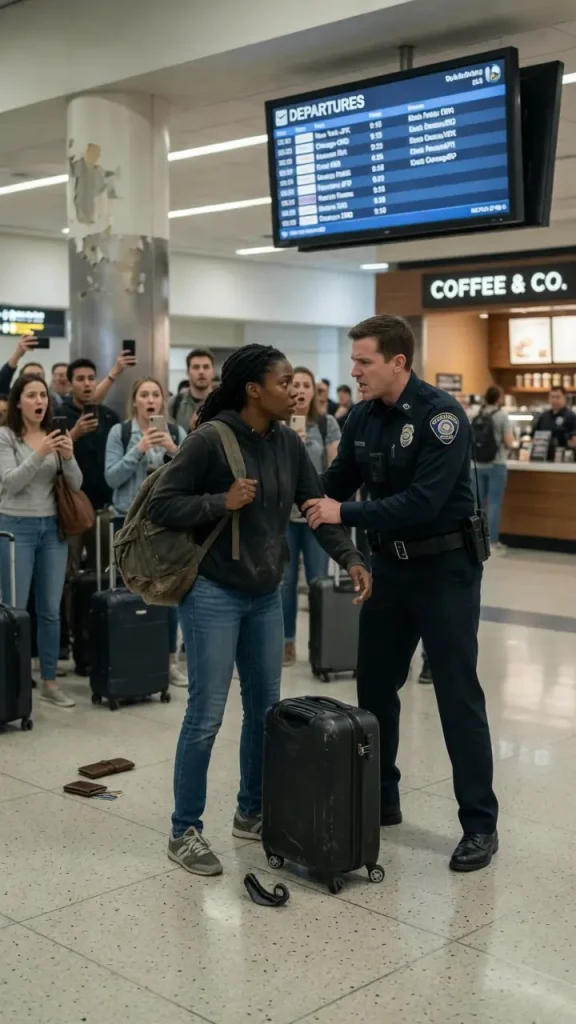
Nobody in that terminal could have guessed that the quiet woman gripping a scuffed backpack strap had once been trained to disappear into rooms full of danger and walk out without leaving a single trace. Within the hour a police officer would slam his boot into her leg in front of hundreds of witnesses accusing her of resisting arrest for a crime she had nothing to do with. Cell phones would rise into the air, screams would echo off the terminal ceiling, and nobody standing there filming would understand that they were about to witness the awakening of a woman the government itself had once been too afraid to name out loud. Her name was Maya Brooks and she was 34 years old though something in the stillness of her eyes made her seem both younger and far older than that number suggested.
She wore no jewelry, carried no expensive luggage, and moved through the terminal with the unhurried patience of someone who had learned a long time ago that panic never solved anything. To anyone watching she looked like a woman heading home from a long shift or perhaps a traveler stretching a modest budget across a long trip. In truth, she was flying to Washington to start a quiet unremarkable civilian job. The kind of position that came with a badge that opened doors but never announced itself.
She had chosen it on purpose. After everything she had lived through, she wanted mornings that felt ordinary, coffee that tasted like nothing more than coffee, and a life where nobody looked twice at her. Even so, certain habits refused to leave her body no matter how many years passed. She counted exits without meaning to, cataloging every door, every stairwell, every gap in the crowd where danger could slip through unnoticed.
She never sat with her back to an open room. She noticed the rhythm of footsteps around her, the way other people noticed music, picking out anything that broke the pattern. She had once explained this briefly and reluctantly to a therapist assigned to her after leaving the service, who had gently suggested that such hypervigilance might ease with time. It had not eased, not fully, though she had learned to carry it quietly, folding it into the background of an otherwise unremarkable life, rather than letting it define her every waking moment.
These were not choices anymore. They were instincts carved so deep into her that she barely registered doing them, the same way a person breathes without thinking about their lungs. Years earlier, before the quiet apartment and the modest wardrobe and the careful anonymity, Maya had served in a classified special operations unit that did not exist on paper, the kind of unit whose members were erased from official records the moment they were recruited. She had walked into embassies under siege and walked out again before backup even arrived.
She had done things that saved lives and things she chose never to speak of again. Now, she simply wanted to be forgotten. And for years, the world had cooperated. Years earlier, in a life she rarely allowed herself to remember in detail, Maya had operated under conditions that most people could never imagine surviving even once, let alone repeatedly across a decade of service.
She had spent nights in places without names on any official map, waiting in silence for hours at a time, trained to control her own heartbeat the way other people controlled their breathing. She had learned to read a room in less than three seconds to identify the single most dangerous person in a crowd before that person even realized they had been noticed. That training had cost her friendships, relationships, entire years of her life spent invisible to everyone who might have loved her. And when she finally left the service, she carried both pride and quiet grief in equal measure.
She told herself boarding that flight in Los Angeles that those years were finally behind her, that the woman in the hoodie pulling a broken suitcase was simply Maya now, nothing more and nothing less. It was a Tuesday morning, ordinary in every visible way. The kind of morning that gives no warning of what it is about to become. Announcements crackled overhead, a toddler cried somewhere near the coffee kiosk, and a line of passengers inched forward through the security checkpoint with the practiced boredom of frequent flyers.
Maya checked the time on a cracked phone screen, calculated how long she had before boarding, and allowed herself, just for a moment, to imagine the calm apartment waiting for her on the other coast. She had no idea that a young officer standing near the gate had already noticed her, had already begun building a story about her in his mind that had nothing to do with the truth. She had no idea that within 20 minutes that story would nearly cost her everything she had worked so hard to leave behind. Officer Ryan Coleman had been on the force for less than two years, and in that short time he had developed a reputation among his colleagues for two things: an eagerness to prove himself, and a temper that flared faster than it should have.





