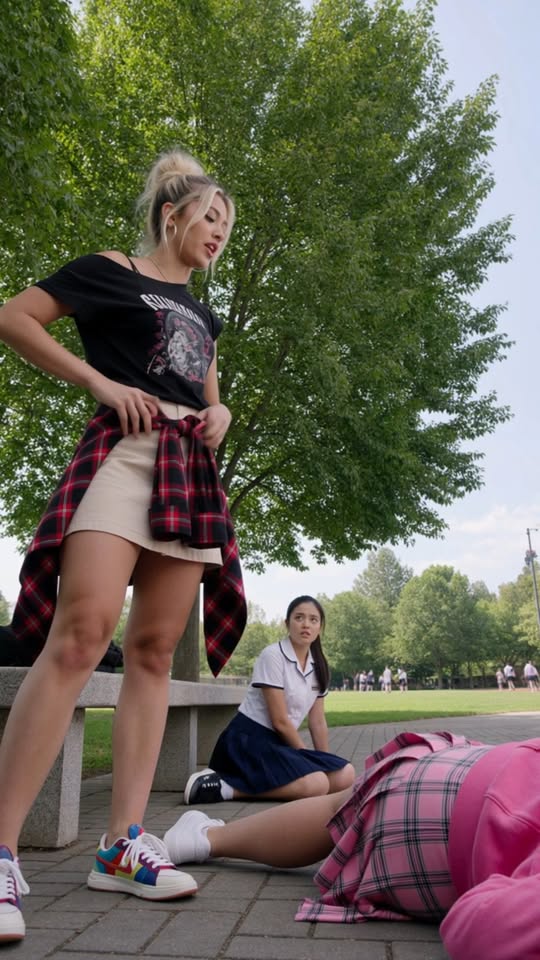
The fog never truly burned off the damp hollows of Blackwood Academy; it merely retreated into the ancient hemlocks that bordered the limestone quadrangle.
Established in 1892 as an asylum for wayward sons of industrial barons, the school had spent the subsequent century laundering its reputation into that of an elite preparatory institution. Yet beneath the manicured wisteria and leaded gothic windows, the architecture of the place remained predatory. Its stone staircases were worn concave by generations of carefully calculated cruelty.
Kai Mercer understood the anatomy of institutions built on stone and fear. She knew how dampness seeped through thin soles, how institutional radiators groaned like dying animals in the early morning, and how whispers traveled down vaulted hallways faster than grease down a drain.
She sat on the weathered wooden bench beneath the copper beech tree at the eastern corner of the lower courtyard. It was 7:42 AM. The first bell would not ring for eighteen minutes.
Her fingers, calloused along the inner edge of the second knuckles and across the flat pads of the palms, carefully traced the spine of an aged, cloth-bound notebook. It was not school property. The pages inside were filled with meticulous, handwritten anatomical notes, vector diagrams of body mass distribution, and entries penned in her father’s spare, slanted handwriting: Kuzushi precedes all things. Without unbalancing, effort is vanity. With unbalancing, a child moves a mountain.
“Quiet morning, isn’t it?”
Kai did not lift her head from the page, but her peripheral vision took in the scuffed leather loafers of Julian Vance. Julian was the headmaster’s nephew, an anxious boy with an overbite and perpetual ink stains on his cuffs. He had spent the last two weeks hovering at the edges of Kai’s orbit, hovering like an insect that sensed a change in atmospheric pressure.
“The wind is coming out of the north,” Kai murmured, her voice carrying the dry, unhurried cadence of the timber country she had left three weeks ago. “It will rain before fourth period.”
Julian hesitated, leaning against the damp brick wall of the science annex. “You shouldn’t sit here, Mercer. I told you on Tuesday. The beech bench belongs to the varsity row.”
“The bench belongs to the Board of Trustees, who purchased it from a lumber mill in Duluth,” Kai said evenly, turning a page. “And unless the varsity row plans to hold an outdoor scrimmage on wet slate, I doubt they require the seat.”
“That’s not the point, and you know it,” Julian whispered, glancing anxiously across the terrace toward the wrought-iron archway that connected the senior quad to the lower court. “Jessica’s car just cleared the southern gate. The Land Rover. The dark green one.”
Kai didn’t look up. “She drives fast on wet gravel. That’s bad for the transmission.”
“She’s looking for blood, Kai. Yesterday in Advanced Placement Biology, you didn’t just correct Mr. Sterling; you corrected her lab sheet. In front of the lacrosse captains. Nobody does that. Even the faculty let her slide on the cell respiration diagrams.”
“Her ratios were calculated in imperial ounces instead of metric grams,” Kai said simply, closing the notebook with a soft, velvet-lined thud. “If you administer pharmaceuticals using those conversions, you rupture the patient’s liver. Truth isn’t a social arrangement, Julian.”
“Here, it is,” Julian said, his voice dropping an octave as his eyes darted toward the iron archway. “God. She’s already across the arcade.”
The courtyard had been steadily filling with the morning tide of gray flannel blazers, navy pleated skirts, and expensive wool scarves. But as three figures crossed beneath the wet stone arch, the ambient sound—the nervous chatter of freshmen, the scrape of boots on limestone, the rustle of brown paper lunch sacks—drained away like water through a cracked cistern.
Jessica Drake moved with the terrifying, unconscious poise of someone who had never once in her seventeen years encountered an unyielding surface. Her father was Chairman of the State Judicial Oversight Committee; her mother’s maiden name was carved into the architrave of the library. She was tall, with cheekbones that looked chipped from winter ice and honey-colored hair pulled into a sleek equestrian ponytail that fell straight past her shoulder blades. She wore her blazer unbuttoned, violating dress code with the casual contempt of someone who knew the headmaster personally vetted her quarterly progress reports.
Behind her flanked the twin pillars of her social architecture: Chloe Vance, whose brother was on the disciplinary tribunal, and Mia Sterling, whose mother controlled the alumni endowment fund. Both carried identical leather satchels and walked with the sharp, rhythmic stride of well-trained hunting dogs.
The fifty-odd students idling near the fountain did not scatter. That was not how the theater of Blackwood operated. Instead, they shrank inward, pressing themselves against the stone balustrades and the mossy retaining walls, their faces assuming the glazed, voyeuristic neutrality of spectators at a public execution.
Kai remained seated. She adjusted the dark wool cuff of her secondhand uniform jacket, feeling the rough weave against her wrist. Beneath the fabric, her tendons were long, dense, and quiet.
“Get up,” Jessica said.
She had not shouted. Her voice was remarkably soft, cultivated in private tennis academies and boarding school dormitories where screaming was considered vulgar. It was an executive voice.
Kai looked up, her dark eyes clear and unclouded by the adrenaline currently paralyzing every bystander within thirty yards. “Good morning, Jessica.”
“I said get up off the bench, Mercer.”
“There is room for three more people,” Kai said, gesturing slightly to the weathered slats beside her. “Though the wood is slightly damp. If you sit, you’ll ruin the wool of that skirt. It’s eighty percent cashmere, isn’t it? It absorbs moisture quickly.”
A choked breath escaped someone near the fountain.





