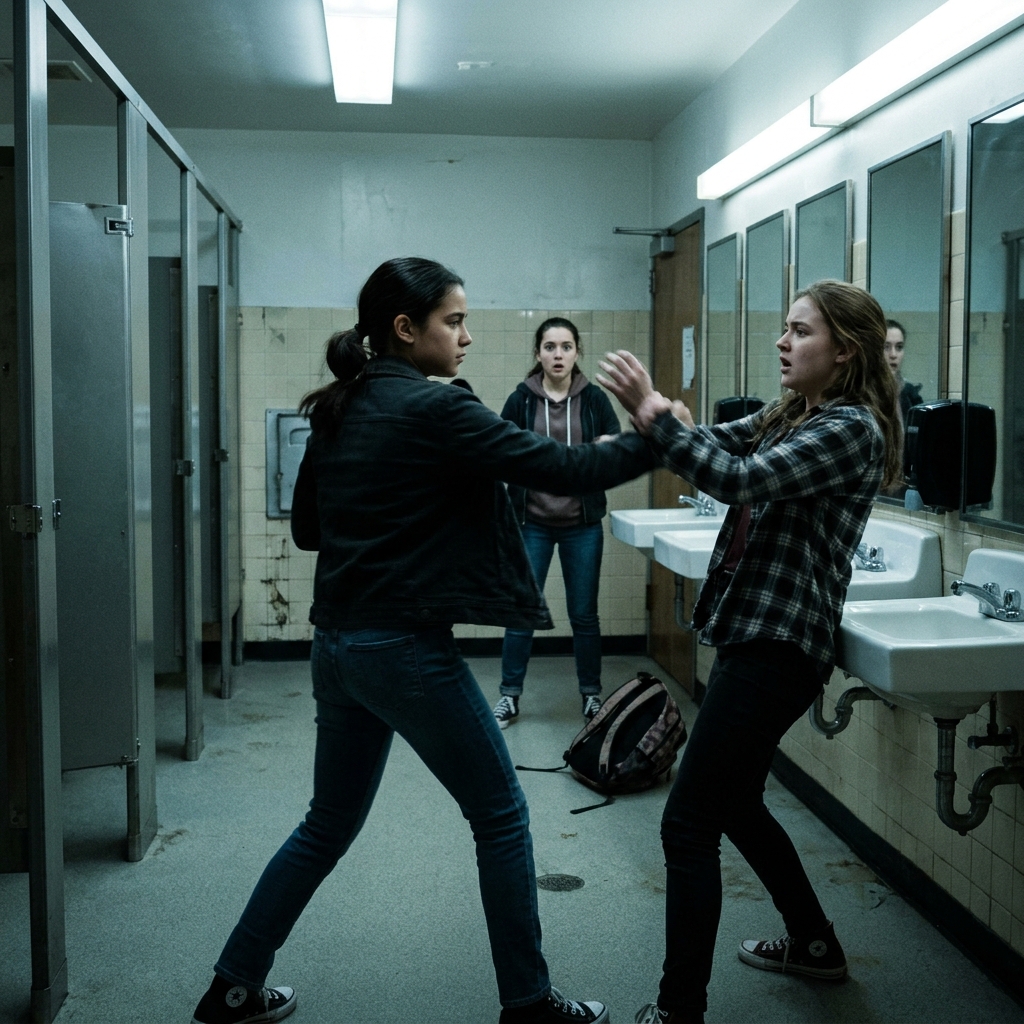
A hard shove against the sinks, a cruel smirk, and the message is clear: “You don’t belong here.” But this time, Maya doesn’t break.
What follows is a tense, realistic confrontation where fear flips into focus. Lexi throws the first move, then Roxy charges in, confident they can overpower her. Instead, Maya uses calm, skilled self-defense—blocks, pivots, and controlled counters—to shut down their attack without losing her cool. No wild brawling, no drama for no reason—just a girl reclaiming her space and her respect.
In the end, there are no screams, no tears—just one powerful line: “You can lock the door… but you can’t lock me out of my own life.” If you love high-school drama, strong female leads, and satisfying karma moments, this short cinematic reel is for you. Watch till the last second for the payoff that hits harder than any punch.
The institutional paint peeling from the west-wing walls of Hawthorne Academy possessed the pale, sickly tint of an old bruised turnip. Beneath it lay fifty years of cinder block, chilled by the damp mid-November fog that rolled off the salt marshes of coastal Connecticut and settled into the masonry.
Maya Lin knew every hairline fracture in those blocks. She had counted twenty-seven radiating outward from the rusted paper towel dispenser in the second-floor girls’ restroom during her first week as a scholarship transfer. By the end of October, she knew that the third stall door hung an inch lower than the frame, that the pipes groaned three seconds before the radiator hissed hot steam, and that the brass latch on the exterior door could be engaged from the inside without a key if someone had the patience to wedge a penny beneath the deadbolt return.
At 3:12 on a drizzling Tuesday, Maya stood over the central porcelain basin with her sleeves rolled twice above her forearms. The cold tap sputtered, spitting rust-tinted water that swirled around the brass drain in a sluggish, clockwise vortex. Her hands were gray with charcoal dust. She had spent the last eighty minutes in the third-floor studio under Mr. Vane’s indifferent supervision, working through the delicate, layered shading of an anatomical hand study. The regional youth fellowship application was due by five o’clock in the administrative office; her train ticket down to New Haven for the final interview was pinned to the inside cover of her canvas portfolio with a rusted paperclip.
The fellowship was worth twelve thousand dollars in tuition remission. To the girls who parked their imported convertibles in the south lot beneath the weeping willows, twelve thousand dollars was an upholstery upgrade on a sixteen-foot runabout. To Maya’s father, who spent sixty hours a week operating a band-saw at the Thames River lumber wharf with an elastic tensor bandage wrapped tight around his lower lumbar spine, it was the exact difference between his daughter finishing her senior year or returning to the public comprehensive across the tracks in New London.
“Work quietly, little bird,” her grandfather used to whisper in the small, kerosene-heated garage behind the fish packing plant where he kept his heavy canvas mat. “The nail that sticks up gets the hammer, yes? But the stone beneath the water outlasts the tide. When they look for your fear, give them nothing to see. When they push, show them that your feet are rooted in the earth, not in their permission.”
Maya dried her palms on a coarse paper towel, feeling the rough, cross-hatched calluses along the base of her fingers. They were not the hands of a Hawthorne girl. They bore no pale half-moons of French lacquer, no delicate gold rings inherited from grandmothers who summered on Martha’s Vineyard. The skin over her second knuckles was dense, scarred faintly from thousands of strikes against the split-pea makiwara board her father had bolted to the cellar beam when she was seven years old.
The heavy mahogany door to the corridor clicked.
It did not open wide. It drifted inward three inches, pausing on its brass hinges, before slipping closed with a sound that was far too deliberate for a casual passerby.
Click.
The dull, metallic thud of the brass deadbolt sliding into the strike plate resonated through the empty tiled chamber like an iron bar falling across an entrance.
Maya didn’t flinch. Her hands remained flat against the damp paper towel, but her shoulders lowered by a fraction of an inch, her weight shifting effortlessly onto the balls of her sneakers. She met her own gaze in the silvered, mercury-spotted mirror above the taps. Her dark hair was pulled into a high, disciplined queue at the crown of her head; her collarbones sat level above the faded navy cotton of her school cardigan.
Behind her, emerging from the shadow of the entry vestibule, stood Roxanne Sterling.
Roxy was seventeen, five feet nine inches of equestrian posture and tennis-court agility, wrapped in a tailored camel-hair blazer that violated the academy’s uniform code with the quiet, structural arrogance of someone whose father’s foundation had funded the new science wing. Her honey-colored hair was ironed into submission, falling over her left shoulder in a pale silk ribbon. In her right hand, she balanced a heavy, silver-cased smartphone, its screen dark, its lens pointed casually forward at waist level.
To her left, flanking the door with her back pressed against the wood, was Lexi Vance. Lexi was shorter, wiry, with the nervous, predatory energy of a terrier that had been trained to bite ankles on command. Her family held the mortgage on half the commercial slips in the harbor; she wore three gold bangles on her right wrist that clinked like tiny coins whenever her fingers twitched.
“Did you think the back stairs were private, Lin?” Roxy asked.
Her voice was soft, cultivated in private voice clinics to carry through drawing rooms without ever requiring a shout. It was an executive voice—pleasant, rounded at the vowels, and entirely devoid of heat.





