The first thing Luke felt was the cold.
The second was the weight of an entire cafeteria turning toward him.
Dark soda struck the top of his head without warning, rushing through the fabric of his worn brown hoodie and spilling down his forehead in freezing streams.
It ran into his eyes, soaked his collar, and splashed across the keyboard of the laptop he had been working on for nearly an hour.
For one brief moment, Luke could not understand what was happening.
Then he heard the laughter.
It began at the table behind him, sharp and sudden, before spreading across the crowded American high school cafeteria like a match dropped into dry grass.
Students turned in their seats, conversations broke apart, and the ordinary noise of lunchtime transformed into something cruel and excited.
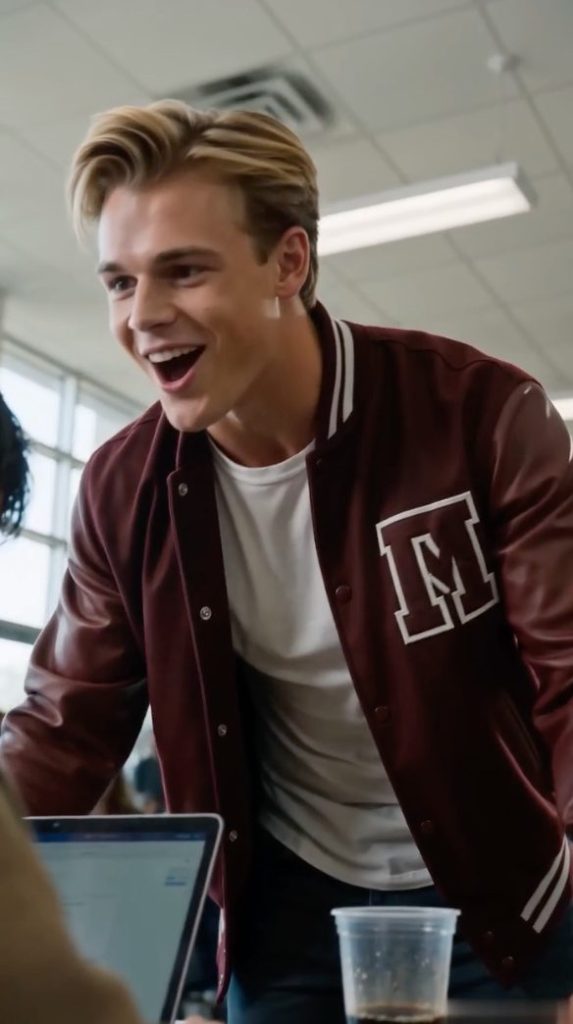
Standing beside Luke’s table was Connor, the school’s celebrated athlete, holding an empty plastic cup above him.
His maroon varsity jacket looked almost impossibly clean against the dark liquid dripping from Luke’s hair.
His broad shoulders were relaxed, his grin was wide, and his expression carried the easy confidence of someone who had never seriously considered being held responsible for humiliating another person.
“What’s the matter, boy?
Cat got your tongue?”
Connor dropped the empty cup onto the table.
It bounced once, rolled against Luke’s laptop, and came to rest beside the keyboard.
Another wave of laughter erupted.
Luke sat perfectly still.
His fingers remained suspended above the keys where they had been working moments earlier.
A drop of soda fell from his nose onto the back of his hand, and another slipped beneath the collar of his hoodie.
He closed his eyes.
For a moment, everyone watching assumed he was about to cry.
That was what Connor expected.
It was what the students gathered around the nearby tables expected, too.
They had seen enough of these moments to recognize the familiar arrangement: one powerful student standing above another, a crowd waiting for entertainment, and a quieter boy expected to accept whatever embarrassment had been chosen for him.
But Luke wasn’t crying.
Beneath the soaked hood, his face was becoming frighteningly calm.
He could feel the sticky liquid running down his neck.
He could hear someone imitating the sound of a person sobbing, followed by several high-pitched laughs.
He could even hear the soft electronic clicking coming from his laptop, a sound so ordinary that it felt cruel against everything happening around him.
And beneath his hands was the machine that contained weeks of careful work.
That detail mattered far more than Connor understood.
The computer science project on Luke’s screen represented countless hours spent correcting mistakes that most people would never notice.
It was the kind of work that demanded patience, concentration, and a willingness to begin again whenever something failed.
Luke had never been the kind of student who enjoyed standing in front of a crowd.
He preferred problems that could be approached quietly, one step at a time.
Computers had always made more sense to him than the complicated rules governing the hallways, classrooms, and cafeteria tables of his high school.

A program either worked or it didn’t.
When it failed, there was usually a reason.
Sometimes the reason was hidden beneath hundreds of lines of code.
Sometimes it was something as small as a missing character.
But if Luke worked carefully enough, he could usually find the problem and understand why it had happened.
People were different.
A person could hurt someone else and call it a joke.
A crowd could watch cruelty and pretend it was entertainment.
A student could remain silent for months and have that silence mistaken for weakness.
Luke had spent much of his high school experience learning those distinctions.
Today, however, something had changed.
The boy sitting beneath the dripping hood knew something that the athlete standing over him did not.
And although Connor was enjoying the attention of the entire cafeteria, he was about to discover that the situation was much more complicated than a spilled drink.
Before the soda struck, the lunch period had felt almost ordinary.
The cafeteria was crowded with students carrying plastic trays, checking their phones, trading stories about classes, and searching for familiar faces.
Bright afternoon sunlight came through the tall windows, falling across the long rows of tables and turning the polished floor into scattered patches of white reflection.
The smell of pizza, fries, and warm bread drifted through the room.
Near the serving area, a group of students argued cheerfully over weekend plans.
At another table, two friends leaned together over a phone, laughing at something on the screen.
Luke sat near the far side of the room, away from the loudest groups.
His brown hoodie had faded at the elbows and along the pocket seams.
The fabric had been washed so many times that its original color had softened into an uneven shade of brown, but it remained comfortable, familiar, and entirely unremarkable.
He preferred it that way.
The laptop in front of him was open to his computer science project, a complicated collection of programs and files he had been refining for days.
A half-finished lunch sat beside it, forgotten while he studied a stubborn section of code.
There was nothing especially glamorous about what he was doing.
He wasn’t trying to impress a crowd.
He wasn’t building something that would make him famous overnight.
He was trying to finish an important assignment properly because he cared about the work and wanted to prove, at least to himself, that all the hours he had invested were worth something.
He checked a line of code, corrected a small error, and tested the program again.
A message appeared on the screen.
The result wasn’t exactly what he wanted.
Luke sighed, adjusted his glasses-free gaze toward the lower corner of the display, and began examining the problem more carefully.
He barely noticed the cafeteria around him.
That was one of the reasons he had chosen this particular table.





