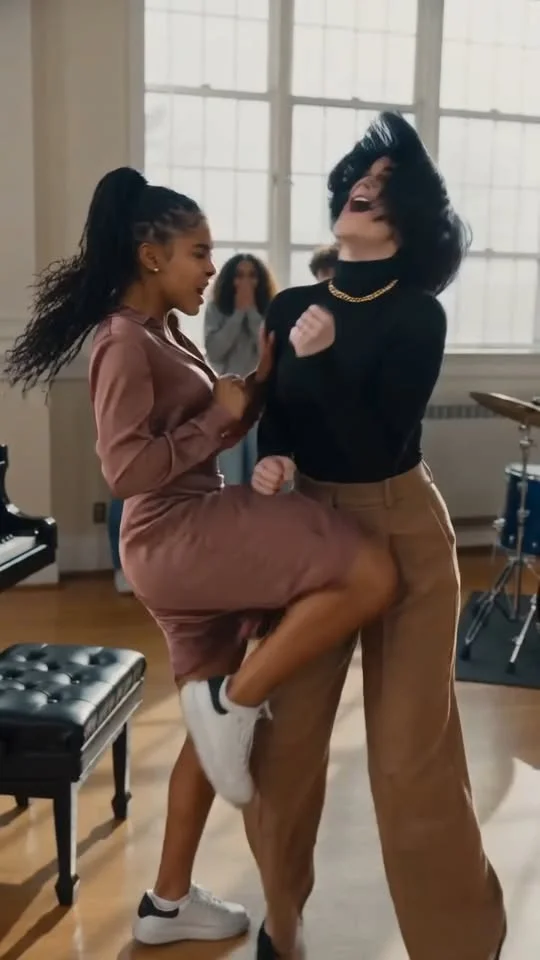
The air inside the grand hall of the conservatory always smelled of old polish, dry paper, and the quiet, suffocating terror of unfulfilled ambition. It was a space designed to humble anyone who walked across its parquetry floor, but tonight, the acoustics felt weaponized.
Clara Vance stood in the wings of the proscenium stage, her fingers pressed so hard against the cold grain of a walnut pillar that the skin beneath her nails had turned bone-white. Through the heavy crimson velvet of the fire curtain, she could hear the restless murmur of the audience—patrons in silk and cashmere, critics with fountain pens poised over pristine notebooks, and, sitting front and center in the VIP box, Maestro Julian Vance.
Her uncle. Her mentor. Her warden.
On the Steinway D concert grand sitting center stage under the merciless glare of the overhead spotlights, sheet music was propped open. But it wasn’t the masterwork Clara had spent six months preparing—the fierce, cascading complexities of Rachmaninoff’s Piano Concerto No. 3. Instead, someone had swapped the folios during the pre-concert tuning while Clara was locked in the corridor’s washroom. Resting on the music desk was a watered-down, abridged student arrangement of a third-rate salon piece, stripped of all technical demand, designed specifically to make her sound hesitant, mechanical, and painfully amateurish.
A familiar voice whispered from the darkness just behind her shoulder, smelling faintly of clove cigarettes and expensive cologne.
“Don’t look so tragic, Clara,” Julian murmured, his breath brushing the shell of her ear like a cold draft. “You’ve always lacked the temperament for the big concertos anyway. Play the simplified score. Let the board see that you’re simply… not quite ready for the tour. It saves us both the embarrassment of a public collapse.”
Clara didn’t turn her head. Her pulse hammered against her ribs, a wild, frantic rhythm that contrasted sharply with the glacial stillness of her face. She knew what this was. For months, the rumors had circulated through the conservatory faculty lounge: Julian’s protégé, a young prodigy from Vienna named Viktor Vance—no relation, though Julian treated him like a crown prince—was slated to take the prestigious autumn European tour. The only obstacle in Viktor’s path was Clara, whose contract guaranteed the opening soloist spot by merit of her competition wins.
Julian hadn’t wanted to outright expel her; scandal was bad for the conservatory’s endowment fund. Instead, he wanted her to self-destruct. He wanted her to walk out onto that stage, stumble through a child’s recital piece, and quietly resign her chair in disgrace, leaving the path wide open for Viktor’s coronation.
The stage manager raised his hand, his fingers curling into a fist, then snapping open. The cue light flashed amber, then steady green.
“Break a leg, my dear,” Julian whispered, offering a smile that didn’t reach his cold, predatory eyes. “Or at least, try not to break the rhythm.”
Clara didn’t move for three agonizing seconds. Then, very slowly, she withdrew her fingers from the wooden pillar. Her hands were steady now. The terror that had paralyzed her moments ago didn’t vanish; rather, it compressed, solidifying into something dense, cold, and razor-sharp.
She walked out from the suffocating shadows of the wings, stepping into the blinding pool of white light at the center of the stage.
The applause was polite, sparse, and perfunctory—the kind of clapping an audience gives out of social obligation rather than genuine anticipation. Clara did not bow. She walked straight to the piano bench, her black silk concert dress rustling softly against the polished wood.
She sat down. She adjusted the bench with deliberate, agonizing slowness, ensuring every movement was crisp and calculated.
On the music rack before her, the simplified student sheets stared back at her with their large, unchallenging notes. In the front row, Viktor Vance leaned forward, a smug, cat-like grin playing across his handsome face. In the VIP box, Julian crossed his arms, settling back against the velvet cushions with an expression of supreme, bored confidence.
Clara reached out. Her fingers didn’t touch the keys. Instead, she grasped the edges of the simplified sheet music, lifted the entire folio off the rack, and turned it completely upside down before sliding it off the piano altogether, letting it flutter silently onto the polished floorboards at her feet.
A sharp, collective intake of breath rippled through the front rows. In the wings, the stage manager choked on his spit, taking a half-step forward as if to rush the stage.
Clara closed her eyes.
She didn’t need the notes. She didn’t need Julian’s curation, nor his safety nets, nor his humiliation. For two years, she had practiced Rachmaninoff in the dead of night in the damp basement studio of her apartment building, long after the radiators had clanked off and the city outside had frozen over. She knew every chord progression, every agonizing suspension, every thunderous cascade of the D-minor concerto down to the marrow of her bones.
Her hands hovered over the keyboard for a heartbeat. Then, she struck.
The opening chords of the Rachmaninoff Third didn’t just fill the hall; they detonated against the mahogany paneling. The sound was colossal, dark, and searingly complex, roaring out from beneath the piano lid with a fury that shook the crystal pendants of the chandeliers overhead. It wasn’t the safe, polite student piece Julian had prepared for her execution. It was a declaration of war.
In the VIP box, Julian bolted upright, his face instantly draining of color. Viktor’s smile vanished, his hands gripping the edge of his seat so hard his knuckles turned translucent.
Clara’s fingers moved with terrifying velocity, a blur of motion across the ivory and ebony keys. She wasn’t just playing the piece; she was tearing it open from the inside out, infusing every measure with a fierce, burning rebellion that defied the stifling traditions of the conservatory. The hall, which had been dead silent seconds before, was now completely electrified, three hundred patrons sitting utterly transfixed, paralyzed by the sheer, unbridled power cascading from the stage.
She didn’t look at the balcony. She didn’t look at her uncle. She stared straight ahead into the blinding lights, her heart beating in absolute, triumphant sync with the relentless rhythm of the keys, knowing that when the final chord struck, the old world they had built to cage her would be nothing more than dust.





