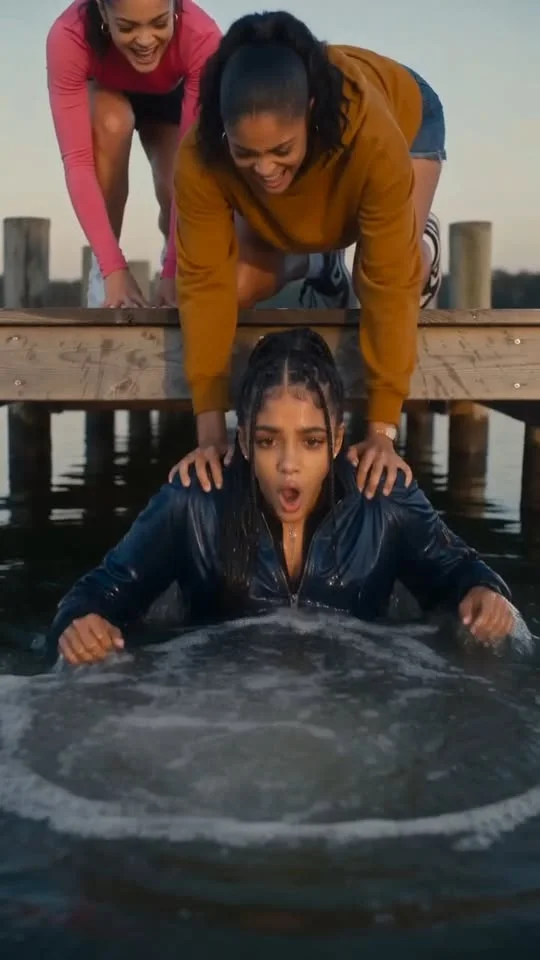
The sun over Lake Macatawa did not set so much as it bled out, staining the western horizon a violent, bruised violet before surrendering the valley to a damp, bone-chilling Michigan autumn. On the weathered cedar planks of the West Michigan Yacht Club’s private slipway, the air smelled of stale draft beer, wet wool, and the bitter copper tang of coming frost. Three hundred yards out, the cold dark water churned in slate-grey swells, indifferent to the three teenagers standing at the edge of the pier.
They had been laughing for twenty minutes. Not the nervous, breathless giggles of children caught doing something wrong, but the smooth, rhythmic laughter of apex predators who had never once tasted consequence.
At the center of them was Sloane Harrington.
At eighteen, Sloane possessed the porcelain, razor-jawed perfection of someone whose family portraits hung in the state capital’s Hall of Governors. Her blonde hair was pulled back into a severe, high ponytail that defied the mist coming off the lake, and her cashmere cardigan—dyed a precise shade of ivory that screamed old money—was buttoned to the collar. She held a half-empty bottle of imported hard cider in one manicured hand, swirling the amber liquid as if she were inspecting a vintage Bordeaux at a country club gala.
A few feet away, trembling so violently his teeth clicked against one another, stood Julian Vance.
Julian wasn’t poor—his father owned three regional surgical clinics and a chain of orthopedic rehabilitation centers—but in the feudal micro-economy of West Michigan private schools, surgical clinics were trade work compared to the Harrington timber and real estate holdings. Julian wore a soaked, slate-gray hoodie that clung to his narrow shoulders like a second skin. Water dripped from his dark curls onto the splintered wood between his sodden sneakers. He was seventeen, built like a scholar who spent too many hours hunched over organic chemistry textbooks and too few on the varsity wrestling mats.
“Look at him, Brooke,” Sloane murmured, her voice dripping with syrupy condescension as she nudged her perennial echo, Brooke Higgins, in the ribs. “He’s leaking. I think the scholarship boy is actually going to cry.”
Brooke emitted a high, synthetic squeak of delight, her silver-encased iPhone raised at a precise forty-five-degree angle to ensure the lighting caught the lake’s reflection. Beside Brooke, Trey Callahan—a six-foot-two lacrosse defenseman whose neck seemed permanently thicker than his skull—grunted, leaning his heavy weight against a rusted mooring post.
“Should’ve stayed in the library, Julian,” Trey laughed, his voice a booming baritone that echoed off the empty boat hulls in the slips. “You cross-reference my history term paper one more time, and next time we aren’t just throwing you in the drink. We’re dropping you with a cinder block.”
Julian didn’t look up. His gaze was fixed on the wet wood inches from his damp sneakers. His chest heaved in shallow, ragged gasps, his vision blurring slightly from the shock of the fifty-degree water. Twenty minutes ago, they had cornered him near the maintenance sheds, ripped his leather-bound biology notebook out of his hands, and pitched it into the harbor. When Julian lunged to save the ink-soaked pages where he had spent three weeks mapping evolutionary lineages, Trey had grabbed him by the collar, hoisted him off his feet, and hurled him straight off the three-foot drop of Slip 4.
The splash had been loud. The laughter that followed had been louder.
“He doesn’t even know how to swim, did you know that?” Sloane crowed, taking a slow, predatory step closer to the edge. Her kitten heels clicked rhythmically against the weathered pine. “Daddy pays for his tuition, the state pays for his lab fees, and the boy can’t even dog-paddle. Honestly, Julian, it’s a miracle you haven’t dissolved yet. You’re like cotton candy in a rainstorm.”
“Leave the notebook,” Julian whispered, his voice cracking, sounding impossibly small against the rising gale. “Please. My dad… that was my grandfather’s journal.”
“Your grandfather’s journal?” Sloane echoed, feigning utter devastation as she pressed a manicured hand to her collarbone. “Oh, Trey, did you hear that? We’ve committed a historical atrocity. We’ve destroyed the archives of the great and powerful Vance dynasty.”
Trey snorted, raising his own cider bottle in a mock toast. “Rest in peace, old man’s notebook. May it rot alongside all the other trash at the bottom of the slip.”
Sloane smiled—a sharp, flawless curve of glossed lips that didn’t reach her cold, pale-blue eyes. She raised her right foot, clad in an expensive riding boot, and nudged Julian’s canvas messenger bag—which lay waterlogged and half-open near the piling—sending it skidding across the wet wood until it tipped over the edge, dropping silently into the black water below with a dull plop.
“Oops,” Sloane said lightly. “My hand slipped.”
Julian’s head jerked up then. For a fraction of a second, the fear in his dark eyes didn’t vanish—it compressed, burning down into something hard, dark, and utterly silent. He didn’t lunge. He didn’t curse. He simply pushed himself up from his haunches, his hands gripping the wet wood of the pier as he hoisted his shivering frame out of the water.
Sloane watched him rise, her smile hardening just a fraction. There was something unsettling about the way he moved—too quiet, too controlled, like an animal that had stopped running and turned to face the hounds.
“Oh, look,” Sloane sneered, taking a step back as he straightened up, water pooling around his boots. “He thinks he’s brave now. Go on, Julian. Go home to your little split-level on the south side and write a very stern letter to the principal. I’m sure my father will read it right before he fires the school board.”
Julian didn’t say a word. He turned his back on them, his shoulders hunched against the wind, and began walking slowly toward the gravel access road that led up to the parking lot.





