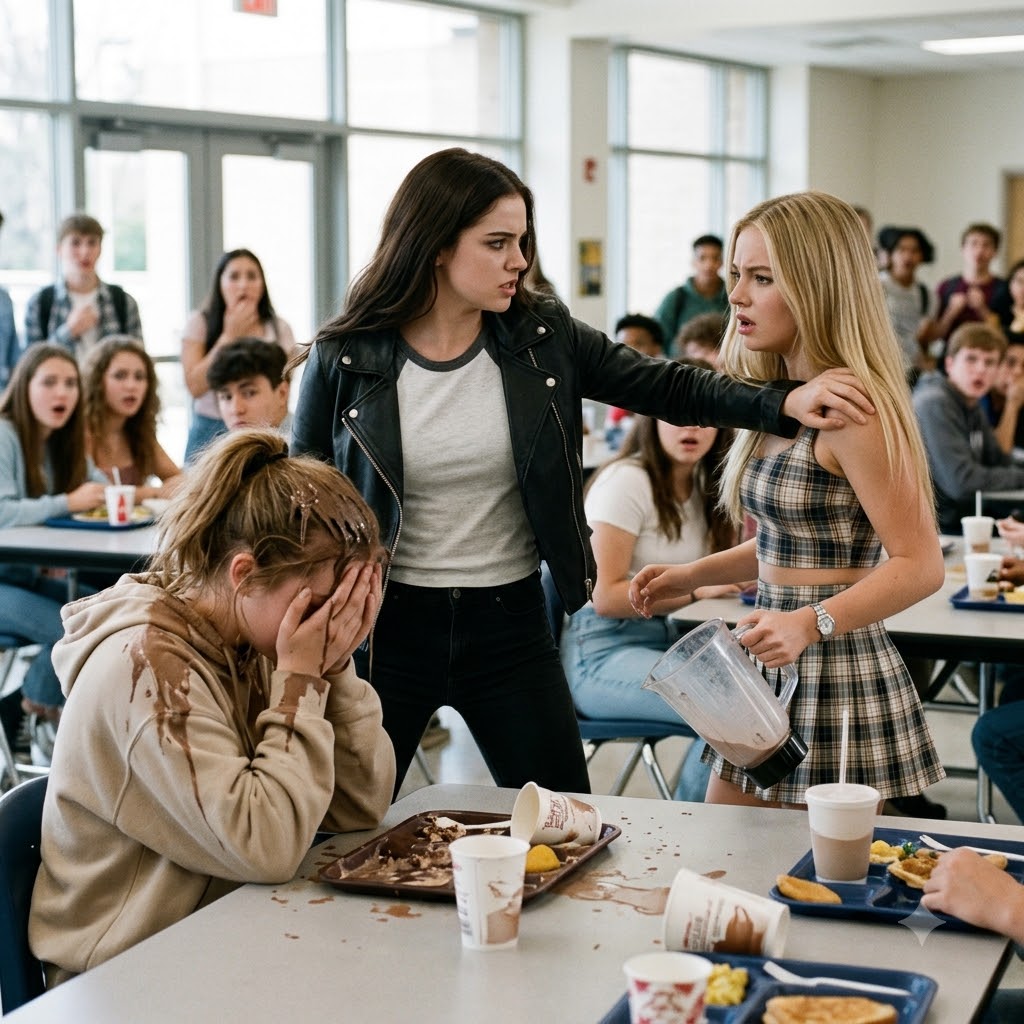
The silver hands on Chloe Vance’s wristwatch ticked past 12:14 p.m., catching the sterile, wintry glare slanting through the floor-to-ceiling glass walls of Westbridge Preparatory’s dining hall. Outside, bare oaks shivered against a slate-grey November sky, their branches scraping against the glass like brittle fingernails. Inside, the air smelled of industrial floor wax, scorched mozzarella, and expensive vanilla body mist—an olfactory hierarchy as rigid as the seating chart itself.
Harper Cole stood near the stainless-steel condiment island, her thumb tracing the jagged metal teeth of her black leather biker jacket’s zipper. Beneath the heavy hide, her grey-and-white raglan tee clung slightly to her collarbone, damp from the brisk walk across the courtyard from the automotive shop annex. Her dark brunette hair fell past her shoulders in thick, untamed waves, framing eyes the color of wet slate. Six inches above her left ankle, hidden beneath the tight black denim of her jeans, a faint, crescent-shaped scar pulsed with a phantom ache whenever the weather turned cold.
Two years ago, Chloe Vance had put that scar there at the top of the sophomore stairwell. Back then, Harper had been thirty pounds lighter in spirit, wearing thrifted cardigans with unraveling cuffs and staring at linoleum tiles as if they held the secrets to invisibility. When her boot had caught on Chloe’s outstretched designer loafer, sending her tumbling down nine concrete steps into a steel trophy case, three dozen students had laughed before a single person asked if her bone was broken. The security footage from Camera Four had mysteriously corrupted before the Vice Principal could review it—a convenient glitch occurring forty-eight hours after Chloe’s father wired the final installment for the school’s new turf stadium.
Harper hadn’t cried in the nurse’s office that day, nor during the six months her mother spent working double shifts at St. Jude’s Urgent Care to pay off the orthopedic deductible before they moved across town for a year. When Harper transferred back to Westbridge at the start of senior fall, she hadn’t come back looking for friends. She had come back with two years of boxing gym calluses on her knuckles, an ironclad scholarship to state university already signed in her locker, and a quiet vow never to look at the floor again.
Until ten minutes ago, keeping her head down had meant minding her own business.
Then she had seen the blender.
At the center tier of the atrium—the elevated oak tables unofficially reserved for varsity captains and legacy donors—Chloe sat perched on the edge of the bench like a magistrate presiding over a public execution. Her long, straight blonde hair gleamed under the recessed lighting, ironed to a razor-sharp edge that grazed the hem of her tailored yellow-and-black plaid crop top. Even in late autumn, with frostrimming the courtyard hedges, she wore the matching pleated miniskirt like armor, crossing bare legs while her lieutenants, Madison and Sloane, flanked her like twin gargoyles.
Across from them sat Mia Bennett.
Mia looked as though she were trying to fold her entire seventeen-year-old frame inside the pocket of her oversized beige hoodie. Wisps of light-brown hair had escaped her messy ponytail, clinging to cheeks already blotchy and wet with silent tears. Between her trembling elbows lay a thick, spiral-bound sketchbook—its corner bent, its cover smeared with ketchup that clearly hadn’t come from Mia’s untouched apple slices.
Harper knew Mia slightly from AP Studio Art. Mia was a quiet scholarship transfer whose father worked night maintenance for the municipal transit authority; she smelled perpetually of graphite dust and peppermint gum, spoke barely above a whisper, and possessed an uncanny gift for capturing human micro-expressions in charcoal. Earlier that morning, Harper had seen Principal Halvorsen pinning the finalists list for the Hawthorne Regional Art Fellowship onto the corkboard outside the administrative suite. Number one on the sheet had been Mia Bennett. Number four—listed merely as an honorable mention—had been Chloe Vance, whose heavily commissioned, ghost-painted acrylic portraits usually bought her automatic first-place ribbons in Westbridge’s local exhibitions.
That explained the blender sitting by Chloe’s elbow.
Westbridge’s culinary club ran a charity smoothie bar every Friday during fifth-period lunch, leaving two commercial-grade glass pitchers beside the espresso cart for student volunteers. Madison must have swiped the heavy Oster pitcher while the faculty advisor stepped into the kitchen pantry. It was filled halfway to the rim with thick, melting chocolate milkshake—a dense sludge of double-fudge syrup, whole milk, and half-churned ice cream left over from the booster club rush.
Harper shifted her tray onto a nearby trash receptacle, leaving it untouched. Across the room, the lone lunch monitor, Coach Miller, had his back turned near the vending machines, engrossed in game tape on his tablet with noise-canceling earbuds wedged firmly in place. Over two hundred teenagers filled the sunlit hall, their collective chatter humming like a hornet’s nest, yet a strange, expectant hush was beginning to ripple outward from the center tables. Smartphones were already sliding out of blazer pockets, lenses tilting subtly above table rims. Nobody intervened. At Westbridge, proximity to cruelty was treated like inclement weather: you pulled up your collar, stayed dry, and hoped the lightning struck someone else’s roof.
Harper’s fingers curled into her palms. She took three slow steps down the main aisle.
At the oak table, Mia reached with shaking fingers to pull her sketchbook back across the wood. Chloe’s manicured hand shot out, pinning the cardboard cover flat with a sharp thwack. Her silver wristwatch glinted as she leaned forward, that familiar, practiced arrogant smirk curving one corner of her glossed lips.
“Honestly, Mia, I’m doing the committee a favor,” Chloe said, her voice pitched at that crystalline volume perfected by girls accustomed to microphones and stages. “You drew yourself sitting on a city bus for your portfolio centerpiece? It’s tragic. Poverty porn went out of style three seasons ago. Did you smudge the charcoal yourself, or is your house just naturally that dirty?“





