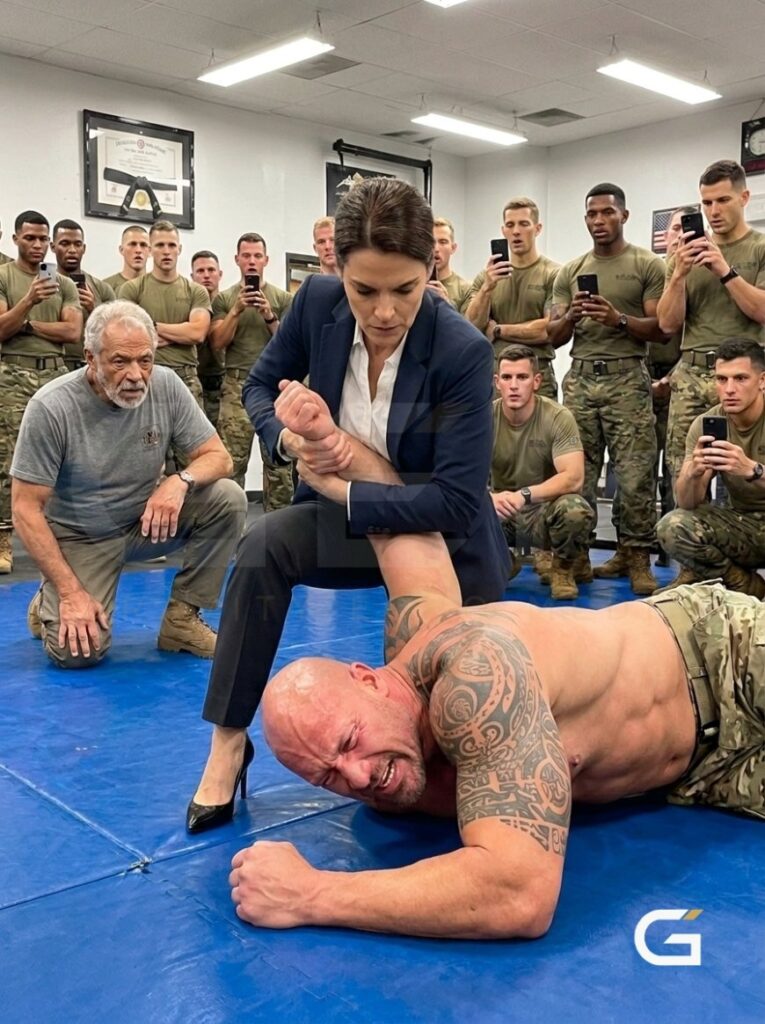

The box was heavier than it looked.
I sat in the driver’s seat of my truck, engine off, the cab already cooling in the North Carolina night. My hands were still trembling from the adrenaline dump. Delayed onset. I knew what it was. I’d been through it a hundred times. It still didn’t help.
The parking lot lights buzzed overhead. Somewhere in the distance, a drill sergeant was still yelling. The base never truly slept, but in this corner of the lot, tucked behind the training facility, the world had gone quiet.
I didn’t open the box.
Not there. Not in the truck with fifty-three soldiers still inside the building behind me, probably still recording, probably already uploading. I could feel their presence like heat on my back. Every phone in that room was a weapon I’d just handed to someone.
Some of them would post it. Most of them would post it.
By morning, I’d be everywhere.
I started the truck, pulled out of the lot, and drove the three miles to my apartment on autopilot. The roads were dark. Fort Bragg rolled past my windows in familiar shapes—barracks, motor pools, the airfield where C-130s squatted on the tarmac like sleeping birds.
I didn’t see any of it.
I saw Walter’s face. Gray eyes sharp as broken glass. Something flickering behind them when Cole’s hand landed on his shoulder.
I saw my father.
Not as I remembered him—not as the man in the photograph on my kitchen table, dress uniform crisp, smile wide, alive. I saw him the way Walter had described him in that parking lot. Helmand Province. October 2012. An ambush that wasn’t random.
They knew we were coming
I pulled into my apartment complex and killed the engine. The silence rushed in. I sat there for a long moment, hands on the wheel, the box on the passenger seat beside me.
I could throw it away. Could pretend I’d never heard of Walter Griffin, never heard the name Helmand Province, never heard the words your father was my instructor. I could go inside, take a shower, go to sleep. Then tomorrow I could file my contractor report, accept my next assignment, and go back to living in the world where Marcus Brennan had died a hero twelve years ago and there was nothing left to find.
That world was clean. That world made sense.
I picked up the box and went inside.
—
My apartment was a single-room efficiency, three miles off base.
Bare walls. Government furniture that came with the lease. A mattress on the floor because I’d never bothered to buy a frame. The only personal items were the photograph of my father in dress uniform and a locked foot locker containing my service weapons.
Still registered. Still maintained. Still ready.
I’d kept them that way for years. Not because I expected to use them. Because my father taught me that ready was a state of being, not a plan.
I set the box on the kitchen table and stared at it.
Bright red LED display on the microwave: 2:04 a.m.
I made coffee. Black. I don’t know why. I didn’t need to be awake. I needed to sleep. It had been six years since I’d left active service, but some habits never washed out. Sleep when you can, eat when you can. Never leave anything to chance.
I didn’t sleep.
I sat in the chair across from the box and stared at it like it was a live grenade. In a way, it was.
The box was small. Maybe five pounds. Plain cardboard, no markings except for the tape on the top, old and yellowing with a strip of packing tape down the center. The tape had creased and wrinkled with age, but the seal was intact.
Whatever was inside, Walter hadn’t opened it in a long time.
Or he had. Maybe he’d opened it every night. Maybe he’d taken everything out, spread it across his own table, sat with it, gone to bed, gathered it up the next morning.
Twelve years of evidence. Twelve years of obsession.
I broke the seal.
The contents spilled across the table with a soft rustle, like autumn leaves scattered by wind.
The first thing I saw was the photograph.
—
It was a surveillance shot, clearly taken with a long lens.
A group of men in desert camouflage—American uniforms, but no visible unit patches. Standing in what looked like a village courtyard. Dust. Low walls. A sun so bright it bleached the color out of everything.
One man stood in the center. Tall. Blonde, in the earlier pictures, or that’s what I thought. He had his head turned away from the camera, his face obscured. But his build. His posture. The way he stood with his weight on his right side, always on his right, because his left knee had been bad since a jump in ’03.
I knew that posture.
I knew it the way you know your own face.
The photograph was timestamped March 2013. Five months after my father was declared KIA.
I set the photo down. My hands weren’t shaking anymore. They’d gone very still. The kind of still that happens when your body decides feeling anything is too dangerous.
I picked up the next item.
—
Handwritten notes. Walter’s careful script, cramped and small, like a man who learned to write in confined spaces.
Entries, dated and cross-referenced. Names of people I didn’t recognize. Locations in countries I’d never served in. Coordinates.
I read through six pages before I found the first mention of my father by name.
*Sighting confirmed 11/12/2012. P. describes Am. male, 45-50, tall, blond, injured left leg. Held in detention facility near Quetta. Convoy from Afg. border.*
*Second source, 01/2013. CCTV image from Islamabad surface. Man matching description in transport vehicle. Face partially obscured.*
*Third source, 03/2013. Photograph. Confirmed.*





