
PART 2
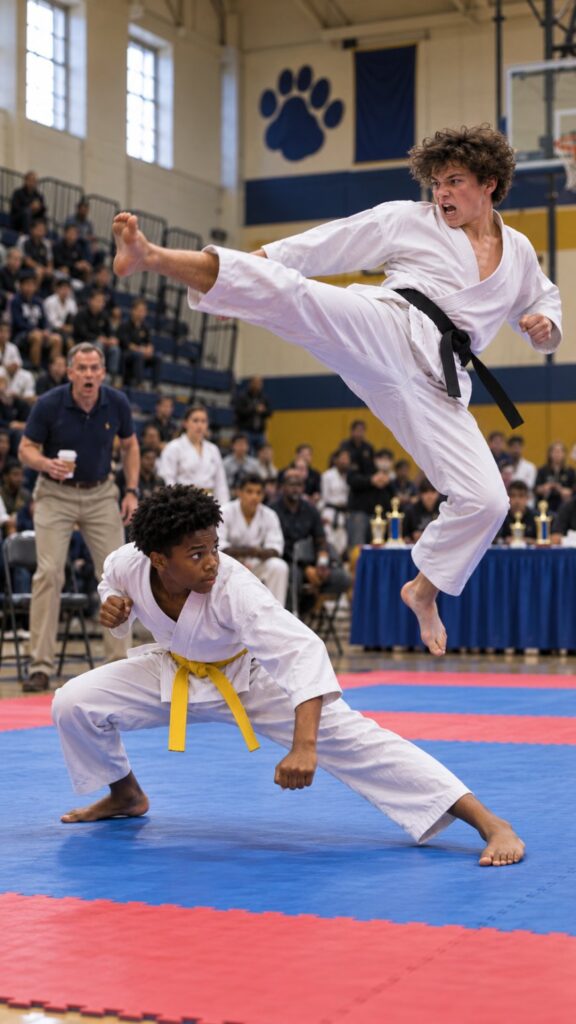
Connor’s foot whistled through empty air, slicing exactly where Michael’s head had been a fraction of a second prior. His momentum, completely unguided now that his target had vanished, carried him awkwardly forward, leaving his ribs and the entire left side of his body completely exposed.
In the front row, Bill Mills didn’t just drop his coffee cup; it slipped from his relaxed, arrogant grip as if his brain had suddenly short-circuited. The ceramic shattered against the gymnasium floor, splashing hot liquid over his expensive leather loafers, but the wealthy father didn’t even blink. He was too busy staring at the impossible geometry of my son’s body.
Michael didn’t hesitate. He didn’t have time to blink, and he didn’t need to. The muscle memory we had forged in the damp, freezing air of our garage took over completely. He closed the distance not with a traditional karate slide, but with a sudden, explosive burst of kinetic energy—a military combative breach step designed to eliminate space before the enemy can draw a weapon.
Crack.
The sound of Michael’s knuckles connecting with Connor’s solar plexus echoed through the cavernous, sudden silence of the gymnasium. It wasn’t the dull thud of a padded sparring match. It was the sharp, breathless impact of a perfectly placed strike hitting dead center.
Connor’s eyes bulged out of his head. The air was violently forced from his lungs in a ragged, wet gasp. As the 17-year-old black belt doubled over, his arrogant smirk instantly replaced by a mask of sheer panic and oxygen starvation, Michael wasn’t finished. He didn’t step back to admire his work. I had taught him better than that. I had taught him that you don’t give a threat time to reassess.
Michael grabbed the lapel of Connor’s heavy, expensive gi, yanked the older boy downward to break his posture entirely, and drove a brutal knee strike directly into Connor’s ribs.
“Point, Thompson!” the center referee yelled, his voice cracking slightly in shock. He thrust his hand toward Michael.
The entire gymnasium went dead silent. You could have heard a pin drop on the padded mats. Hundreds of parents, competitors, and coaches simply froze. Yellow belts did not do this. Yellow belts, especially fourteen-year-old kids who had only been training for a few months, did not systematically dismantle seventeen-year-old regional champions in under three seconds.
Connor stumbled backward, clutching his chest. His face had gone completely pale, drained of all the blood and bravado that had fueled his bullying for the last two months. He looked at Michael not as a victim, but as a ghost—something terrifying and entirely beyond his comprehension.
“Time!” Bill Mills suddenly screamed from the sidelines, finally shaking off his paralysis. He stepped right to the edge of the mat, his face purple with indignation. “Time out! That was illegal! That was excessive contact!”
The referee, a seasoned martial artist in his sixties, frowned and held up his hand to stop the clock. He looked at Bill, then at Connor, who was still wheezing, trying to suck air into his bruised lungs. “Sir, please step back from the ring. It was a clean strike to a legal target area. Your son dropped his guard.”
“He’s a yellow belt!” Bill shouted, pointing a shaking finger at Michael, who stood perfectly still, breathing evenly, his eyes locked on his opponent. “He’s supposed to be pulling his punches! He’s fighting like a street thug!”
I stood up from my folding chair, my arms crossed over my chest. I didn’t raise my voice. I didn’t have to. “He’s fighting in the Open Division, Bill,” I said, my voice carrying clearly across the quiet room. “The division you laughed at us for entering. You wanted full contact. You got it. If your boy can’t handle it, throw in the towel.”
The veins in Bill’s neck looked ready to burst. He looked at Sensei Mitchell, the corrupt instructor from Warriors Path Dojo, who was standing nearby, his mouth slightly open, completely bewildered. Mitchell had spent the last two months allowing Connor and Jake to use my sons as punching bags, convincing these rich fathers that their boys were unstoppable warriors. Now, the illusion was shattering in real-time.
“Fight,” Connor rasped, pushing himself upright. Pride and humiliation warred on his face, but the humiliation was winning, mutating into a desperate, reckless anger. “I’m fine. Let’s go.”
The referee nodded. “Fighters, reset. Begin!”
Connor abandoned all pretense of technique. He didn’t use the forms he had practiced for seven years. Driven entirely by the burning shame of being dropped in front of his father and his peers, he launched a wild, looping combination—a street brawler’s haymaker aimed right at Michael’s jaw.
It was the worst mistake he could have made.
Michael absorbed the initial strike effortlessly on a tight, military-style guard, not even bothering to backpedal. As Connor overextended, throwing all his weight into a punch that hit nothing but Michael’s forearms, my son countered with surgical, terrifying precision. He stepped inside Connor’s reach, delivered a devastating hook to the floating ribs that made the older boy grunt in agony, and followed it instantly with a short, sharp uppercut that snapped Connor’s head back.
Connor’s eyes rolled up for a fraction of a second. His knees buckled. He collapsed onto the mat, falling heavily onto his side, clutching his ribs, entirely unable to defend himself.
“Point, Thompson! Match, Thompson!” the referee shouted, stepping quickly between them and crossing his arms downward to signal the end of the bout.
It was over. Less than thirty seconds had passed on the clock.





