PART 2
The small silver card caught the glare of the overhead fluorescent lights, casting a sharp metallic reflection across the blue mat. On its worn surface, beneath years of friction and handling, was an embossed emblem that very few civilians in the world would ever recognize.
“Ghost Hawk,” Sarah said quietly, her voice flat and steady, like she was reading items off a grocery list. “Class 9.”
The room remained frozen, but near the back of the hall, an older gentleman in a faded training GI gasped softly. He was a quiet veteran who usually kept to himself during evening practice. His calloused hands began to tremble slightly as he adjusted his belt, his eyes fixed on the silver card in Sarah’s hand.
He leaned toward a younger student beside him with a buzzcut and whispered in a low, shaking voice, “Ghost Hawk… I heard about them during my time in the service. They don’t exist on paper. That unit was completely erased from official records.”
The whisper rippled through the front row of students like a cold wind.
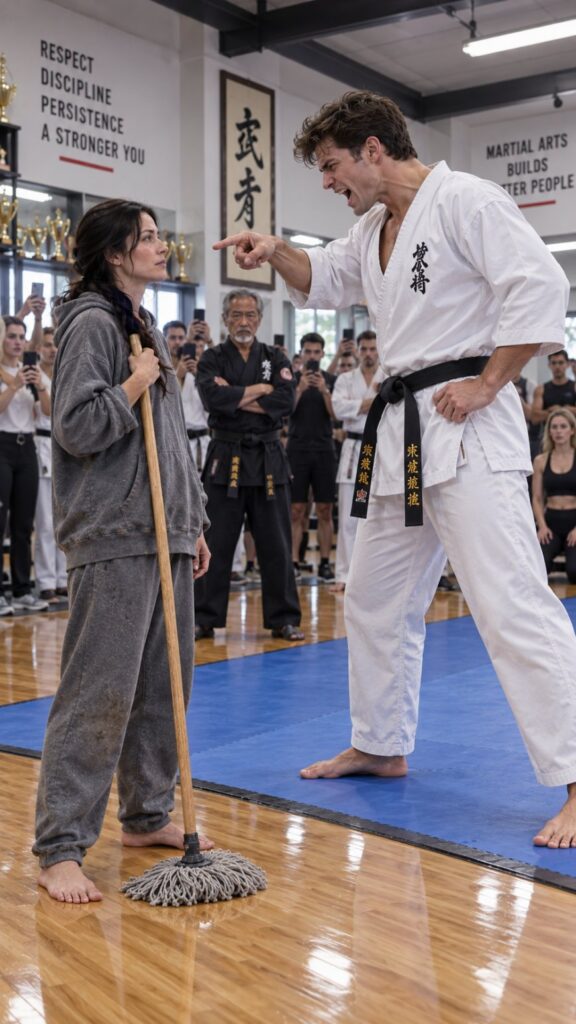
“Ghost Hawk?” the red belt stammered, his arrogant posture faltering for the first time. “What is that supposed to mean? You can’t just flash some random piece of metal and expect us to believe you’re some special forces operative! If you’re so elite, why on earth are you mopping floors for pocket change?”
A woman in a sleek yoga outfit stepped forward, crossing her arms scoffingly. “Exactly. Sounds like a total scam to me. Real military veterans don’t clean dojos.”
Sarah didn’t waste her breath responding. She didn’t yell, she didn’t boast, and she didn’t try to defend her dignity. She simply tucked the silver card back into the lining of her shoe and picked up her frayed canvas bag. Something in her calm, unyielding gaze made the woman in the yoga outfit take an instinctual half-step backward, her sudden bravado wavering.
Before Sarah could take three steps toward the exit, the dojo manager—who had stepped into the hallway holding his smartphone to his ear—hurried back into the room. His face was entirely drained of color, his fingers gripping the phone so tightly his knuckles were white.
He looked at Sarah not as the woman who cleaned his floors, but as if a ghost had just walked into his building.
“She…” the manager stammered, his voice barely audible across the quiet hall. He cleared his throat, trying to regain his composure, but his shoulders slumped in defeat. “She trained Unit Zero Delta. The call just went through to central command… Let her go. Right now.”
The silence in the dojo didn’t just deepen—it stopped the room from breathing entirely.
Ethan, still sitting on his knees on the mat while rubbing the red marks on his throat, stared up at her in absolute horror. The red belt who had accused her of being a fraud froze in place, his mouth open, unable to utter another word. The woman with the designer handbag lowered her phone, her face flushed with deep embarrassment.
Coach Mr. Tanaka, a man who had spent forty years building a reputation for strict discipline and unyielding pride, took three slow steps forward. He stopped directly in front of Sarah, straightened his posture, and then bowed lower than anyone in that dojo had ever seen him bow to another human being.
“Sensei,” Tanaka said, his voice thick with genuine reverence. “We apologize deeply for failing to recognize who stood among us.”
Sarah looked at the veteran master, her expression softening just a fraction. “I just came to clean the mats,” she said softly. “Literally and otherwise.”
She turned toward the double glass doors, her canvas bag resting against her hip. But as her hand touched the metal handle, a young student in the front row—a teenager whose GI was still stiff and bright white from being brand new—called out in a shaking voice.
“Wait!” the boy begged, stepping forward. “How… how did you learn that chokehold? Please, tell us!”
The crowd watched, expecting Sarah to walk out and ignore him. But Sarah paused. She kept her hand on the door frame and looked back over her shoulder at the young boy.
“You don’t learn it,” Sarah said, her voice carrying through the silent hall like a clear bell. “You earn it.”
Before anyone could reply, an older woman clutching a worn leather purse pushed her way through the crowd. Her face was lined with years of hard work, and her eyes were filled with desperate tears. She reached out toward Sarah, holding her young son by the shoulder—a frail ten-year-old boy whose dojo uniform hung loosely on his small frame.
“Please, ma’am,” the mother sobbed softly, her voice trembling. “My son… he gets bullied at school every single day. They push him down, they take his things, and he comes home crying. Could you… could you teach him how to fight?”
The entire room turned toward Sarah, waiting for her answer. The arrogant black belts, the wealthy spectators, and the snobbish parents all watched the quiet janitor in the faded hoodie.
Sarah looked down at the small, terrified boy staring up at her. For the first time that night, the cold military distance in her eyes completely melted away. She walked back onto the mat, knelt down so she was at eye level with the child, and placed a gentle, steady hand on his shoulder.
“I won’t teach him to fight,” Sarah said gently to the mother. “I will teach him how to stand.”
The boy’s mother wept quietly, nodding in gratitude, while several senior students dropped their heads in shame, realizing how far they had strayed from the true spirit of martial arts.
The consequences of that evening spread through the dojo quietly, like gravity restoring balance to a broken system.





