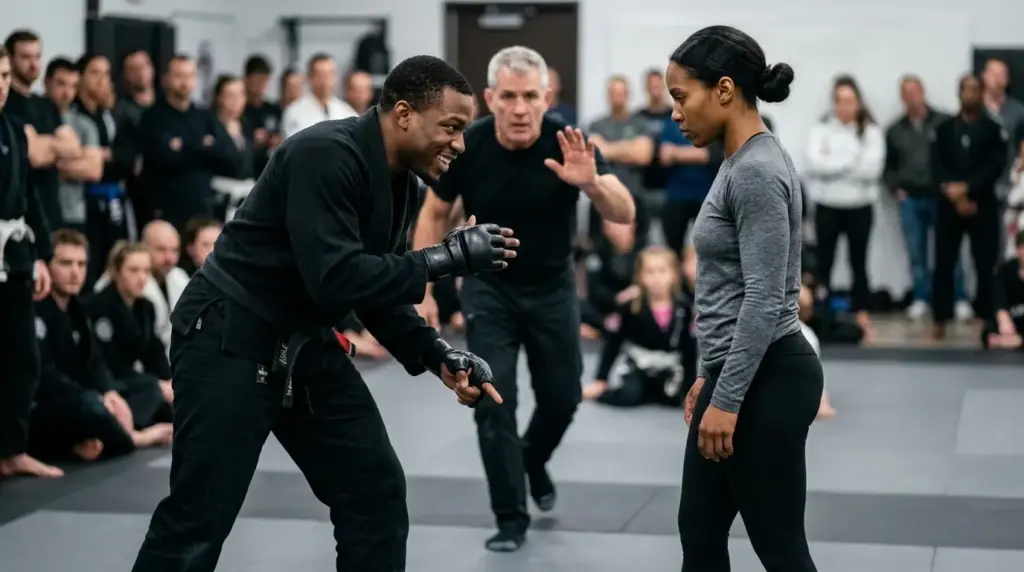
Aaron trained with her again three weeks later.
This time no audience.
Daniel present.
Five-minute positional round.
No strikes.
Aaron defended the foot sweep.
Of course.
He knew.
Maya tried another entry.
He countered.
She stumbled to one knee.
Daniel called score for Aaron.
They reset.
Later Maya got an inside trip.
Aaron recovered.
No score.
Balanced round.
At the end, Aaron smiled.
“Harder when I know.”
Maya said:
“Exactly.”
Good.
Surprise had mattered.
Information changed outcome.
That was the honest version.
Then they kickboxed lightly.
Maya struggled badly.
Aaron’s jab touched her repeatedly.
Her distance was wrong.
She flinched at a body kick.
He stopped immediately.
“You okay?”
“Yes.”
“Want to continue?”
“Lower pace.”
Good.
Consent updated.
He slowed.
Maya still got outpointed.
Afterward she laughed.
“Easy match.”
Aaron groaned.
“Fair.”
Respect grew.
Not romance.
Not instant friendship.
Training relationship.
The next important moment happened because of something much less dramatic than a sweep.
Maya missed three weeks.
Work got heavy.
A patient at the rehab clinic had complications after a shoulder surgery.
Elise had a school project.
Then Maya’s knee swelled after she twisted while carrying groceries.
Nothing serious.
Still enough to stop training.
When she returned, Aaron saw the slight limp.
He started to say:
“You good?”
Then stopped himself.
Better question.
“What can you do today?”
Maya noticed.
That was growth.
“Upper body.”
“No live takedowns.”
“Light movement.”
Aaron nodded.
“Done.”
No lecture.
No teasing.
No “push through.”
Daniel had changed the culture slowly enough that people barely noticed.
Athletes still trained hard.
But current condition mattered.
What can you do today?
Not:
What should you be able to do based on your reputation?
That question became important for Maya too.
She had been carrying an invisible argument with her old self.
At twenty-four, she could train four nights a week.
Throw repeatedly.
Recover quickly.
Compete on Saturday.
Work Monday.
At thirty-four, after six years away, that body existed only in memory.
The problem with memory is that it edits recovery out.
You remember the throw.
Not the ice pack.
The medal.
Not the sore back.
The tournament.
Not the week you limped afterward.
Maya had spent years helping patients accept current bodies.
Now she had to do it herself.
Harder.
One evening, she tried to force a turning throw from a deep squat.
Knee protested.
She stopped.
Daniel said:
“Good.”
Maya frowned.
“What’s good?”
“You stopped.”
“That’s the minimum.”
“Not for people returning after a long break.”
Fair.
She adjusted the technique.
Higher entry.
Less knee flexion.
Different option.
Worked.
Not as beautiful.
Safer.
That became another theme in her training.
Technique is not one sacred shape.
Bodies change.
Good coaching adapts.
Aaron watched.
He had always admired clean textbook movement.
Maya showed him something else.
A technique modified to fit a current body could be less pretty and more honest.
He started doing the same with older students.
One man, fifty-two, could not comfortably kick above the ribs because of hip replacement history.
Aaron stopped correcting him toward head height.
Focused balance.
Body kicks.
Hands.
Angles.
The man improved.
No one needed the head kick.
That sounds obvious.
It had not been obvious to younger Aaron.
The gym’s culture shifted in small ways.
Another shift came from the video problem.
Daniel did more than add a posting rule.
He made everyone discuss consent.
Not just legal waiver consent.
Training consent.
Media consent.
Intensity consent.
He gathered the adult class after Thursday training.
“No one owes you a round because you asked politely.”
People listened.
“No one owes you a video because you were both on the mat.”
“Someone agreeing to spar is not agreeing to be a joke online.”
“Someone agreeing to thirty percent is not agreeing to sixty because you got embarrassed.”
Aaron looked at the floor.
Daniel noticed.
Kept going.
“If the purpose of the round changes, ask again.”
“If injury appears, ask again.”
“If size mismatch becomes relevant, adjust.”
“Consent is not a signed form you stop thinking about.”
That language stayed.
Maya appreciated it.
She had worked in healthcare long enough to know people often treat consent like a box.
Checked once.
Done.
Bodies do not work that way.
Neither does trust.
A month later, Maya and Aaron had another technical takedown round.
No audience.
No phone.
Aaron asked:
“Same rules?”
Maya said:
“Add thirty seconds.”
Daniel approved.
One minute.
This time Aaron stayed more square.
No easy step.
Maya tried the same foot sweep.
Nothing.
Good.
She switched to an inside trip.
Aaron recovered.
Then he caught her on a counter and guided her to one knee.
Score.
Reset.
Maya laughed.
“There.”
Aaron smiled.
“Do I get my dignity back?”
“No.”
They continued.
Maya scored later with a different entry.
One to one.
Timer.
Done.
No winner.
Useful.
Afterward Aaron said:
“That first clip makes it look like you had some magic trick.”
Maya tied her shoe.
“Magic gets less magical after information.”
Exactly.
They started using the famous seven-second clip as a teaching example for advanced students.
Not to celebrate Maya.
To discuss reaction.
Aaron would pause the video at second four.
“Where’s my weight?”
Students answered.
“Forward.”
“What can I do?”
“Step.”
“Why don’t I?”
“Because you’re expecting resistance.”
There.
Prediction creates posture.
Physical and mental.
Then they would show the later round where Aaron defended.
Same people.
Different information.
That made the lesson honest.
Maya agreed only if the clip stayed inside class.
No posting.
Good.
The video also created one bad consequence neither expected.
A young woman named Tori joined the gym partly because of it.
Twenty-one.
Small.
Athletic.
No grappling experience.
She came in believing technique meant size did not matter.
Internet lesson.
Dangerous.
During her second week, she asked to spar a man fifty pounds heavier.
Daniel said no.
Tori pointed at Maya.
“She did it.”
Maya overheard.
Walked over.
“No.”
Tori frowned.
“You took down Aaron.”
“In one narrow drill.”
“He was bigger.”
“Ten pounds.”
“You’re asking for fifty.”
“But technique—”