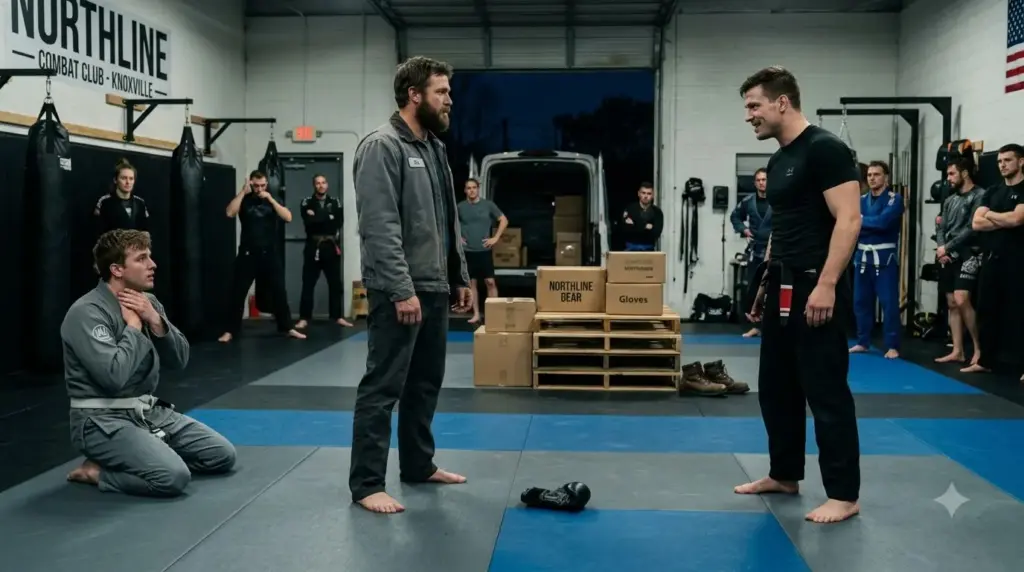
“Tell you what. After you unload, step on the mat. One minute. I’ll show you why people who don’t train should be careful judging what they see.”
Caleb stared at him.
“No.”
The answer was immediate.
A few people looked surprised.
Mason laughed.
“No?”
“No.”
“Why not?”
“Because I have a delivery schedule.”
“One minute won’t kill you.”
Caleb’s eyes shifted toward Owen.
Then back.
“That’s not the standard I’d use.”
The room reacted before Mason did.
A few quiet laughs.
One person coughed into a hand to hide another.
Mason stopped smiling.
“You think you’re funny.”
“No.”
“Then step on the mat.”
“No.”
Mason moved closer.
“You scared?”
Caleb rested one hand on the pallet jack.
“Of being late to Cincinnati? A little.”
More laughter.
Mason’s jaw tightened.
Owen stood up.
“Mason, leave it.”
Mason looked at him.
That was enough to silence Owen.
Caleb saw it.
So did everyone else.
The problem in the room was no longer a choke.
It was a habit.
The habit of everyone calculating whether speaking was worth what came next.
Caleb had lived inside that kind of calculation before.
He had promised himself he would not live there again.
He rolled the empty pallet jack toward the door.
Mason called after him.
“Come on, Cal. Everybody knows you. You drive the truck, you drink your coffee, you disappear. Maybe there’s more to you than that.”
Caleb stopped.
The service door stood open beside him. Beyond it, his trailer waited under the loading lights.
Owen immediately knew he had found the edge of something.
Caleb did not look angry.
That would have been easier.
He simply became quiet in a way that made the question feel intrusive.
Owen lowered the box slightly.
“Sorry.”
Caleb nodded.
“It’s okay.”
“You don’t have to answer.”
“I know.”
Owen waited.
Caleb resumed walking.
“I served.”
“What branch?”
Caleb gave him a look.
Owen caught himself.
“Right. Sorry.”
They reached the diner entrance.
Caleb held the door for a family leaving.
Before he went inside, Owen said, “For what it’s worth, you helped.”
Caleb looked back.
“With Mason?”
“With the room.”
Caleb said nothing.
Owen continued.
“People are paying attention now. Not just to him. To themselves.”
“That’s good.”
“You could come in for ten minutes.”
“Why?”
“Because you keep acting like what happened has nothing to do with you.”
“Mostly doesn’t.”
“You said something nobody else was saying.”
Caleb looked through the diner window toward the gym.
“Then say it next time.”
Owen’s expression changed.
“I did.”
Caleb turned back.
“To Mason.”
“What happened?”
“Nothing. He got mad. I survived.”
Caleb smiled for the first time.
“Good.”
Owen grinned.
“So coffee?”
“Coffee.”
They sat at the counter.
Owen talked about work, not fighting. He was trying to move into a supervisor role at the distribution center. He had failed the first interview because he talked too much about what he could personally do and not enough about how he would help other people do their jobs.
Caleb asked, “What’d you change?”
“Started listening more.”
“Hard skill.”
“Apparently.”
“Most useful ones are.”
Owen stirred sugar into his cup.
“You ever lead people?”
Caleb’s eyes stayed on his coffee.
“A long time ago.”
“At work?”
“Something like that.”
Owen did not push.
That earned him more than another question would have.
Caleb said, “Leading isn’t being the one who can do the most.”
“What is it?”
“Making sure the group can still function when you’re not there.”
Owen thought about that.
“Mason would hate that definition.”
“Then don’t tell him I said it.”
A voice behind them said, “Too late.”
Mason stood near the diner entrance.
Caleb closed his eyes for half a second.
Owen muttered, “You’ve got to be kidding me.”
Mason walked over.
He had come to pick up another tray of donated food. Two Northline members waited outside with him.
“Didn’t know truck drivers gave management seminars too,” Mason said.
Caleb took another drink of coffee.
“Busy profession.”
Mason ignored the joke.