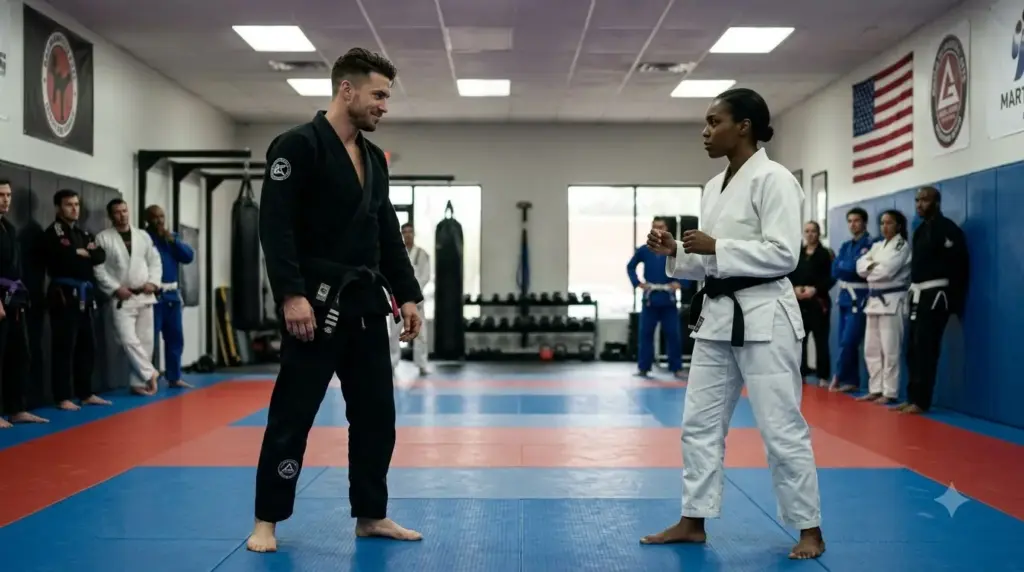
Tyler laughed.
“Meaning?”
“Meaning I should’ve stopped the demonstration when you framed her as the less-experienced person before asking.”
“You’re serious?”
“Yes.”
“It was a joke.”
“I know.”
“People laughed.”
“I know.”
“So?”
Samuel leaned forward.
“Did Maya?”
Tyler looked at her.
Maya said nothing.
He exhaled.
“This place is getting unbelievably sensitive.”
Samuel’s expression hardened.
“No.”
“We’re getting specific.”
Tyler shook his head.
Then walked out.
Maya watched the door close.
Samuel sighed.
“He’s not usually like that.”
Maya looked at him.
“That sentence should make you nervous.”
Samuel frowned.
“Why?”
“Because it usually means somebody has been like that enough times that people stopped noticing.”
That evening, Maya drove back to Raleigh.
She did not think about the throw much.
She thought about the teenager Tyler had used in the earlier demonstration.
The boy who laughed while people watched.
Then stopped smiling when the camera moved away.
Maya had seen that expression before.
At fourteen, she had been that kid.
Her first serious wrestling camp was held at a gym outside Richmond.
Forty boys.
Three girls.
The head clinician was famous locally.
During the first session, he needed someone to demonstrate a fireman’s carry.
He chose Maya.
Not because she was good.
Because she was small.
He told the room:
“This works even on someone quick.”
Then picked her up before asking.
Everyone laughed when her feet left the mat.
Maya laughed too.
She was fourteen.
You learn quickly that sometimes laughing with the room is easier than becoming the reason the room gets uncomfortable.
Afterward, her father asked:
“You okay?”
“Yeah.”
“You sure?”
“Yes.”
Marcus stared at her.
“You know you can say you didn’t like something even if everybody else thought it was funny.”
Maya remembered that sentence for eighteen years.
Now she wondered whether Harbor Point had students doing the same math.
Samuel began the survey the following week.
Anonymous.
Short.
No accusation.
What makes training feel safe?
What makes you avoid certain classes?
Have you ever felt pressured to spar?
Have you ever felt embarrassed during demonstration?
Have you ever declined training and been asked repeatedly?
Responses arrived.
Most were positive.
People loved Harbor Point.
Loved Samuel.
Loved the community.
Loved Tyler’s technical teaching.
Then came the details.
One teenage girl wrote:
Coach Tyler is good but sometimes if I say I’m tired he tells me I’m stronger than I think and keeps asking until I roll.
Another:
I stopped advanced class because I didn’t want to be used in videos.
A smaller male blue belt:
Tyler likes me for demos because he can move me easily. I know he’s joking, but sometimes I hate being the joke.
A woman named Rachel:
I told him my neck was bothering me and he said I was being too cautious. Nothing happened, but I stopped training with him.
Nothing catastrophic.
No assault.
No serious injury.
No monstrous secret.
That made Samuel feel worse.
Because he could see how easily he had ignored it.
Small discomforts rarely force action.
They accumulate quietly.
Three weeks later, Maya returned to conduct interviews.
She met students individually.
Never asked:
“What did Tyler do?”
She asked:
“What happens when you say no?”
That question revealed more.
Some coaches accepted it instantly.
Some asked whether the student was injured.
Some tried to encourage once.
Tyler often tried to persuade.
Not maliciously.
Often sincerely.
He believed people underestimated themselves.
He believed discomfort was part of growth.
He also failed to recognize when encouragement became pressure.
Maya wrote that down.
Specific.
Not evil.
Not harmless.
Specific.
Tyler refused an interview at first.
Then changed his mind.
He walked into Samuel’s office wearing an academy hoodie.
Sat across from Maya.
“No recording.”
“Fine.”
“What are you trying to prove?”
“Nothing.”
“Samuel says you’re reviewing the program.”
“I am.”
“Because of me.”
“Partly.”





