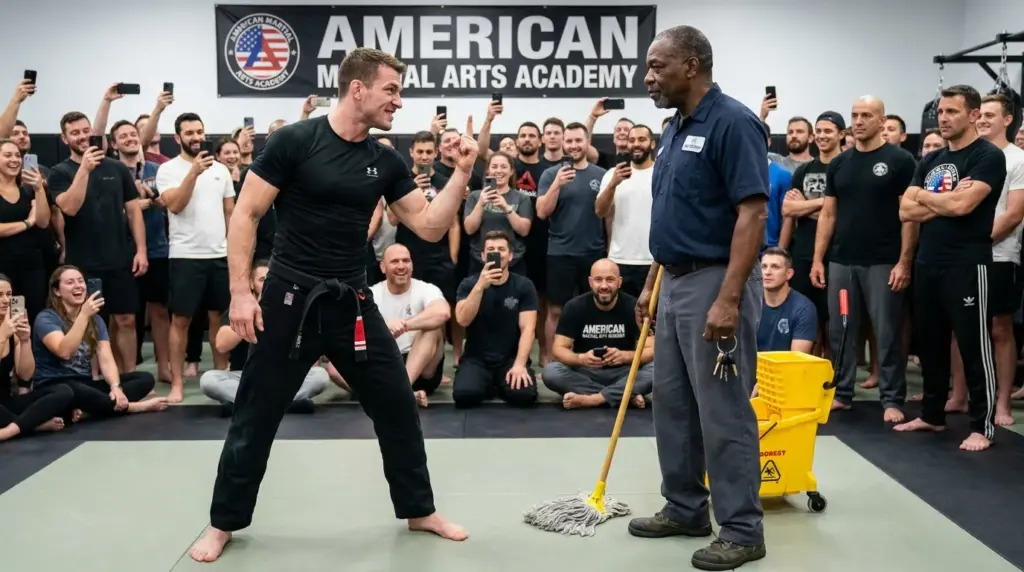
“But every good thing about you doesn’t erase Saturday either.”
That sentence hurt.
Because it removed both exits.
He could not call himself a monster and disappear.
Could not call himself a good man and dismiss it.
He had to examine behavior.
More difficult.
More useful.
Leon knew something about disappearing.
He had done it for twenty-seven years.
The story started before Jason Reed was born.
Leon Carter grew up in Dayton, Ohio.
His father, Clarence, worked at a tire plant.
His mother, Evelyn, was a nursing assistant.
Five children.
Three bedrooms.
One bathroom.
Almost constant noise.
Leon discovered wrestling at thirteen because a middle-school coach saw him carry two cafeteria tables alone.
“You strong?”
The coach asked.
Leon shrugged.
“You know how to wrestle?”
“No.”
“Good.”
Leon frowned.
“Why good?”
“Nothing to unteach.”
Leon joined.
Lost his first seven matches.
His father attended all seven.
After the seventh, Leon threw his shoes into the back seat.
“I’m quitting.”
Clarence nodded.
“Okay.”
Leon stared.
“That’s it?”
“You want me to stop you?”
“Yes.”
“Why?”
“Because I’m mad.”
Clarence smiled.
“Then don’t make permanent decisions while mad.”
Leon hated that.
He returned Monday.
Won his first match three weeks later.
By high school, Leon was good.
Not dominant.
Good.
The Army changed that.
He enlisted at nineteen.
Signal Corps first.
Then spent time in a competitive combat-sports program where wrestling led him to judo.
Judo led him to submission grappling before the term became common in American gyms.
Leon loved the puzzle.
He loved that strength mattered but could become a liability.
He loved that balance told the truth.
He loved the certainty of a tap.
Enough.
Stop.
No argument.
By twenty-five, he was competing nationally.
By twenty-seven, internationally.
He won.
Lost.
Learned.
Married Diane Russell at thirty.
She was a public-school teacher.
Sharp laugh.
Sharper opinions.
She attended one tournament and decided combat sports were “laundry with concussions.”
Leon married her anyway.
Their daughter, Michelle, arrived three years later.
Leon left active competition gradually.
Coaching replaced it.
He remained in the Army.
Eventually became an instructor working with soldiers preparing for close-contact situations.
He did not teach fantasy.
No secret moves.
No invincibility.
His favorite instruction was:
“Get home.”
Young soldiers found it disappointing.
They wanted winning.
Leon wanted survival.
After leaving the Army, he opened a gym with his closest friend, Calvin Booker.
Carter & Booker Training Center.
Dayton.
Small.
Hot.
Cheap.
Popular.
They coached wrestlers.
Police officers.
Military personnel.
Teenagers.
Parents.
Anyone willing to work.
Leon became known for control.
Calvin became known for intensity.
They balanced each other.
Until they did not.
In 1998, a nineteen-year-old student named Devon Miles began training with them.
Devon was gifted.
Fast.
Powerful.
Impulsive.
Leon liked him.
Calvin loved him.
Within two years, Devon was winning advanced tournaments.
He became the gym’s proof.
Their poster.
Their future.
Then Devon injured his neck during training.
Not catastrophic.
A doctor recommended six weeks away from contact.
Devon rested twelve days.
Then returned.
Leon told him no.
Calvin disagreed.
“He’s cleared for conditioning.”
“Conditioning isn’t live work.”
“He feels fine.”
“That is not clearance.”
Devon stood between them.
“I can train.”
Leon shook his head.
“No.”
Devon’s face changed.
“There’s a qualifier next month.”
“I know.”
“If I miss it—”
“You miss it.”
Calvin pulled Leon aside.
“Don’t kill the kid’s season.”
“I’m protecting his neck.”
“He knows his body.”
“He is nineteen.”
“So were we once.”
“Exactly.”
They argued.
For three days.
Then Leon did something he regretted for decades.
He compromised.
Technical rounds.
Light only.
No explosive work.
Trusted partners.
Devon agreed.
Calvin agreed.
Leon supervised.
At first, fine.
Then one evening Devon asked for one harder round.
Qualifier coming.
Leon said no.
Devon pushed.
Calvin said:
“Let him feel one.”
Leon hesitated.
That hesitation became permission.
Three minutes.
Controlled.
Devon moved well.
Then became competitive.
His partner matched him.
One scramble.
Nothing looked dramatic.
Devon stopped.
Sat.
Said his hands felt strange.
Hospital.
Imaging.
Surgery.
The previous injury had not healed adequately.
The new damage made it worse.
Devon did not become paralyzed.
He recovered much of his function.
But high-level competition was over.
For Leon, that distinction offered little comfort.
He had said no.
Then allowed the no to become negotiation.





