He kept wiping down his leg.
“I know,” Trent said.
His voice was subdued.
The arrogant edge was gone.
“I saw Vic leave. I saw the lights were still on.”
Garrett reached for a bottle of rubbing alcohol and began cleaning the silicone sleeve of his prosthetic. The sharp chemical smell filled the small room.
“You forget something in your locker?”
“No.”
Trent shifted his weight and leaned against the metal doorframe.
He looked exhausted in the way a man looks when sleep has been avoiding him because his brain refuses to shut off.
“I haven’t trained in two weeks.”
“Take a rest day,” Garrett muttered. “Good for the joints.”
“I went to another gym,” Trent admitted.
The words came out like a confession.
“A fancy one downtown. Air conditioning. Mat-side towel service. Guys there fight exactly like I do. They bounce around. Throw spin kicks. Worry about how they look in mirrors.”
Garrett picked up his prosthetic and aligned the socket with his knee. He pushed down, feeling the vacuum seal grip his skin with a familiar, uncomfortable pinch.
He stood and tested his weight.
The rubber sole clicked sharply against the tile.
“Sounds like you found your crowd.”
He grabbed his gym bag.
“Turn the lights out when you leave. I’ve got a mop.”
“How did you do it?” Trent asked.
The question hung between them.
Garrett stopped at the doorway, close enough to pass within inches of him.
“How did I trip you?”
“How did you make me feel like I was going to die?” Trent said.
His eyes met Garrett’s.
For the first time since he had walked into Iron Street Gym, Trent looked stripped of armor.
“I’m stronger than you. I’m faster. I’ve trained six years. I know escapes from bottom. But when you put your arm on my throat, I forgot everything. I couldn’t breathe. I panicked.”
His voice tightened.
“Why did I panic?”
Garrett studied him.
He saw through the expensive haircut, broad shoulders, and designer gear.
He saw a kid who had built a fortress out of cardboard and had finally experienced his first thunderstorm.
“Because you play a game with rules,” Garrett said flatly. “And I don’t.”
Trent followed him out of the locker room and onto the main gym floor.
The only light came from security lamps buzzing outside the barred windows, casting long, prison-like shadows across the mats.
Garrett opened the janitor’s closet, pulled out an industrial yellow mop bucket, and shoved it beneath the slop sink.
The rusty pipes groaned when he turned on the hot water.
Steam rose, carrying the smell of bleach and pine cleaner.
“That’s a cop-out,” Trent said from the edge of the mats. “It wasn’t just dirty fighting. It was leverage. Weight distribution. You knew where my center of gravity was going before I threw the punch.”
Garrett poured a capful of industrial soap into the water.
“You threw a haymaker you saw in a movie. Your weight went past your lead knee. A stiff breeze could have tripped you. I just happened to be standing there.”
“I want you to teach me,” Trent said.
Garrett turned off the water.
The sudden silence felt heavy.
He wrung the mop through the mechanical press and dropped it onto the concrete with a wet slap.
“No.”
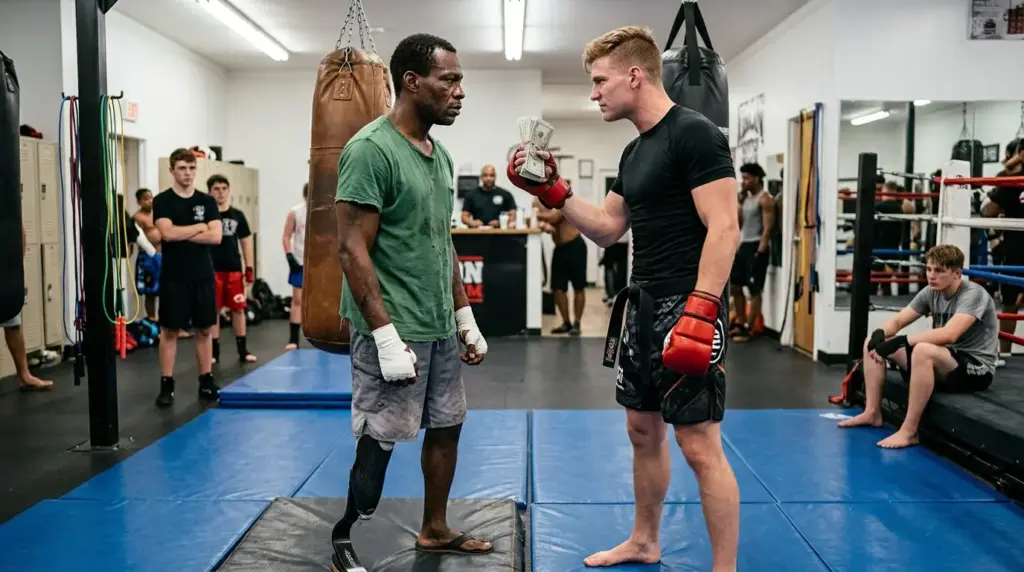
“I’ll pay you,” Trent pushed, stepping forward. He reached into his hoodie pocket. “Double what I paid Vic. Triple. Cash every week. Show me that clinch. Show me how you killed my momentum.”
Garrett stopped mopping.
He leaned on the wooden handle and looked at Trent properly.
“Put your wallet away,” he said, “before I make you swallow it.”
Trent froze.
The threat was not delivered with anger.
It was delivered with the casual certainty of a man describing the weather.
“You think this is a transaction?” Garrett asked. “You think you can buy the grit it takes to stay calm when you’re choking on your own blood?”
Trent said nothing.
“You want the technique,” Garrett continued. “The technique is nothing. The technique is a parlor trick. What you want is mindset. And you can’t buy that with Daddy’s credit card.”
Trent’s jaw tightened.
“So what? You have to get blown up in a desert to learn how to throw a trip?”
“No,” Garrett said softly.
Then his voice changed.
Lower.
Heavier.
“But you have to know what it feels like to lose something you can never get back. You have to know what it feels like to be completely helpless and realize nobody is coming to save you. No referee. No tap-out. No bell.”
Garrett pushed the mop forward, leaving a streak of clean concrete behind him.
“You step on those mats and treat them like a stage,” he said. “You want an audience. You bullied Jesse because making him look weak made you feel strong.”
He looked at Trent.
“But real violence is not a stage. Real conflict is ugly. Quiet. It smells like blood and panic and dirty floors.”
The mop hit the bucket.
“When you were on the floor and I had my arm on your throat, you didn’t panic because of my technique. You panicked because, for the first time in your life, you looked into someone’s eyes and realized they did not care whether you lived or died.”
Trent swallowed hard.
His hand slipped out of his pocket.
Empty.
“I didn’t care about your black belt,” Garrett said. “I didn’t care about your car. I didn’t care about your ego. I just wanted you to stop moving. That is not martial art, Trent. That is survival. And you do not want to learn survival, because learning it means walking through hell first.”
Trent stood in the shadows for a long time.
He watched Garrett work.
He watched the methodical, uncomplaining way the older man dragged the heavy bucket, wrung out dirty water, pushed soap across the floor, and put his environment back in order.
There was no glory in it.
No crowd.





