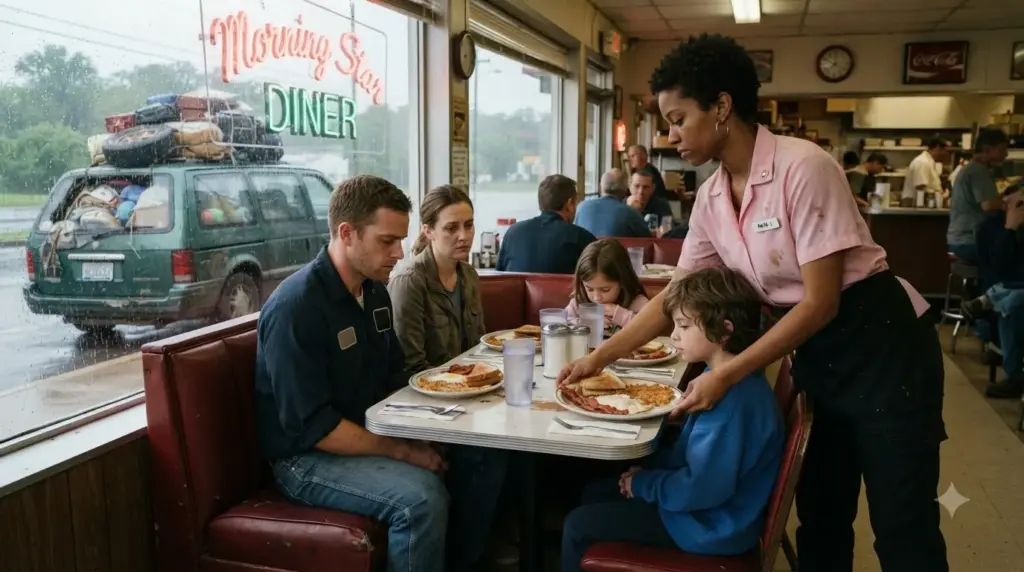
“Family breakfast,” she said. “Two adult plates, two kids plates. Cheapest way you can build it without making it look cheap.”
Luis finally looked at her. “How much you got?”
“Enough.”
“That’s not a number.”
“It’s my number.”
He stared at her for several seconds, then pointed his spatula at the tip money. “Keep ten.”
“Luis.”
“Keep ten or I don’t help.”
“Why?”
“Because if you walk out of here tonight with zero dollars, I have to listen to you complain tomorrow.”
Maya smiled. “Fine.”
Luis started moving. Eggs. Pancakes. Sausage. Hash browns. Toast. He reached into the low refrigerator for strawberries and divided them between two smaller plates.
“Fruit is on me,” he said.
“You don’t even like fruit.”
“That’s how generous I am.”
Maya carried the first two plates to booth six.
Aaron looked confused immediately. “We didn’t order this.”
“Kitchen had a duplicate ticket.”
His wife looked at the four separate plates. “A duplicate ticket with four meals?”
Maya put the kids’ plates down last.
Maisie stared at the pancakes. Eli stared at Maya.
He knew.
Children sometimes did.
Aaron pushed his plate away before touching it. “We can’t take this.”
“Sure you can.”
“No.”
“Then I’m going to throw it away, and Luis gets personally offended when people waste eggs.”
From the kitchen Luis shouted, “Deeply offended.”
A couple of regulars laughed.
Aaron did not.
“Ma’am,” he said, lowering his voice. “I don’t know what you think you saw, but we’re not asking anybody for charity.”
“I know.”
“Then don’t do this.”
Maya leaned closer. “I’m not doing it because you asked. I’m doing it because your son is hiding jelly in a napkin.”
Aaron looked at Eli.
The boy stared at the table.
His mother covered her mouth with one hand.
For a long moment, no one moved.
Then Maisie whispered, “Can I eat it?”
Aaron closed his eyes.
His wife answered. “Yes, baby. Eat.”
Maya walked away before gratitude could become another burden.
She had almost reached the coffee station when Steve Collins came out of the office.
Steve was forty-nine, narrow through the face, and permanently dressed like he was waiting for a district manager who did not exist. He wore a white button-down shirt under a maroon vest with a brass MORNING STAR MANAGER pin. His eyes moved across the room and stopped on booth six.
Then they moved to Maya.
“What did you ring?”
She kept pouring coffee. “Food.”
“Don’t get cute.”
“Family breakfast.”
“They ordered that?”
Maya did not answer.
Steve stepped closer. “Did they order that?”
“I paid for it.”
His face hardened. “Using what?”
“My tips.”
“Employee discount?”
Maya said nothing.
Steve laughed once without humor. “Of course.”
Luis appeared in the kitchen window. “I discounted the food.”
“I wasn’t talking to you.”
“You are now.”
Steve turned toward Maya again. “Office.”
“I’m in the middle of a table.”
“Now.”
Aaron had heard enough to look up.
Maya saw it and shook her head slightly. Don’t.
He stayed seated.
Inside the office, Steve shut the door hard enough to rattle the cheap framed certificates on the wall.
“How many times have we discussed this?”
“Discussed what?”
“You deciding this diner is your personal charity.”
“I paid for the food.”
“At employee price.”
“So charge me the difference.”
“That’s not the point.”
Maya crossed her arms. “Then what is the point?”
Steve leaned against the desk. “People come in here with stories. They know exactly how to work somebody like you.”
“Somebody like me?”
“Soft. Emotional. Always trying to rescue somebody.”
“They didn’t tell me a story.”
“That’s even worse. You invented one for them.”
Maya thought about the plastic storage bins in the minivan, the removed company patch on Aaron’s shirt, the jelly packets hidden in Eli’s napkin.
“I noticed them.”
Steve sighed. “Your job is to notice when coffee is empty.”
Something about that sentence stayed in the room longer than it should have.
“No,” Maya said. “My job is to serve people.”
“Your job is whatever I tell you it is while Ruth is gone.”
Maya stared at him.
Steve opened the point-of-sale screen on his computer. “I’m voiding the discount. Full price comes out of your pay.”
“Fine.”
“And you’re off the schedule tomorrow.”
“For paying for breakfast?”
“For ignoring policy.”
“There isn’t a policy against me buying food for a customer.”
“There is now.”
Maya almost laughed.
Steve pointed toward the dining room. “Finish your shift. And if those people ask for anything else, they pay for it.”
Maya walked out before she said something she could not take back.
At booth six, Aaron had stopped eating.
His wife stood when Maya approached. “I’m Hannah.”
“Maya.”
“We heard some of that.”
“You weren’t supposed to.”
Aaron pushed his chair back. “I’m paying.”
“No.”
“You shouldn’t lose money because of us.”
“I’m not losing money because of you.”
“He took you off the schedule.”
“Steve takes people off the schedule when the ice machine insults him.”
Aaron looked toward the office. “He shouldn’t talk to you like that.”
“He shouldn’t do a lot of things.”
“Then let me fix this one.”
Maya saw the same thing in his face she had seen when he first ordered one breakfast for four people. Pride, yes, but not vanity. He needed to believe he could still protect his family from the cost of his own bad luck.
She sat in the empty edge of the booth.
“Okay,” she said. “Tell me what’s actually happening.”
Hannah looked at Aaron.
Aaron exhaled.
“Our apartment building caught fire six nights ago.”
Maya’s expression changed.
“Everybody got out,” Hannah said quickly. “No one died.”
“Third floor started in an electrical closet,” Aaron continued. “Smoke damage got the whole building condemned for now. Red Cross gave us two motel nights. My sister said we could stay with her in Bowling Green, but our van started overheating outside Shepherdsville. Mechanic says it’s probably a water pump.”
“How much?”
“More than I have.”





