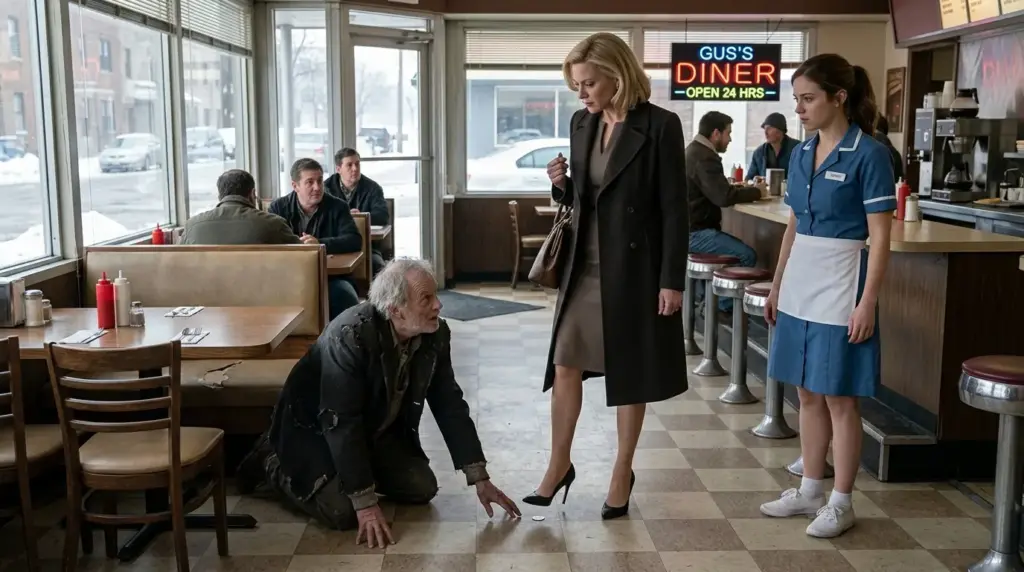
Dani had just stepped outside Gus’s Diner when she saw the silver-haired man bend toward the sidewalk. A woman in red heels trapped his quarter beneath her shoe and sneered that anyone who could not hold onto money should stop asking for it. Dani stopped beside them, still wearing her apron, and felt her temper rise.
“Ma’am,” she said, “that belongs to him.” The woman turned as though the sidewalk itself had spoken, then glanced at Dani’s diner apron and name tag. “It’s a quarter.” Dani set the trash bag down, met her eyes, and answered, “Then it should be easy to give back.” After a tense second, the woman lifted her shoe, muttered something about people being too sensitive, and walked toward a black sedan.
The old man crouched slowly, but Dani picked up the quarter first and held it out. “You okay?” she asked. He studied her face longer than most strangers would, then nodded and said his name was Walter. His hands were clean but cold, and when he closed his fingers around the coin, Dani noticed the tremor he tried to hide. “You didn’t have to do that,” he said.
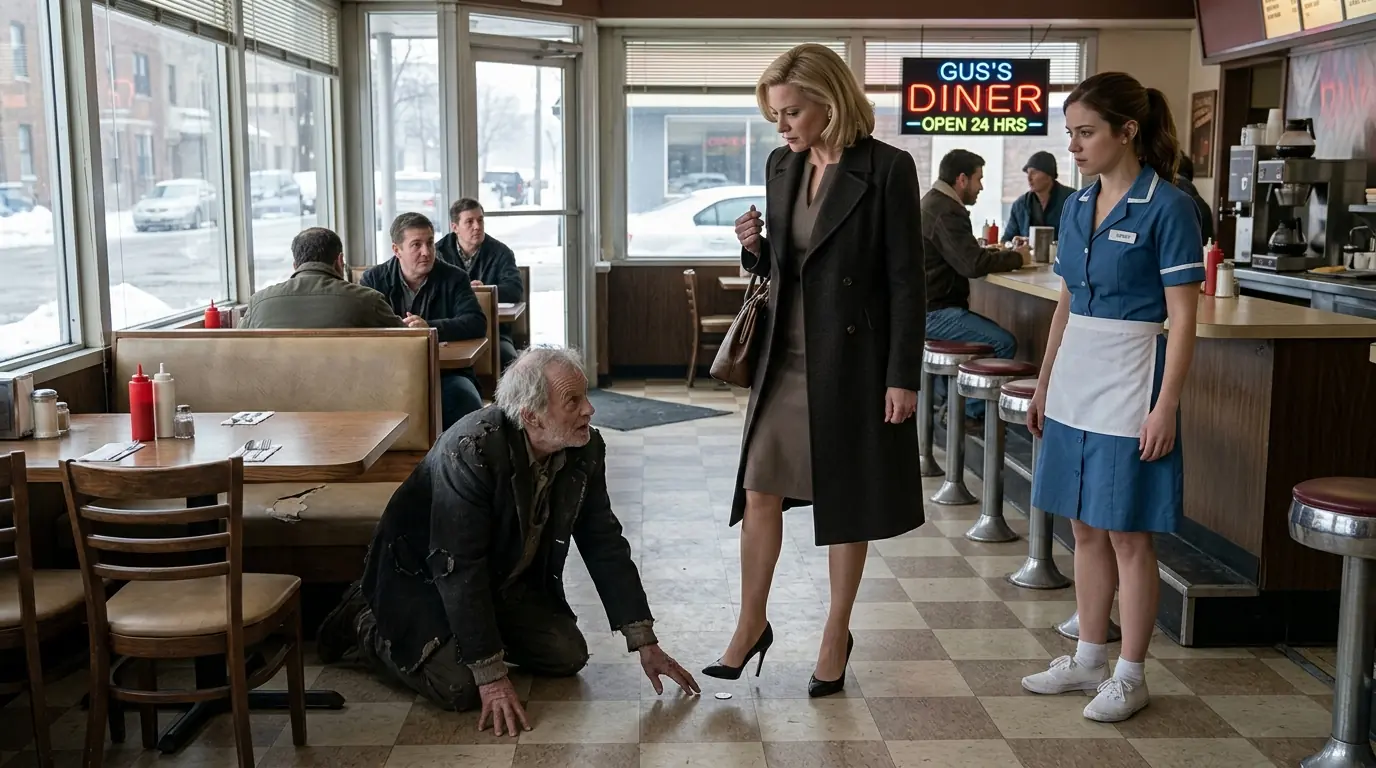 “Neither did she.” Dani looked at the gray clouds gathering over Columbus and the wind cutting between the brick buildings. “Come inside before you freeze.” Walter hesitated, and she could almost see pride arguing with hunger in his face. Finally he followed her through the diner door, where the bell above the frame gave its usual tired little jingle.
Gus Moreno had owned the place for twenty-three years, long enough that the booths had been reupholstered twice and the coffee machine sounded like it was clearing its throat every morning. He looked up from the register, saw Dani guide the old man toward a corner booth, and raised one eyebrow. Dani ignored him and slid a menu in front of Walter. “What can I get you?”
“Dry toast,” Walter said. “And hot water, if that’s free.” Dani waited, thinking he might add something else. He did not. When she asked if he wanted coffee, he shook his head and touched the quarter in his palm as if it were the last piece of a very small budget.
Dani carried the order ticket toward the kitchen, then stopped beside Gus. “Eggs, potatoes, bacon, toast, and coffee,” she whispered. Gus stared at the ticket. “He ordered dry toast.” Dani pulled two crumpled bills from her apron pocket. “Then the kitchen made a mistake.”
Gus glanced toward Walter, then back at her. “You made thirty-four dollars in tips yesterday and your electric bill is due Friday.” Dani stuffed the bills under the edge of the register. “He’s hungry.” Gus sighed, but his expression softened. “Your father ruined you.” Dani smiled without humor. “Yeah. He was terrible that way.”
Ten minutes later, Dani set a full breakfast in front of Walter. Steam rose from scrambled eggs and home fries, two strips of bacon rested beside buttered toast, and the coffee smelled strong enough to wake the dead. Walter looked at the plate, then at her. “I didn’t order this.”
“Kitchen made an extra.” Walter’s eyes narrowed. “I may look poor, but I’m not stupid.” Dani leaned one hip against the booth. “Good, because I’m terrible at lying.” He asked how much he owed, and she told him nothing.
Walter stared at the plate before finally eating. Dani kept working, but she noticed him watching how she treated everyone else: the elderly couple who needed refills, the child who dropped a toy, the teenage server who had miscounted change. None of it was dramatic, which was exactly why Walter paid attention.
When Walter finished, he left the plate almost spotless. At the register he placed the quarter on the counter and said, “At least let me pay for the toast.” Dani pushed it back. “Keep it. You may need bus fare.” He smiled faintly. “Bus fare costs more than a quarter now.”
Dani reached into her apron, pulled out a folded twenty, and held it toward him. Walter’s smile vanished. “No.” She pressed it into his hand anyway. “You already argued about breakfast. I’m not doing round two.” He looked genuinely offended. “Young woman, you’re giving money to a stranger who may be perfectly capable of taking care of himself.”
“Then take care of yourself with twenty extra dollars.” Dani stepped around him to wipe the counter. “Get somewhere warm tonight.” Walter stood in silence, then asked why she was doing any of this. She stopped wiping and said, “My dad used to tell me that when somebody is down, don’t start by asking what they can give you. Ask what might help them stand up again.”
Walter lowered his eyes. “Your father sounds like a good man.” Dani’s hand tightened around the rag. “He was.” She did not explain that Patrick Mercer had died three years earlier after a sudden stroke, or that she still caught herself reaching for her phone when something happened at work because some part of her forgot he would never answer again.
Walter folded the twenty and slipped it into his coat. “Thank you, Dani.” She pointed at the door. “Go before I find you a scarf too.” He laughed, and for the first time she noticed the laugh did not sound tired at all.
Outside, Walter walked two blocks before turning into an alley beside a closed pharmacy. A dark Lincoln waited there with the engine running. The rear door opened before he reached it, and a man in a charcoal suit stepped out with the expression of someone who had been trying not to panic for the last hour.





