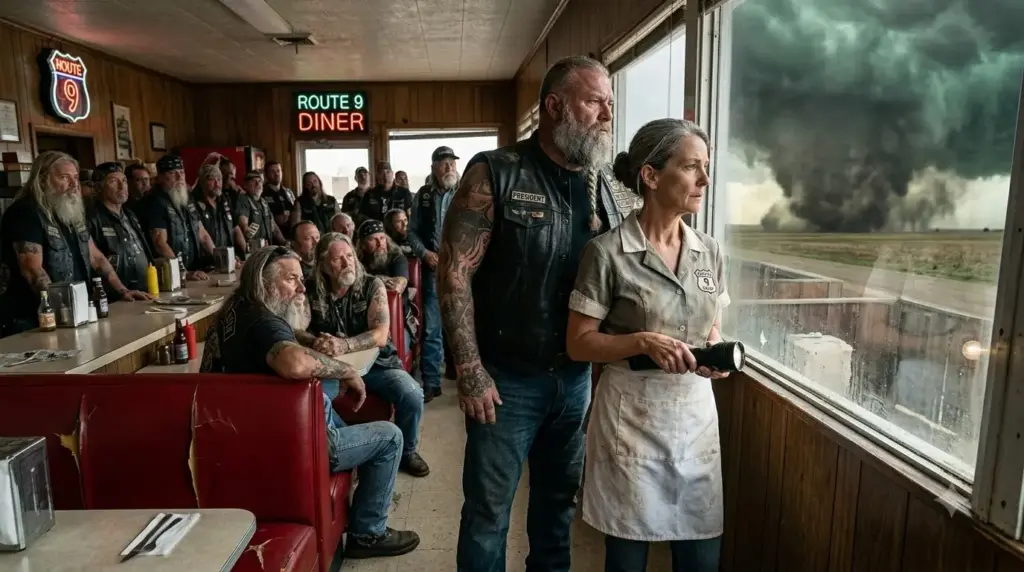
She sat on the bottom step, her arms wrapped around her knees. She felt a large, heavy body slide down the wall to sit next to her. It was Brick. She couldn’t see him, but she could smell the leather and the distinct coppery scent of fear sweat. He bumped his shoulder against hers, a small grounding contact in the middle of the abyss.
Sarah leaned into it. For 3 minutes, the earth tried to scrub them off its surface. They sat in the dark, an aging waitress and a hardened outlaw, shoulder to shoulder waiting to be buried. And then, just as quickly as it had peaked, the violence began to recede. The deafening roar shifted back to a heavy rumble, then to the howl of a strong wind.
And finally, just the steady, rhythmic drumming of pouring rain. The silence that followed in the basement was heavy. The air was thick with dirt and the smell of ruptured gas lines. Someone struck a lighter in the back corner. The small, orange flame illuminated a sea of dust-caked faces.
“Everyone good? ” Brick’s voice boomed in the confined space. A chorus of grunts, coughs, and yeahs echoed back. Sarah clicked the Maglite back on. She pointed it at the stairs. The wooden door at the top was blocked.
“We need to get out. ” Sarah said, her voice shaking for the first time. “Gas line is broken. ” Brick stood up. He motioned to two other men, giants built like defensive linemen. They marched up the narrow wooden stairs. The stairs creaked dangerously under their combined weight.
Brick placed his hands flat against the wooden cellar door and pushed. It didn’t budge. He swore. “It’s buried. On three. ” One of the other bikers said.
They braced their backs against the door, their heavy boots digging into the wooden steps. “One, two, three. ” They shoved. The wood splintered, but the weight above held firm. “Again! ” Brick roared. They pushed a second time, veins popping in their necks, muscles straining under the leather vests.
With a violent crack, the door broke outward. Debris tumbled down the stairs, bricks, twisted metal, and shattered wood. Gray, washed-out daylight spilled into the basement. Brick climbed out first, kicking away the rubble to make an opening. He reached down a hand.
Sarah took it, and he hauled her up out of the hole. She stood up and looked around. Her legs gave out. The diner was gone. Not damaged, gone.
The walls were swept away. The roof was missing. All that remained was the concrete foundation, the heavy, flat-top grill, and pipes sticking jaggedly out of the floor. Sarah dropped to her knees on the wet concrete. 20 years of her life, the early mornings, the late nights, the mortgage she had just paid off 2 years ago, erased in 3 minutes.
Behind her, the bikers began climbing out of the basement one by one. They stood on the concrete slab, covered in dirt and plaster dust, looking at the devastation. The parking lot was a junkyard of twisted chrome and shredded metal. A few of the heavy Harleys had survived, knocked over and dented, but most were scattered across the highway, crushed under downed trees, or wrapped around telephone poles. The storm had cut a clean line through the landscape.
The oak tree across the road was stripped of its bark, standing like a white skeleton. Sarah didn’t cry. She was too empty to cry. She just stared at the crushed remains of the Pie Case. Brick walked over to her.
He didn’t offer a platitude. He didn’t say it was going to be okay. He just looked at the ruins, then looked at her. You saved my boys. He said quietly.
Sarah didn’t look up. Couldn’t save your bikes. Brick let out a short, rough bark of a laugh. Metal can be replaced. Blood can’t.
The bikers spent the next 2 hours digging out what was salvageable. They righted the bikes that could still roll. They didn’t talk much. The reality of the destruction was too heavy. By dusk, tow trucks and emergency crews from the next county started arriving.
Brick stood by the side of the highway with the men whose bikes were destroyed. They were arranging rides, cramming two onto the surviving bikes. Before he left, Brick walked up to Sarah. She was sitting on a milk crate amidst the rubble, staring blankly at a twisted piece of red vinyl from a booth. He pulled a heavy silver Zippo lighter from his pocket.
It had the Hells Angels insignia deeply engraved into the metal. He pressed it into her hand and closed her fingers over it. We don’t forget. Brick said, then he turned, threw his leg over his battered Harley, and kicked it over. The engine roared to life, a defiant sound against the quiet destruction.
The remaining bikers fell in behind him, and they rode away into the fading light, leaving Sarah alone in the ruins of her life. She put the lighter in her apron pocket. She assumed she would never see them again. She was wrong. Four days after the storm, the smell set in.
It was a suffocating cocktail of wet, pulverized drywall, rotting meat from the destroyed deep freezes, and the sharp chemical tang of ruptured Freon lines. Sarah sat on the tailgate of her 1998 Ford Taurus station wagon. The local police had strung yellow caution tape around the perimeter of what used to be the Route 9 Diner, as if there was anything left to steal. To her right, a pile of shattered red vinyl booths sat baking in the relentless afternoon sun. To her left, her insurance adjuster, a man named Greg, was sweating through his pale blue button-down shirt.