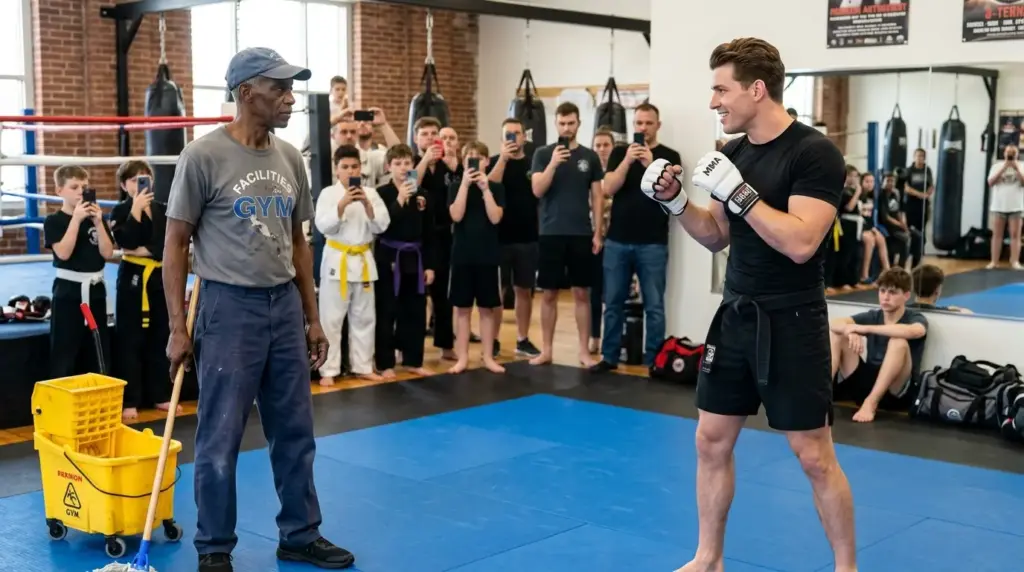
Not because it was funny.
Because he thought the old man had just made the worst mistake of his life.
“I’ll end this fight in ten seconds,” the champion had said, loud enough for the entire gym to hear.
The students laughed.
The cameras lifted.
The owner stepped back, already imagining the video going viral.
A cocky martial artist humiliating a quiet janitor in front of everyone.
But the janitor only looked down at the mop in his hand.
He was sixty-one years old, thin through the shoulders, with gray hair tucked under a faded ball cap and a work shirt with the gym logo peeling off the chest.
He looked like a man who cleaned sweat off mats for minimum wage.
A man nobody noticed unless the trash cans were full.
A man who knew how to disappear.
Then he looked up and asked quietly, “What will you do with the other nine?”
The laughter died so quickly it felt like somebody had cut the power.
And for the first time all afternoon, the black belt stopped smiling.
Before that moment, nobody at Eastside Combat Academy thought much about Samuel Briggs.
Most people called him Sam.
Some called him Mr. Briggs.
The younger fighters called him “sir” because he was old enough to be their grandfather and because he had a way of looking at people that made disrespect feel childish.
But to most of the gym, he was simply the janitor.
He arrived before sunrise, unlocked the back entrance, and turned on the lights one row at a time. He swept the lobby, wiped the mirrors, cleaned the bathrooms, refilled soap dispensers, and mopped the blue mats until the whole place smelled faintly of disinfectant and old vinyl.
He never complained.
He never bragged.
He never asked anyone to move unless he needed to clean under them.
Most days, he wore the same faded navy work pants, black sneakers, and a gray short-sleeve shirt with “Facilities” stitched over the pocket.
His hands were rough.
His knuckles were crooked.
His left ear had a slight fold at the top, the kind most people did not notice unless they had spent years on wrestling mats.
But nobody looked that closely at janitors.
That was one of the few advantages of becoming invisible.
Sam liked being invisible.
He had spent too much of his life being watched.
Judged.
Measured.
Tested.
A long time ago, men had looked at him from across rings, cages, alleys, and locker rooms, wondering what it would feel like to break him.
Some tried.
Most failed.
But age had a way of sanding down a man’s public shape.
By sixty-one, Sam’s shoulders were smaller. His knees clicked in the morning. His right wrist ached when rain came in from the river. He no longer moved with the loose bounce of a fighter.
He moved like a man who conserved effort.
Slow.
Quiet.
Exact.
Eastside Combat Academy sat in a renovated warehouse near the old rail district in Cleveland. It had exposed brick walls, a front desk made of polished wood, heavy bags along one side, a boxing ring in the back, and a large open mat where jiu-jitsu classes filled the evenings.
The gym had once been a serious place.
Old-school.
Hard.
No nonsense.
But things had changed when the new owner, Brandon Voss, took over.
Brandon had business instincts, good lighting, and a talent for selling confidence to people who had never been punched in the mouth. He turned Eastside into a brand. He repainted the walls matte black, installed neon signs, hired a social media manager, and started promoting weekend seminars with flashy fighters who had more followers than discipline.
Membership doubled.
So did the ego in the room.
That was how Mason Rourke arrived.
Mason was twenty-nine, six feet tall, shredded, handsome in the cold way expensive men often are, and convinced that every room was an audience waiting for him.
He wore custom rash guards, white gloves, and a black belt tied perfectly around his waist. His hair never seemed out of place. His smile looked rehearsed. He had won regional karate tournaments, a few kickboxing exhibitions, and one televised “combat challenge” against a fitness influencer who had no business fighting anybody.
But Mason understood attention better than he understood danger.
He knew how to intimidate beginners.
How to turn light sparring into punishment.
How to speak just loudly enough that others could hear his insults.
How to make cruelty look like coaching.
Brandon loved him because Mason brought cameras.
Mason loved Brandon because Brandon gave him a stage.
Every Saturday, Mason hosted a public “black belt challenge” session where members could try to last one round with him. It was supposed to be playful. Promotional. A way to bring people into the gym.
In reality, it was a ritual humiliation.
Mason never went full power on anyone who could hurt him.
He chose carefully.
A nervous office worker.
A college kid with no footwork.
A father trying to impress his son.
A beginner who had just learned how to wrap his hands.
Then Mason would move around them, tap them on the head, sweep their legs, laugh, and finish with some line for the camera.
“Martial arts teaches humility,” he would say afterward, standing over someone gasping on the mat.
Sam saw it all.
He said nothing.
He just mopped the sweat after.
But he noticed things.
He noticed that Mason held wrist locks half a second too long.
He noticed that Mason threw body shots harder when the person in front of him was embarrassed.
He noticed that Mason smiled whenever somebody looked afraid.
And Sam had known men like that before.
Men who mistook fear for respect.
Men who loved violence only when it came with rules protecting them from consequences.
Men who had never learned the difference between being skilled and being dangerous.





