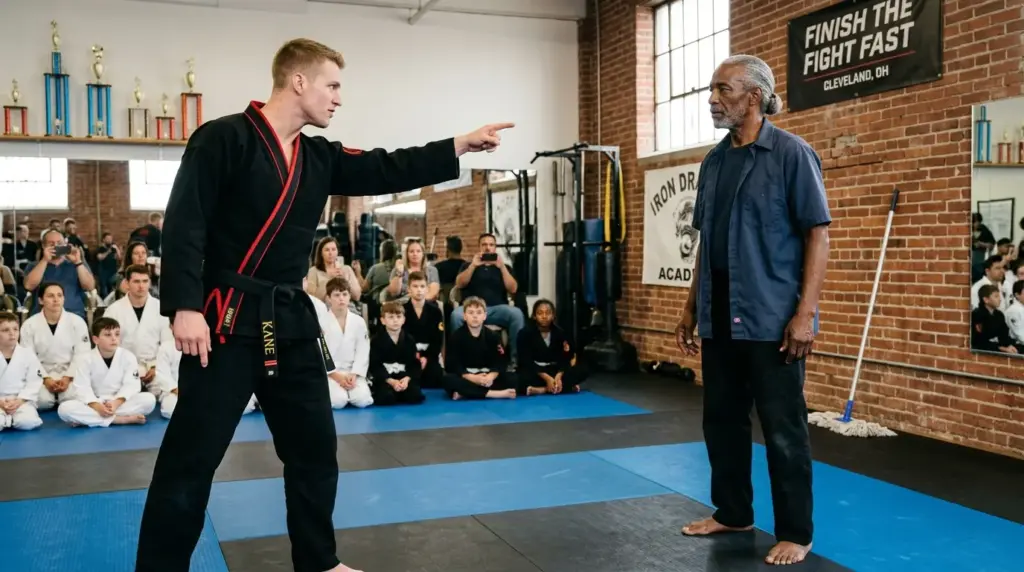
Former students.
Everyone wanted to speak to the janitor.
Victor found Adrian in the locker room, replacing paper towels.
“You never told me,” Victor said.
Adrian did not turn around.
“You never asked.”
“Were you really Adrian Vale?”
“I am still Adrian Vale.”
Victor let out a stunned laugh.
“I mean the Adrian Vale. The American Ghost. Pan-American champion. World combat invitational winner. The man who trained special forces. The man people still argue about on forums.”
Adrian closed the paper towel dispenser.
“Forums argue about many useless things.”
Victor stared at him.
“Why are you cleaning my academy?”
Adrian finally faced him.
“Because you offered me work when I needed work.”
“You could have taught anywhere.”
“No.”
“Yes, you could have. People would pay thousands to train with you.”
Adrian’s expression grew distant.
“People paid thousands to learn how to hurt others with clean technique and dirty hearts. I was tired of teaching hands before teaching conscience.”
Victor did not answer.
Adrian picked up a spray bottle.
“My son died twenty-one years ago,” he said.
Victor’s face changed.
“I’m sorry. I didn’t know.”
“Cancer. He was nineteen. While he was sick, he asked me why men respected me for knowing how to break bodies, but I struggled to sit still beside one that could not be fixed.”
Adrian looked at the rows of lockers.
“I had spent my life perfecting control over others. I had very little control over myself. Anger. Ego. Pride. The same disease that has infected Trevor.”
“That’s why you left?”
“That is why I began leaving. His death finished the work.”
Victor sat heavily on the bench.
“I let Trevor get out of control.”
“Yes.”
The answer was simple.
Not cruel.
Worse.
True.
“I built this place to teach discipline,” Victor said. “Somewhere along the way, I started selling confidence instead.”
“Confidence without humility becomes permission to harm.”
Victor rubbed his face.
“What do I do now?”
Adrian looked at him for a long moment.
“First, stop pretending trophies are character.”
That afternoon, Trevor returned to the academy.
Not through the front entrance.
Through the back, wearing a hoodie, hoping to avoid attention.
Adrian was cleaning the hallway.
For a moment, neither man spoke.
Trevor’s eyes were red.
Whether from anger or lack of sleep, Adrian could not tell.
“You ruined me,” Trevor said.
Adrian dipped the mop into the bucket.
“No. I interrupted you.”
“My sponsors are calling. Parents are pulling kids from my classes. People online are laughing at me.”
“They are laughing at the mask.”
Trevor stepped closer.
“What does that mean?”
Adrian wrung out the mop.
“You built a mask. Champion. Killer. Ten-second finisher. People laughed when the mask fell. If there is a man beneath it, he can still stand.”
Trevor’s face tightened.
“You think you’re better than me.”
“No.”
“Stop saying that.”
“It remains true.”
Trevor looked away.
For the first time, his voice lowered.
“I worked for everything I have.”
“I believe you.”
“No, you don’t. You think I’m some spoiled punk.”
“I think you are afraid that if you are not feared, you are nothing.”
Trevor looked back sharply.
Adrian had touched something.
He saw it.
Trevor hated that he saw it.
“My father used to make me fight older kids,” Trevor said suddenly. “Backyard tournaments. Basements. Garages. He’d bet money. If I cried, he called me weak. If I lost, he made me sleep outside.”
Adrian said nothing.
“First trophy I won, I was nine. He put it on the kitchen table and said, ‘Now you’re worth something.’”
His jaw worked.
“So yeah. I like trophies.”
Adrian leaned on the mop handle.
“A child who is taught love must be earned through winning becomes a man who cannot survive ordinary respect.”
Trevor swallowed hard.
“I don’t need therapy from a janitor.”
“No,” Adrian said. “You need it from a therapist. But you also need to apologize to Luke.”
Trevor laughed bitterly.
“That’s your big wisdom? Apologize?”
“First step.”
“And then?”
“Learn to fall without hating the floor.”
Trevor stared at him.
“What does that even mean?”
“It means come tomorrow at six in the morning. Before students. Before cameras. Before ego.”
“You want to train me?”
“No,” Adrian said. “I want to see if you can clean.”
Trevor frowned.
“What?”
Adrian handed him the mop.
“Tomorrow. Six.”
Then he walked away.
Trevor did not come the next morning.
Adrian was not surprised.
At 6:17, the back door opened.
Trevor walked in wearing sweatpants and a hoodie. No black belt. No embroidered gi. No gold letters.
He looked exhausted.
Adrian pointed to the bucket.
“You are late.”
Trevor stared at him.
“You’re serious.”
“Yes.”
“I’m not mopping floors.”
Adrian nodded.
“Then you are not ready to train.”
He picked up the mop himself.
Trevor stood there, jaw tight.
Then, with visible effort, he reached out.
Adrian handed him the mop.
For the first ten minutes, Trevor mopped like he fought.
Too much force.
Too much speed.
Water splashed onto the baseboards.
The mop streaked the floor instead of cleaning it.
Adrian watched silently.
Finally, Trevor snapped, “What?”
“You are attacking dirt.”
“I’m mopping.”
“You are trying to dominate the floor.”
Trevor stared at him like he was insane.
Adrian took the mop, placed it properly in his hands, and demonstrated.
“Pressure. Direction. Rhythm. Enough force to clean. Not so much that you scatter the mess.”
Trevor tried again.
Slower.
More controlled.
The work was boring.
Humiliating.
Uncomfortable.
That was why it mattered.
For two weeks, Trevor arrived at six.
He cleaned mats.
Scrubbed mirrors.
Wiped down bathrooms.
Stacked pads.
At first, the staff watched him with open satisfaction.
Then curiosity.
Then something close to respect.
One morning, Luke arrived early and found Trevor disinfecting the mat.
They looked at each other awkwardly.
Trevor’s face flushed.
“I owe you an apology,” he said.
Luke blinked.
“What?”
“I used you like a prop during demonstrations. I hurt you because I wanted to look good. That was wrong.”





