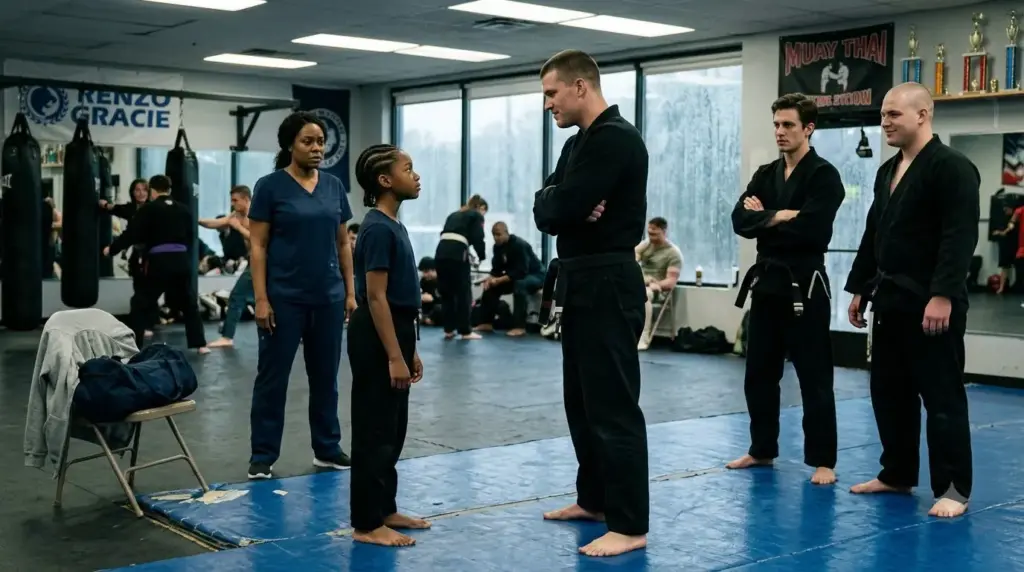
Nia picked up her hoodie.
“Thanks.”
“But don’t walk around thinking that means you’re ready for real black-belt work.”
Nia turned.
For the first time, she looked directly at the belt around Cody’s waist.
It was new. Stiff. The embroidered ends had not yet softened from years of tying and untying.
“I don’t,” she said.
Cody frowned. “Don’t what?”
“Walk around thinking that.”
Mason snorted.
Cody’s eyes flashed toward him, and Mason immediately looked down.
Lena picked up Nia’s bag. “We’re leaving.”
Martin stepped closer. “You are welcome back.”
Cody shook his head. “Seriously?”
Martin ignored him.
Nia slipped on her shoes.
They were almost at the door when a voice behind them said, “What belt are you?”
It was Trevor.
Nia stopped.
Rain streaked the glass in front of her.
She could feel everyone waiting.
For eight months, she had avoided saying the words.
Black belt.
Champion.
National team.
Each one felt connected to the day she had fallen, to the ambulance, to the surgery, to the months when her leg would not bend far enough to sit normally at the dinner table.
She turned slightly.
“I used to compete,” she said.
Cody rolled his eyes. “That wasn’t the question.”
Lena opened the door.
Cold air rushed in.
Nia looked at Cody.
“Then maybe you don’t need the answer yet.”
She stepped outside.
The bell chimed behind her.
For several seconds, no one in Northgate Martial Arts said anything.
Then Mason laughed under his breath.
“Man, she cooked you without even sparring you.”
Cody turned on him.
“Shut up.”
Martin watched through the rain-streaked window as Nia and Lena walked toward their car.
He had noticed something when Nia bowed.
Something familiar.
Not her face.
Her timing.
Her stillness.
The way she had touched Trevor’s ribs and disappeared before he could answer.
Martin walked behind the front desk and opened the browser on the old desktop computer.
He typed two words into the search bar.
Nia Bennett.
The first result made him sit down.
A photograph filled the screen.
Nia was two years younger in the picture, standing on a podium in a black uniform with a gold medal around her neck. Her hair was braided the same way. Beside her was a banner from the United States Junior Martial Arts Championships.
The headline read:
TEN-YEAR-OLD NIA BENNETT WINS THIRD CONSECUTIVE NATIONAL TITLE.
Martin scrolled.
There were more results.
Junior Grand Champion.
National kata champion.
Point-fighting champion.
Invitational winner.
A video thumbnail showed her facing a girl almost twice her size.
Then another headline appeared beneath the results.
YOUNG CHAMPION SIDELINED AFTER SERIOUS KNEE INJURY.
Martin leaned back slowly.
Across the room, Cody was still talking.
“I don’t care what she trained,” he said. “She’s twelve.”
Martin looked at the screen again.
Then at Cody.
“You might want to start caring.”
In the parking lot, Lena waited until the car doors were closed before she said anything.
Rain drummed against the roof. The windshield fogged at the corners. Nia sat in the passenger seat with her duffel across her knees and stared at the karate school through the glass.
“You okay?” Lena asked.
“Yeah.”
“Real answer.”
Nia pulled at a loose thread on the bag. “I don’t know.”
Lena did not start the engine.
“Did the knee hurt?”
“No.”
“Did anything feel unstable?”
“No.”
“Then what happened?”
Nia watched Cody through the front window. He was arguing with Martin now, moving his hands sharply. Trevor stood nearby with his arms folded.
“I liked it,” Nia said.
Lena blinked. “The school?”
“Being on the mat.”
The answer changed Lena’s face. Relief came first, so quickly she could not hide it. Then fear followed.
“That’s good,” she said carefully.
“It didn’t feel like the tournament. Not at first.”
“And when it did?”
Nia looked down.
“I stayed.”
Lena reached across the console and squeezed her hand.
Eight months earlier, staying had not seemed possible.
The injury itself had lasted less than a second.
The consequences had filled nearly every day since.
At the junior national championships in Indianapolis, Nia had entered the final as the favorite. She was eleven then, already a three-time national champion in her division, and she had developed a reputation that embarrassed her whenever adults repeated it: calm under pressure, unusually precise, impossible to rush.
Her opponent, fourteen-year-old Sofia Alvarez, was not reckless or dirty. That mattered to Nia, though internet strangers had spent weeks looking for someone to blame.
With thirty-seven seconds left, Sofia drove forward in a fast combination. Nia stepped back, planted her right foot to angle away, and her shoe caught near the edge of the competition mat.
Her knee turned while the rest of her body did not.
She remembered the sound more clearly than the pain.
Then she remembered her father’s face.
Marcus Bennett had been standing behind the barricade. He had spent years teaching Nia not to look at him during a match because he wanted her decisions to belong to her. But when she fell, he moved so fast that security barely stopped him from entering the competition area.
Lena, who had been recording from the stands, dropped her phone.
The diagnosis came the next morning: torn ACL, damaged meniscus, surgery required.
The surgeon said Nia could return to competition someday if rehabilitation went well.
Everyone treated that sentence like good news.
Nia heard only one word.
Someday.
For a child who had spent half her life organizing time by tournaments, someday felt like a locked door.
Her first months of rehabilitation were mechanical. Bend. Straighten. Lift. Hold. Ice. Repeat.
Then came anger.
She snapped at Marcus when he reminded her to do exercises. She deleted competition apps. She stopped answering her closest teammate. She hid her medals in a storage bin and asked Lena to take down the framed photograph from nationals.
The worst day came when she tried her first controlled pivot six months after surgery.
Her knee held perfectly.
Nia still burst into tears.





