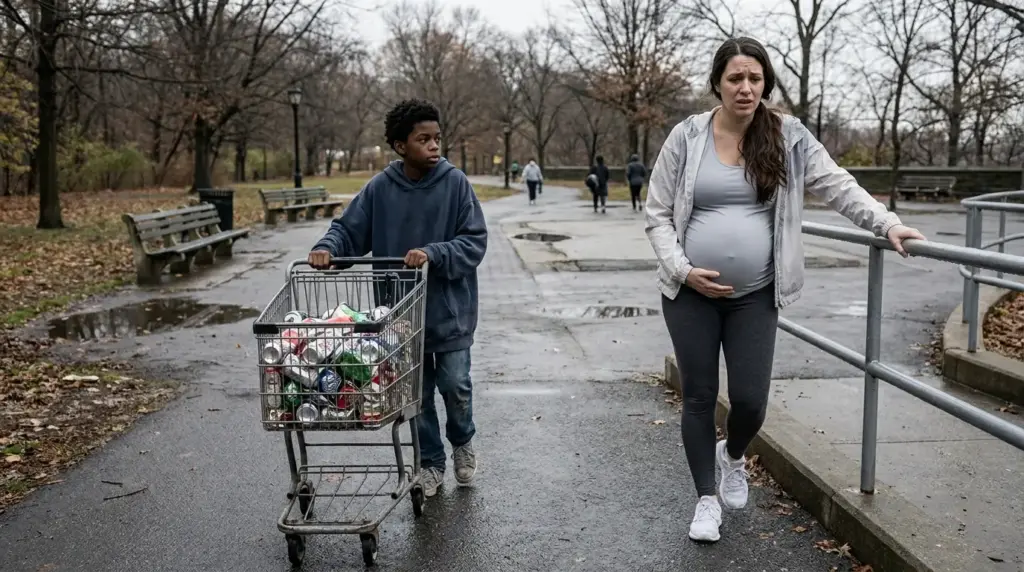
Without a moment’s hesitation, he ran to her side. He never imagined one small act of kindness could change his life forever. The sun had barely risen over Maple Brook when the soft rattle of aluminum cans echoed through the still air of Riverside Park. The morning haze hung low, silver threads catching the first streaks of light as they stretched across the cracked concrete paths and de-kissed grass. The neighborhood was quiet at this hour, too early for joggers, too late for the night wanderers.
A worn out shopping cart squeakaked along the gravel, its wheels sticking occasionally in the grooves of uneven pavement. Pushed by a boy who looked smaller than his 12 years, the cart bore the rusted scars of long days and longer nights. Tyrese Walton moved with purpose, his steps measured, practiced. His small hands, calloused beyond their age, reached down to collect another can. His eyes scanning instinctively for glass bottles tucked under benches or discarded near trash bins.
He wore a faded hoodie with holes at the elbows and sneakers held together by more faith than fabric. Strapped to his back was a fraying backpack filled with empty bags, a plastic water bottle, and a small notepad where he kept a running tally of every item he found. His self-made system, his way of keeping order in a life that rarely offered any. The park, nestled on the edge of downtown, sat like a forgotten memory, where the clean cut borders of wealth met the frayed edges of the working poor. Further east, glass buildings gleamed like polished teeth in the morning light.
But over here, even the pigeons seemed to move slower. Tyrese didn’t mind. This was his route, the one he walked every morning before the city fully woke up. He bent down to pick up a Sprite can near the fountain, its metal cool against his skin. A breeze swept through, carrying the scent of damp earth and distant fried food from the 24-hour diner his grandmother, Miss Althia, used to work at before her knees gave out.
Now she stayed home, her body too tired, but her mind still sharp, still full of stories. She whispered at night when the bills piled up and the lights flickered like dying stars. It did this for her, for the pills they sometimes had to choose over groceries, for the gas bill that came redstamped and final. For the roof that leaked when it rained too long. He didn’t complain.
This was their life. This was how you survived when no one came to save you. As he moved past the old swing set, he caught sight of a woman in yoga pants and a designer windbreaker walking a purebred golden retriever. She glanced at him once, then pulled her dog a little tighter, crossing to the other side of the path as if his presence was something contagious. Tyrese didn’t flinch.
He was used to the stairs, the looks that measured his worth by the stains on his sleeves and the color of his skin. He learned long ago that people didn’t see a boy when they looked at him. They saw a threat, a warning, a reason to keep their windows rolled up. He passed a park bench where a young couple sipped lattes from biodegradable cups, laughing softly as they scrolled through their phones. Neither of them looked up.
To them, he was just background noise. That was fine. Being invisible had its uses. As he neared the foot bridge that crossed over the duck pond, Tyrese paused, his breath catching slightly from the weight of the cart and the chill in the air. He looked out over the water where the early light shimmerred like a broken promise, his fingers tightened on the handlebar.
Another hour and the park would fill with joggers, dog walkers, city workers on their brakes. He needed to finish before then, before people started acting like he didn’t belong here, because they always did. Just last week, a groundskeeper had stopped him near the north entrance, barking at him to get lost. This ain’t no place to be hustling, kid. He had said, his voice thick with condescension.
When Tyrese tried to explain to say he was just collecting recyclables, the man’s face twisted with disgust. I don’t care what you’re doing. Go back where you came from. Where was that exactly? Tyrese hadn’t figured it out yet.
All he knew was here. This park, this cart, this hunger in his gut that never really left. He rolled his cart forward again. The rattle of cans like a rhythm he could trust. Somewhere behind the trees a baby cried.
Somewhere ahead a new day waited and Tyrus Walton, barely 12, all heart and bone, kept walking. On the bench beside her sat a small brown paper bag, still warm with grease spots at the bottom. An unopened bottle of juice rolled slightly with the breeze as if someone had left in a hurry, but planned to come back. She glanced at it once, then closed her eyes like she was trying to steady herself. A paper bag rested beside her on the bench, its bottom darkened with grease spots.
An unopened juice bottle rolled gently against the leg of the bench. It looked like someone had just stepped away. Tyrese noticed her. She was sitting alone near the railing, dressed in sleek athleisure, one hand resting on the small of her back. She looked like she was waiting for someone, but her shoulders were hunched.





