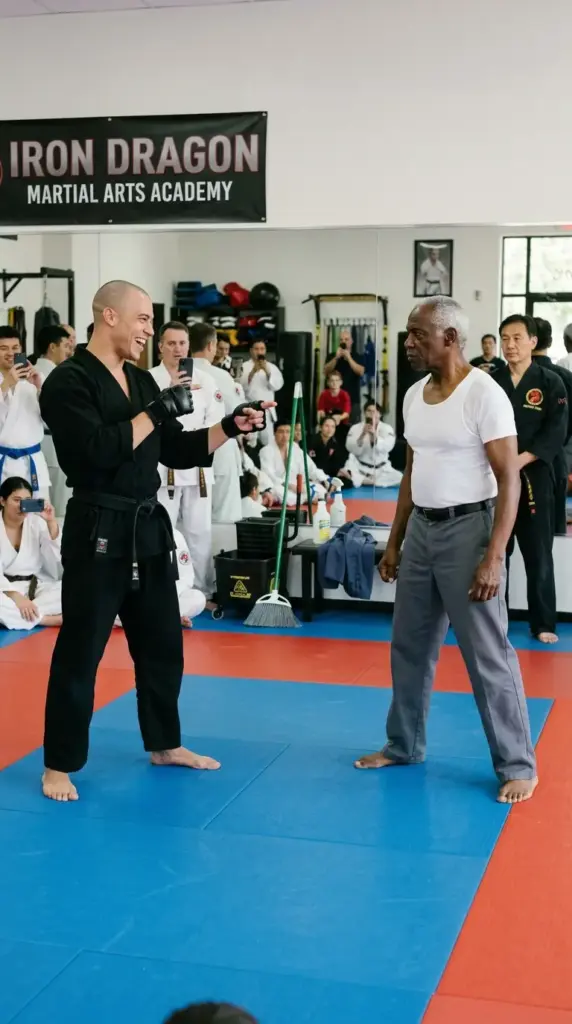
“I was like you,” Mr. Henry began. “Maybe worse. I liked winning. I liked people fearing me. I liked hearing my name before a match and watching the other fighter’s eyes change. I thought that was respect.”
Marcus stared at the floor.
“In 1987, I fought a young man named Daniel Reyes. He was fast, proud, and brave. He had a family in the crowd. His little daughter sat in the front row wearing a yellow dress.”
Mr. Henry paused.
His hands folded together.
“I was angry that night. Angry at my coach. Angry at the judges. Angry at the crowd for cheering for him. So when I had a chance to end the match safely, I did not. I wanted to make a point.”
The room was silent.
“I hurt him badly. Not by accident. Not fully on purpose either. Something worse. I let my pride decide before my conscience could stop it.”
Marcus swallowed.
“What happened to him?”
“He lived,” Mr. Henry said. “But he never fought again. He walked with a limp for the rest of his life. His daughter watched it happen.”
No one moved.
“I won the title that night. They put a belt around my waist. Cameras flashed. People cheered. But all I could see was that little girl crying beside the ring.”
Mr. Henry looked at Marcus.
“That was the night I learned humiliation is not victory.”
His voice was steady, but something old and painful lived underneath it.
“I left the sport. I gave away the medals. I stopped teaching. Years later, Master Park opened this academy and offered me work. I said I did not deserve to teach. He said, then clean. Serve the place until you remember what martial arts are for.”
Master Park’s eyes softened.
“And he has served longer than most people train.”
Mr. Henry looked around the room.
“Skill is not given to you so you can make people smaller. It is given so you can protect, discipline, guide, and control yourself when your ego begs you not to.”
Marcus could barely meet his eyes.
For the first time, the students saw their champion differently.
Not powerful.
Not untouchable.
Just young.
Just embarrassed.
Just human.
Marcus stepped forward.
His voice was quieter now.
“I didn’t know.”
“No,” Mr. Henry said. “You did not. But you knew they were weaker than you, and you enjoyed it.”
Marcus flinched.
That truth did what the takedowns had not.
It reached him.
He turned toward the students he had mocked earlier that day. The white belt he had swept too hard. The brown belt he had laughed at. The shy teenager he had called “slow” in front of everyone.
“I’m sorry,” Marcus said.
The words came out stiffly at first.
Then again, better.
“I’m sorry. I was showing off. I wasn’t teaching. I wasn’t respecting any of you.”
Nobody knew what to say.
The shy teenager nodded once.
It was not forgiveness yet.
But it was a beginning.
Marcus turned back to Mr. Henry.
“Will you teach me?”
Mr. Henry shook his head.
The room stiffened.
“You are not ready to be taught.”
Marcus lowered his eyes.
“What do I need to do?”
Mr. Henry pointed toward the mop bucket.
“Start by cleaning the mat.”
Some students laughed quietly.
Marcus did not.
He walked to the bucket, picked up the mop, and began.
Badly.
He used too much water. He missed corners. He pushed dirt from one side to another. Mr. Henry corrected him with the same calm voice he had used on the mat.
“Slow down.”
Marcus stopped.
“Even for mopping?”
“Especially for mopping. How you do small things is how you do everything.”
That became Marcus’s first real lesson.
Not a kick.
Not a throw.
Not a secret technique.
A mop.
For the next month, Marcus arrived early every morning.
At first, people thought it was for show. Maybe he wanted to repair his reputation after the video went viral. And it did go viral.
COCKY BLACK BELT PICKS JANITOR — REGRETS IT INSTANTLY.
Millions watched it.
They laughed at Marcus.
They praised Mr. Henry.
They turned “You promise not to cry?” into a meme.
But at six every morning, when there were no cameras and no audience, Marcus was there.
He swept floors.
Wiped mirrors.
Carried trash.
Helped little kids tie belts.
Held pads for beginners.
Listened more than he spoke.
Mr. Henry did not teach him advanced techniques.
Not yet.
He taught him how to bow properly.
How to breathe before moving.
How to help a white belt fall safely.
How to apologize without explaining.
How to lose a drill without making excuses.
Marcus struggled with all of it.
One afternoon, a twelve-year-old girl named Nina accidentally kicked him in the ribs during a beginner drill. Old Marcus would have snapped at her.
New Marcus bent over, caught his breath, and said, “Good aim.”
Nina smiled.
Mr. Henry watched from the corner.
That night, he finally said, “Tomorrow, bring your uniform.”
Marcus froze.
“For training?”
“For training.”
The next morning, Marcus arrived in a plain white gi.
No sponsor patches.
No custom black belt with gold lettering.
Just white.
A beginner’s color.
The students noticed.
So did the internet, eventually, when someone posted a photo of Marcus Reed training in a white belt under the janitor he once mocked.
Reporters wanted interviews.
Marcus refused them.
For once, he wanted to learn something without turning it into content.
Training under Henry Tanaka was nothing like Marcus expected.
There were no flashy secrets.
No magical pressure points.
No dramatic speeches.
Only basics.
Stance.
Breath.
Timing.
Balance.
Control.
Again.
Again.
Again.
Whenever Marcus rushed, Mr. Henry made him start over.
Whenever Marcus used strength instead of structure, Mr. Henry stepped aside and let him fall.
Whenever Marcus grew frustrated, Mr. Henry handed him the mop.
“Clean until your mind settles.”
Weeks turned into months.
Marcus’s tournament season came and went. He withdrew from two events, shocking his manager and sponsors.





