Because this time, strength could not force the result.
It could only support.
At the end of class, Luke looked up at him.
“Were you mad when Mr. Ward beat you?”
Dante smiled softly.
“Very.”
“Are you still mad?”
Dante looked across the gym, where Elias was helping another student.
“No. I think I needed it.”
Months passed.
The viral clip became old news, replaced by new scandals, new knockouts, new things for the internet to devour. But in the small gym behind the laundromat, Dante stayed.
He still trained professionally.
Still fought.
Still won.
But his interviews changed.
When reporters asked about intimidation, he talked about discipline. When they asked about destroying opponents, he talked about control. When they asked if he wanted revenge against the old man, he shook his head.
“Mr. Ward gave me the most expensive lesson of my life,” he said. “And it was worth every dollar.”
Then came the night of Dante’s title defense.
The arena was packed. Lights flashed. Music thundered. Millions watched at home.
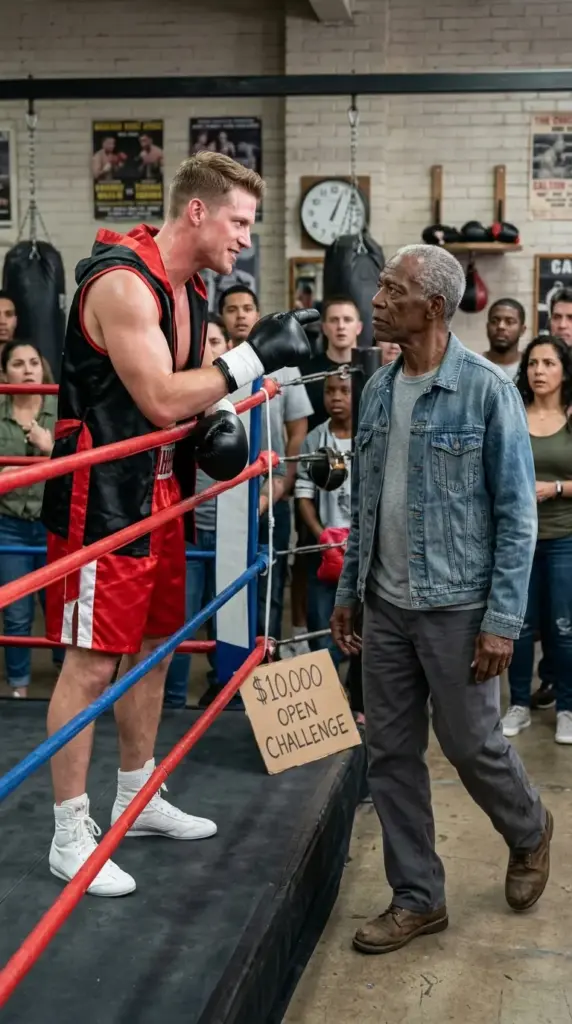
His opponent was younger, faster, and almost as arrogant as Dante used to be. At the press conference, the challenger mocked Dante for training with an old man in a broken-down gym.
“You’ve gone soft,” the challenger said. “I’m going to retire you.”
Old Dante would have exploded.
New Dante smiled.
“You might beat me,” he said. “But you won’t make me forget who I am.”
On fight night, Elias Ward sat in the front row with Luke and his mother.
Dante saw them before the opening bell.
He touched his glove to his chest.
The fight was brutal.
The challenger came in wild and strong, throwing power from every angle. In the first round, Dante was hit harder than he had been hit in years. The crowd gasped. Commentators wondered if the champion had lost his edge.
But Elias saw something else.
Dante was not panicking.
He was watching.
Listening.
Feeling rhythm.
In the second round, the challenger rushed.
Dante stepped half an inch to the left.
Not a full dodge.
Not dramatic.
Just enough.
The challenger’s force carried him past.
Dante turned, controlled the angle, and placed him on the mat with clean, perfect timing.
The crowd roared.
Elias smiled.
“Physics,” Luke whispered.
Elias chuckled.
“That’s right.”
Dante won in the fourth round.
Not with rage.
Not with humiliation.
With patience.
After the referee raised his hand, Dante took the microphone.
A year earlier, everyone would have expected him to brag.
Instead, he looked toward Elias.
“A while back, I offered ten thousand dollars to anyone who could last nine seconds with me. An old man stepped forward, and I laughed at him. I disrespected him. Then he taught me something I should have learned a long time ago.”
The arena quieted.
“Strength without humility is just noise.”
He turned toward Luke.
“And because of that day, a kid got surgery. Because of that day, I found a teacher. Because of that day, I stopped being a bully with a belt and started trying to become a man worthy of one.”
The crowd rose.
Dante stepped out of the ring, walked to Elias, and bowed his head.
Not for the cameras.
Not for a clip.
For real.
Elias stood slowly and placed one weathered hand on Dante’s shoulder.
“Better,” he said.
Dante laughed.
“That’s all I get?”
“For now.”
Years later, people still replayed the nine-second video.
They laughed at the champion’s face when he hit the mat. They admired the old man’s timing. They argued online about technique, balance, and whether Dante had underestimated him too much.
But the people who knew the story understood that the real victory did not happen in those nine seconds.
It happened afterward.
It happened when a proud man picked up a mop.
It happened when a champion tied a child’s belt.
It happened when strength learned patience.
Elias Ward never cared about fame. He kept teaching in the same gym, though now the roof no longer leaked and the mats were new. Donations came in from strangers who had seen the video. Dante quietly paid the rent for five years in advance, though Elias pretended not to know.
Luke Bennett learned to walk with braces.
Then without them.
At fourteen, he joined the beginner class as an assistant coach, helping younger kids who were scared of falling. Whenever someone said they were too weak to learn, Luke smiled and told them, “Everyone learns balance.”
Dante King went on to defend his title six more times. But his greatest legacy was not the belt. It was the foundation he started with Elias, paying for medical care, gym memberships, and mentorship programs for children whose families could not afford either.
They called it the Nine Seconds Foundation.
On the wall of the gym, above a framed photo of Dante flat on his back and Elias standing beside him, was a sentence Elias wrote himself.
Nine Seconds Can Humble A Man. What He Does Afterward Defines Him.
And sometimes, late at night, after the kids had gone home and the mats were clean, Dante would still ask Elias for one more round.
Elias always refused at first.
Dante always insisted.
They would step onto the mat, the old man slower now but still sharp, the champion stronger now but wiser. And every time Dante rushed, even a little, Elias made him pay for it.
Not with embarrassment.
With a lesson.
Because the old man had never stepped forward that day to prove he was dangerous.
He stepped forward to prove something far more important.
That pride can fall in nine seconds.
That humility can raise a man for life.
And that sometimes the person everyone laughs at is the one carrying the lesson everyone needs.





