Dante used the fight money to start a small fund for local fighters who needed equipment, medical checkups, and travel costs. He put Luis’s daughter in a children’s martial arts program at no cost. He paid for Luis’s physical therapy after learning the man had hidden a rib injury because he could not afford to miss work.
He stopped posting humiliation clips.
His follower count dropped at first.
Then rose again.
Different people now.
Fighters.
Coaches.
Parents.
Kids.
People who respected skill more than cruelty.
One afternoon, Dante found Eli sitting alone in the empty warehouse, looking at an old newspaper clipping.
It showed a young Elias Ward with gloves raised, face unmarked, eyes sharp and sad.
“You miss it?” Dante asked.
Eli folded the clipping.
“Sometimes.”
“Fighting?”
“No. Being young enough to think winning solved things.”
Dante sat beside him.
“Does it ever?”
“Sometimes it pays bills. Sometimes it opens doors. Sometimes it keeps bad men from thinking you’re easy prey.”
Eli looked at the cage.
“But no. It doesn’t solve what’s underneath.”
Dante nodded slowly.
“What does?”
Eli smiled faintly.
“Work. Truth. People who don’t clap when you lie to yourself.”
Dante looked at him.
“So basically you.”
“Unfortunately for you.”
They both laughed.
A year after the warehouse challenge, Vic Russo tried to recreate the moment.
He organized another viral fight night, this time without Dante. New cocky fighters. New cash envelope. New insults. New promises of easy wins.
But the crowd had changed.
Or maybe the city had.
When a young fighter mocked a nervous opponent after dropping him, people booed.
When Vic tried to hype humiliation, someone shouted, “Pride should pay for what it breaks.”
Others picked it up.
The chant spread.
Vic ended the event early.
Outside, near the same garage door where Eli had once swept popcorn, a group of kids practiced footwork while Malik counted rhythm.
Step.
Turn.
Balance.
Breathe.
Again.
Eli stood nearby with his broom, pretending not to coach.
Dante arrived carrying a box of donated gloves.
A little boy pointed at him.
“You’re the guy who got beat by the old janitor.”
Dante winced.
Malik laughed so hard he nearly dropped the timer.
Eli looked amused.
Dante crouched in front of the boy.
“That’s me.”
“Were you embarrassed?”
“Yes.”
“Did it hurt?”
Dante thought about it.
“Not enough at first.”
The boy frowned.
“What does that mean?”
“It means sometimes the part that needs fixing isn’t your jaw.”
The boy nodded like he understood, though he probably did not.
Dante stood and looked at Eli.
“See? I’m becoming wise.”
Eli picked up the broom.
“Don’t overdo it.”
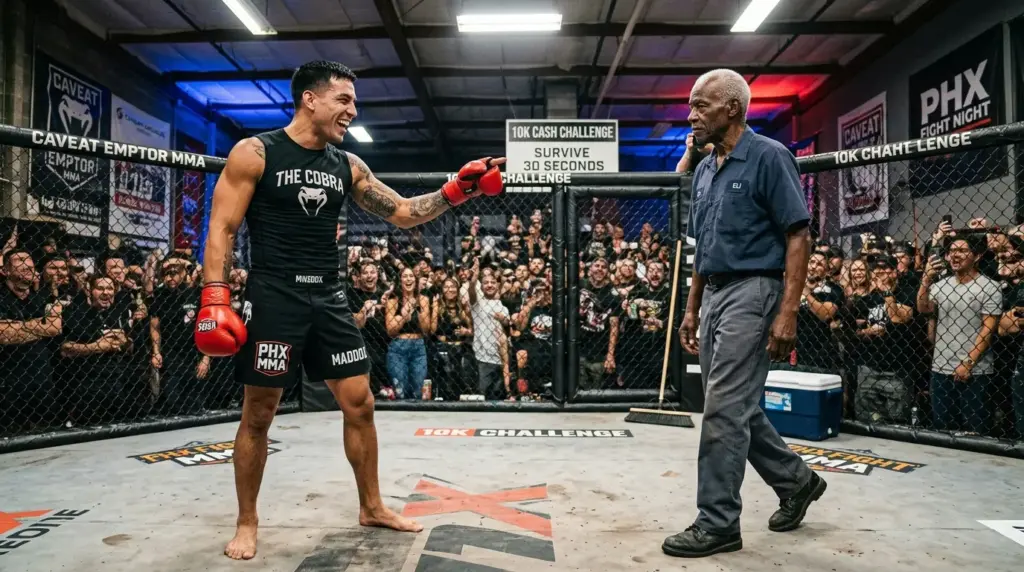
Years later, people still told the story of the night Dante Maddox offered ten thousand dollars for an easy win and the wrong old man stepped forward.
Some versions made the fight bigger than it was.
They said Eli knocked him out cold.
He did not.
They said Dante begged for mercy.
He did not.
They said the old man revealed himself with some dramatic speech.
He did not.
The truth was better.
Eli Ward stepped into a cage because a young man had confused cruelty with strength.
He touched him once in the chest.
Then lasted three minutes.
Then made him apologize to a child.
That was all.
And somehow, that was everything.
Because the point was never that old men are secretly dangerous, though some are.
It was never that legends hide in janitor shirts, though sometimes they do.
The point was that strength without humility becomes a performance.
Talent without character becomes a weapon.
And pride, sooner or later, always meets someone who has nothing left to prove.
Dante learned that lesson in front of hundreds of people with phones raised.
Eli had learned it alone decades earlier, when walking away cost him everything except his soul.
The old fighter did not give Dante a defeat.
He gave him a mirror.
And when Dante finally had the courage to look into it, he saw the boy underneath the arrogance, the fear underneath the noise, and the man he might still become if he stopped trying to make everyone else feel small.
On the wall of the youth gym that opened two years later, a sign hung above the ring.
It did not say WIN.
It did not say DESTROY.
It did not say BE UNTOUCHABLE.
It said:
BALANCE FIRST.
Under it, in smaller letters, were the words every young fighter learned before they ever threw a punch.
Pride should pay for what it breaks.
And beside the ring, on most mornings before anyone else arrived, an old man with white hair swept the floor slowly, quietly, and with perfect footwork.





